
Structures of Metamorphic Rocks
Structures of Metamorphic Rocks
Introduction
Structures in metamorphic rocks are a product of unbalanced directive forces and various interrelated textures are present in the rock unit.
The term structure includes features on a large scale or on outcrop scale or on the hand specimen scale, or even at a regional scale. On the contrary the term texture is used for features at small scale, viz. from microscopic to hand specimen scale.
The various types of structures of metamorphic rocks are-
- Slaty cleavage
- Schistose
- Gneissic
- Granoblastic
- Hornfelsic
- Cataclastic
Slaty Cleavage
- The parallel foliations of fine grain platy minerals are seen perpendicular to the maximum stress direction.
- The platy minerals which have parallel alignment are such as chlorite and commonly seen in low grade metamorphic rocks.
- Example: slate and phyllite

Schistose Structure
- It is the structure seen in low-medium grade metamorphic rocks due to strong foliations.
- The layers are developed due to the parallel alignments of platy minerals such as mica under the directed stress.
- The grain size is increased here and the grains are easily be seen by naked eye.
- Example: Schist

Gneissic Structure
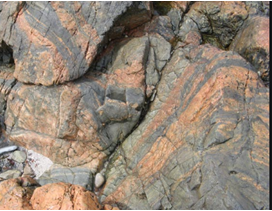
- The structure shows discontinuity in bands which are alternating in nature.
- The light coloured minerals such as feldspar and quartz are alternate in bands with dark coloured minerals such as pyroxenes and hornblende.
- The bands are produced by the segregation of minerals in the rocks.
- Example: Gneiss
Granoblastic Structure
- The grains are granular, equidimensional and interlocking in nature.
- The grains show no preferred orientation and display triple junction between the grains.
- Example: Quartzite

Fig.: Quartzite
Hornfelsic Structure
- This structure is formed by the fined gained interlocking grains with variable shapes and sizes.
- The structure characterized the contact metamorphism with preferred orientation thus showing no foliations.
- Example: Hornfels

Fig: Hornfels
Cataclastic Structure
- This structure is produced under stress in the low temperature regime where the brittle rock formation undergo shearing and fragmentation.
- The softer minerals in the rock get powdered due to shearing while the hard minerals overcome the crushing force to some extent, get shattered and crushed forming crushed breccias.
- Example: Cataclasite
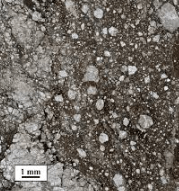
Fig.: Cataclasite