
Species – Definition and Nomenclature
Definition
- A species is defined as a group of organisms capable of inter-breeding and producing fertile offspring, typically by sexual reproduction.
- Speciation: Evolutionary process by which biological population evolve to become distinct species.
- In biology, a species is the basic unit of biological classification and a taxonomic rank of an organism.
Mayr's Biological Species Concept, 1942
- Species are defined as “the groups of actually or potentially interbreeding natural populations.”
- It is also called a reproductive or isolation concept.
Taxonomic rank
- It is the relative level of a group of organisms (a taxon) in a taxonomic hierarchy.
“Dilse Karo Pyare class over For Gropiper Soda”
|
|
Life |
Cat |
Human |
|
1. |
Domain |
Eukarya |
Eukarya |
|
2. |
Kingdom |
Animalia |
Animalia |
|
3. |
Phylum |
Chordata |
Chordata |
|
4. |
Class |
Mammalia |
Mammalia |
|
5. |
Order |
Carnivora |
Primates |
|
6. |
Family |
Felidae |
Hominidae |
|
7. |
Genus |
Felis |
Homo |
|
8. |
Species |
Felis catus |
Homo Sapiens |
Historical perspective
- Teleological view: Species were seen as fixed categories that could be arranged in a hierarchy, the great chain of being.
- The Origin of Species, 1859: Charles Darwin explained the evolution of species by natural selection.
- De Vries challenged the Darwinian concept; and proposed spontaneous and abrupt evolution of species.
The Species concept or The Species problem: Issue with the definition
- It is difficult to provide a universal definition of a species.
- The species problem is the set of questions that arises when biologists attempt to define a species.
- Such a definition is called a species concept.
- There are at least 26 recognized species concepts.
- The scientific study of the species problem has been called micro-taxonomy.
- Mayr's defined species as “the groups of actually or potentially interbreeding natural populations.”
- The boundaries between closely related species is often unclear.
- “No one definition has satisfied all naturalists; yet every naturalist knows vaguely what he means when he speaks of a species.” – Charles Darwin (Origin of Species, 1859)
In the following cases, Mayr's Biological Species Concept fails:
- Hybridization or cross breeding: it permits substantial gene flow between species.
- Tiglon: a hybrid offspring of a male tiger and a female lion.
- Liger: a hybrid offspring of a male lion and a female tiger.
- Tiglon and liger have parents with the same genus, but of different species.
- Species complex: is a group of closely related organisms that are very similar in appearance with often unclear boundaries.
- Ring species: It is a connected series of neighboring populations, each of which can interbreed with neighboring populations of a species, but at the ends of the ring, the populations cannot interbreed.
- If organisms reproduce asexually. as in single-celled organisms such as bacteria and other prokaryotes.
- Each clone is potentially a microspecies. e.g. Blackberry (Robos Robicosus)
Other Ways of Defining Species
- Other ways of defining species include their karyotype, DNA sequence, morphology, behaviour or ecological niche.
- Paleontologists use the concept of the chronospecies, since fossil reproduction cannot be examined.
Chronospecies
- In paleontology, the evolution of species comes mainly from the comparative anatomy of fossils.
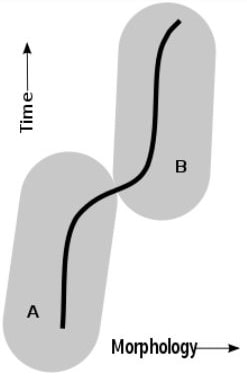
- A Chronospecies is a species derived from a sequential development pattern; which involves continual changes from an extinct ancestral form.
A chronospecies is defined in a single lineage (solid line) whose morphology changes with time.
At some point, there is enough change to conclude that two forms (A and B) are separated in time and anatomy.
If only sporadic examples are taken, then the forms will appear sharply distinct.
Nomenclature of Species
Common names
- These are the commonly used names. Cat
- A cat could mean the domestic cat (Felis catus), or the whole cat family, Felidae. Eg. Tigers.
- The cat (Felis catus) is the only domesticated species in the family Felidae.
- Common names often vary from place to place.
- Panther also mean the jaguar (Panthera onca) of Latin America or the leopard (Panthera pardus) of Africa and Asia.
Scientific names (binomial or binary nomenclature)
- Carl Linnaeus, a Swedish botanist, invented the modern system of binomial nomenclature, in his work Species Plantarum, 1753.
- These are unique and universal names.
- All species (except viruses) are given a two-part name, a "binomial or binary nomenclature".
- Binomial nomenclature: It is a formal system of naming species by a name composed of two parts.
- Both the parts use Latin grammatical forms, although they can be based on other languages. More informally it is also called a Latin name.
- The first part is the genus to which the species belongs.
- The second part is the specific name of the
- Species is given a name when type specimen is described formally by a scientist.
For example
- Panthera pardus: Pardus is one of four species of the genus Panthera.
- Boa constrictor: Constrictor is one of four species of the genus Boa.
- Homo Sapiens: Homo is one of the species of the genus Homo.
International codes
Two different codes for Botany and Zoology
- Zoology: International Code of Zoological Nomenclature (ICZN) for animals
- Botany: International Code of Nomenclature for algae, fungi, and plants (ICNafp).
|
Code |
First part |
Second part |
|
ICZN |
genus name |
specific name |
|
ICNafp |
generic name |
specific epithet |
Code
- The name must be binomial.
- Not already in use.
- Must be published in approval medium.
- Illustration of new species.
Guidelines
- The first letter of the first part, the genus, is always capitalized in writing.
- While that of the second part is not capitalized.
- Both parts are italicized in typing or underlined in handwriting. Homo sapiens (Human). Tyrannosaurus rex (dinosaur).
- In scientific works, the authority for a binomial name is usually given.
- Authority is a way of designating the scientist(s) who first published the name.
- The authority is written in slightly different in zoology and botany.
Abbreviation
- Sometimes books and articles intentionally do not identify species and use abbreviation. Eg. (singular) or Spp. (plural).
- This occurs when authors are confident about the Genus but not sure about the species. This is common in Paleontology.
Value/ Pros
- Economy of words: Compared to the polynomial system.
- Widespread use: The binomial system of nomenclature is governed by international codes and is used by biologists worldwide.
- Homo sapiens, E. coli, Tyrannosaurus rex etc.
- Uniqueness: Provided that taxonomists agree as to the limits of a species.
- One species can have only one name.
- Stability: when species are transferred between genera, if possible, the second part of the binomial is kept the same.
Issues
- When a species is moved from one genus to another: the specific name must be changed as well.
- It is possible for two or more species to share the same binomial if they occur in different kingdoms.
- At least 1241 instances of such binomial duplication occur.
- Change: Species are subject to change
- By evolution
- Exchanging genes with other
- Extinction