
Sea Floor Spreading
- It was postulated by Prof. Harry Hess in his “Essays in Geopoetry” (1960).
Background
- Irregular oceanic bottom topography was found by submarines during World War II. Features like sea mounts, guoyts, trenches etc. were observed.
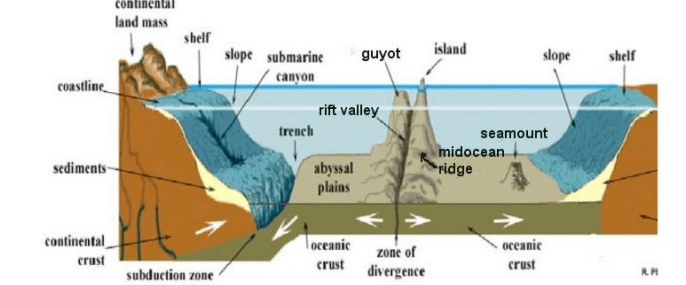
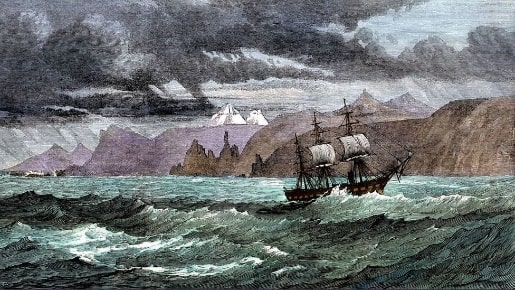
- HMS challenger expedition (1972) – eco sounder, SONAR-Sea MARC, GLORIA.
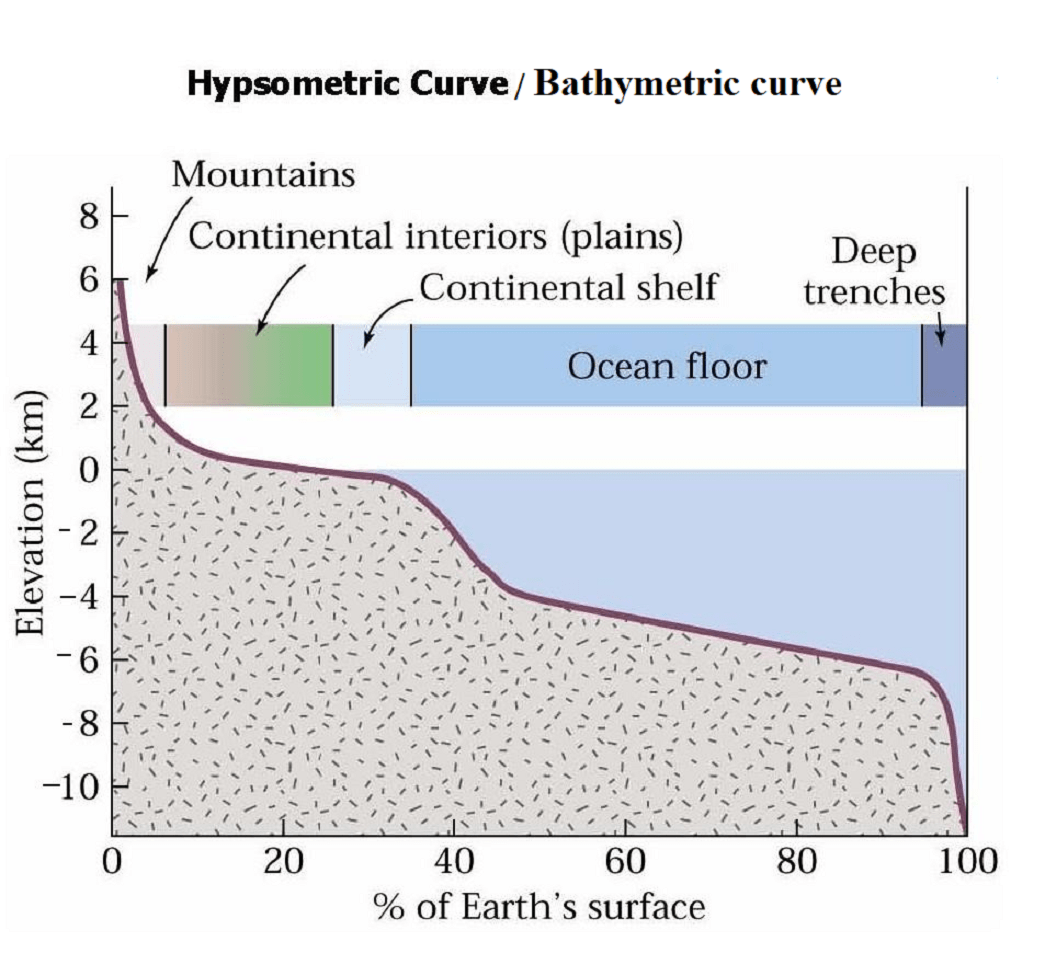
- Bathymetric curve.
- Wegener’s theory was unexplained.
- Magnetic anomalies of Pacific Ocean floor data.
Basis
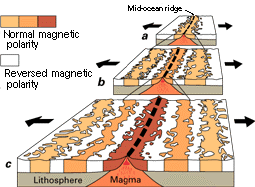
- Magnetic reversal (distance between isochrons)
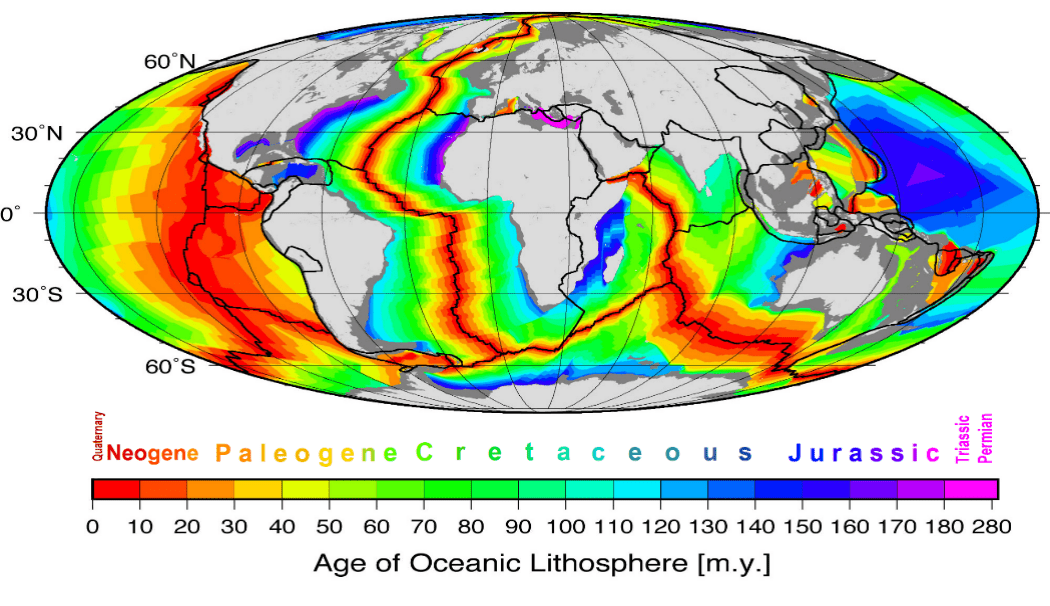
- Age of rocks or isochrons.
Note: Isochrons are the lines joining equal date of magnetic strips.
The theory
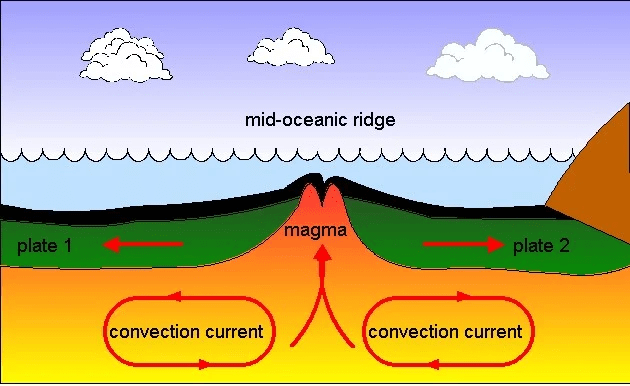
- When oceanic plates diverge, tensional stress causes fractures to occur in the lithosphere.
- Hence the Mid Oceanic Ridge (MOR) is formed. It is situated on the rising thermal convective currents, originating from mantle.
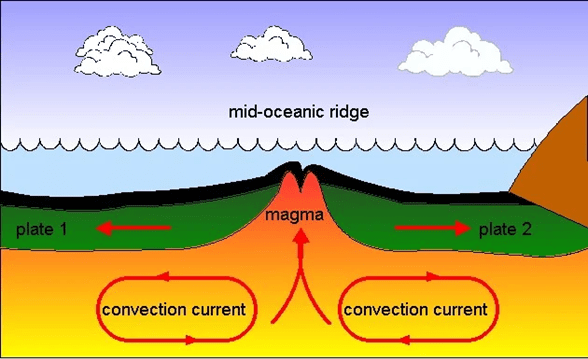
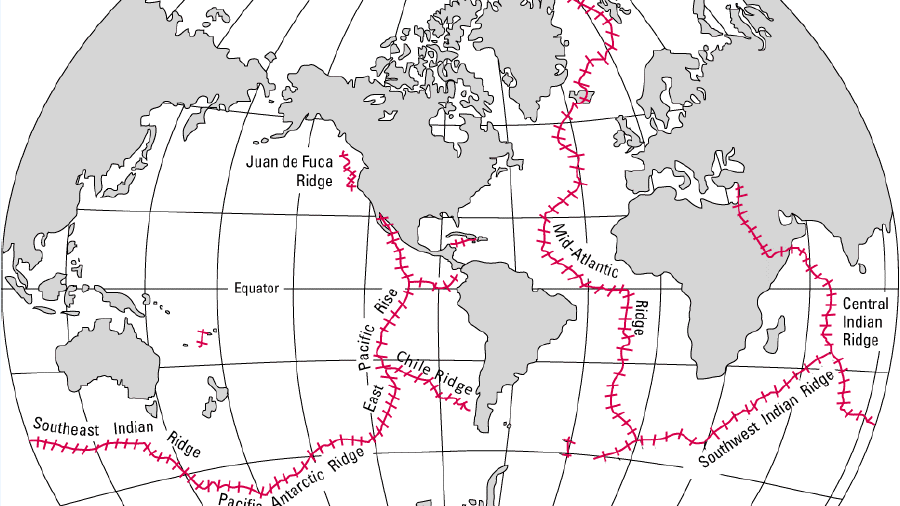
- Upwelling basaltic lava along MOR: It cools down to form new seafloor.
- Sea floor spreads and gradually moves away from the MOR (diverging limbs) and it destroyed along trenches or the descending limbs.
- With time, older rocks are spread farther away from the spreading zone while younger rocks will be found nearer to the spreading zone. It is confirmed by the age of rocks.
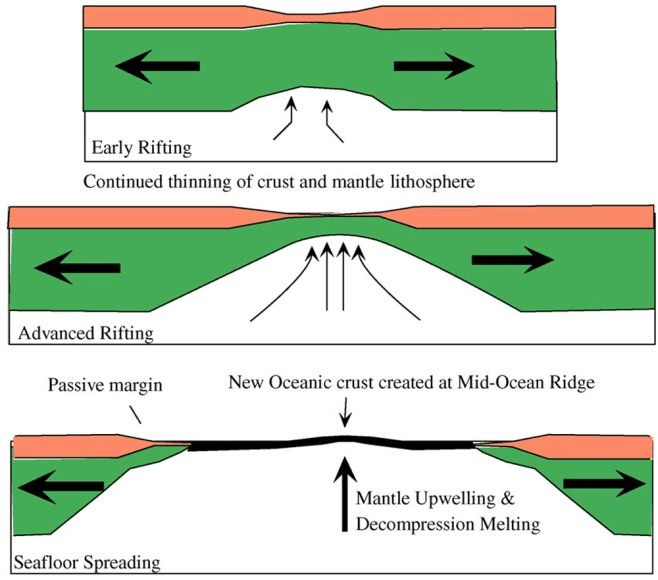
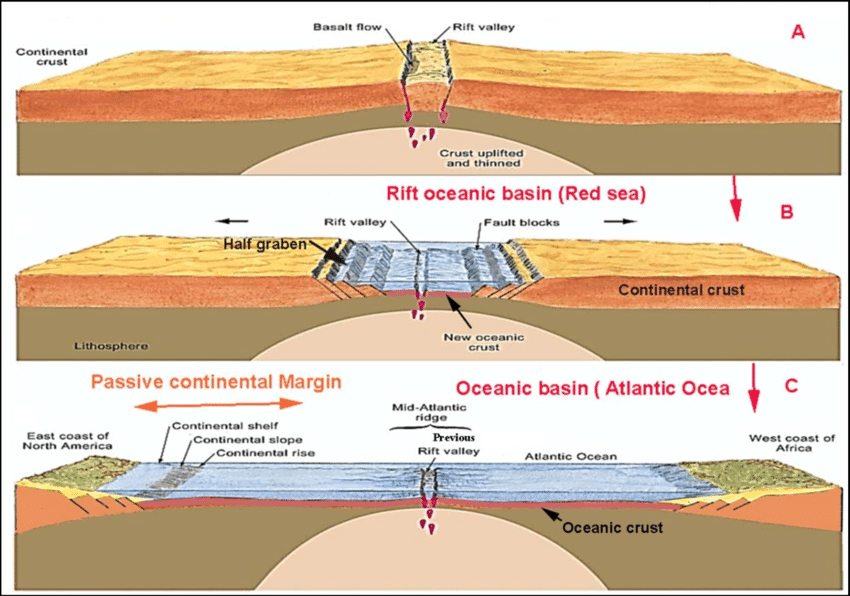
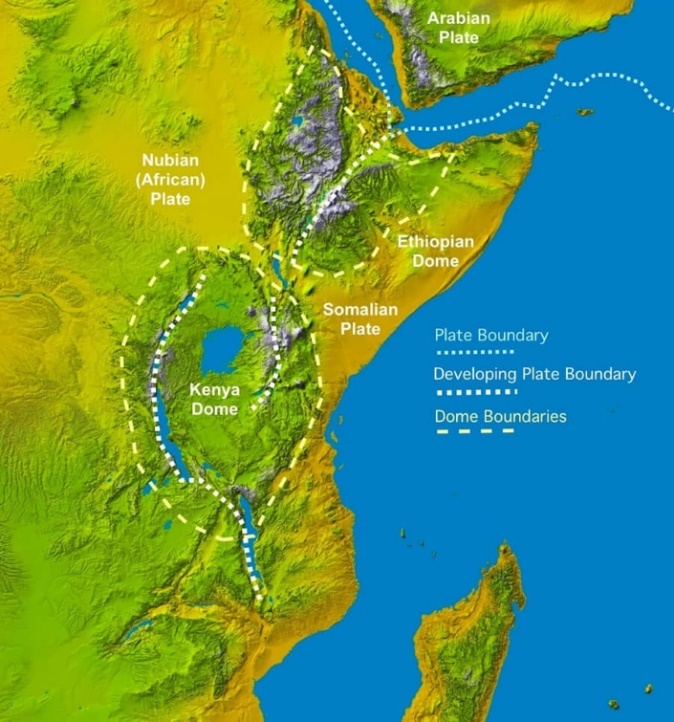
Evidence for Seafloor Spreading
- Nature of oceanic rocks around MOR
- Equidistant rocks on either side of the MOR have geological similarities. They have similar constituents, age and magnetic orientation.
- Rocks closer to the MOR have normal polarity and are the youngest.
- The age of the rocks increases as these moves away from the ridge. Eg. The rocks near the MOR are much younger than the rocks of the continental crust.
- Distribution of Earthquakes and Volcanoes along MOR
- The normal temperature gradient near the ridges is higher. It indicates upwelling from mantle.
- Volcanic Ring of Fire is almost parallel to the coastlines. This indicates that the seafloor has widened with time.
- In general, the foci of the earthquake near the MOR is at shallow depths. However, along the Alpine-Himalayan belt and the rim of the Pacific, the earthquakes are deep-seated ones.
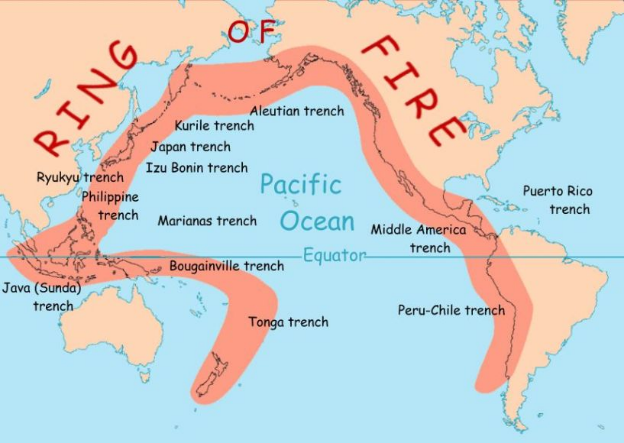
Explanation of Magnetic reversal (Paleomagnetism)
- Study of paleomagnetism was done based on Carlsberg ridge. (Vine and Mattheus, 1963)
- Alternate magnetic rock stripes are flipped, i.e. one stripe is of normal polarity and the next is of reverse polarity.
Explanation
- Basaltic lava acquires magnetic property of magma (T>Tcr) and cools down with the same property.
- Hence, alternative strips of magnetic anomalies are formed on either side of the MOR (Parallelism).
- As the conventional currents spreads the oceanic plates, and a new strip of rock takes a few million years to form. This results in this magnetic striping where the adjacent rock bands have opposite polarities.
- This cycle is repeated. It creates an alternating pattern of magnetic striping on the seafloor.
Evaluation
- The theory provided solid foundation for Plate Tectonic Theory.
Thinkers on Sea Floor Spreading
Alfred Wegener:
- Wegener suggested that the continents were once joined together in a single landmass called Pangaea and later drifted apart.
- Wegener's views laid the groundwork for understanding the movement of continents and contributed indirectly to the development of Sea Floor Spreading Theory.
Harry Hess:
- Hess was an American geologist and Navy officer who introduced the concept of Sea Floor Spreading in the 1960s.
- He proposed that new oceanic crust was formed at mid-ocean ridges through volcanic activity and then spread outward.
- Hess's views revolutionized the understanding of oceanic crust formation and the dynamics of tectonic plates.
Fred Vine and Drummond Matthews:
- They were British geophysicists who worked with magnetic anomalies in the ocean floor.
- They discovered that the ocean floor showed symmetrical patterns of magnetic striping on either side of mid-ocean ridges.
- Their findings supported the idea of Sea Floor Spreading, as new crust formed at ridges and older crust moved away, leaving a record of magnetic reversals.
Dan McKenzie and Robert Parker:
- They contributed to refining the Sea Floor Spreading Theory in the 1960s and 1970s.
- They proposed the theory of plate tectonics, which integrated Sea Floor Spreading with continental drift and provided a comprehensive explanation for Earth's surface dynamics.
20. Plate Tectonics
- Plate tectonics is a great geological synthesis of 1960s, which completely revolutionized the perception about the earth.
- Propounders: T. Wilson defined Plate; Mckenzie and Parker discussed the mechanism by ‘Paving Stone Hypothesis’; Morgan & Pichon elaborated the concept.
Background
- It is an improvement over the Wegener’s continental drift theory.
- It is considered as the most comprehensive theory about the drift of continents and the expansion of sea floors.
Basis
- Continental drift.
- Sea floor spreading.
- Convectional current.
- Polar wandering and magnetic reversal.
- The earth’s interiors according to mechanical rigidity can be classified into: Lithosphere, Asthenosphere and Mesosphere. It theory rejects the SIAL and SIMA based classification.
The Theory
What are the Plates
- The lithosphere is broken up into tectonic plates. These plates are amorphous, aseismic, and quasi-stationary to moving lithosphere slabs.
- Plates float on the underlying asthenosphere due to the convention currents. They move independently of the other plates.
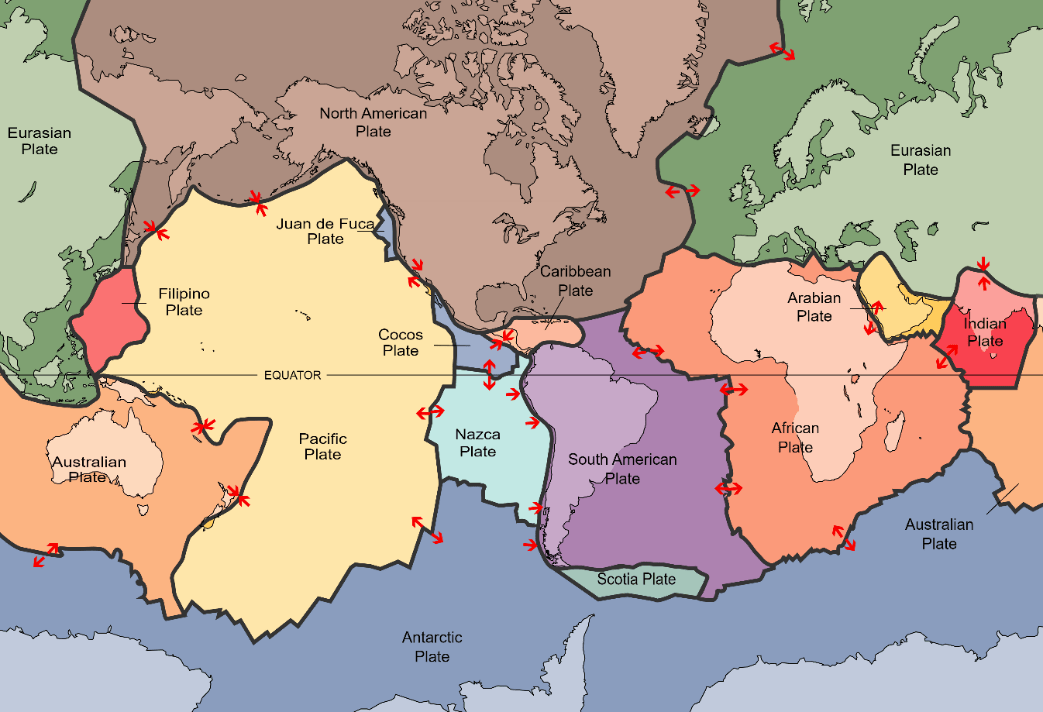
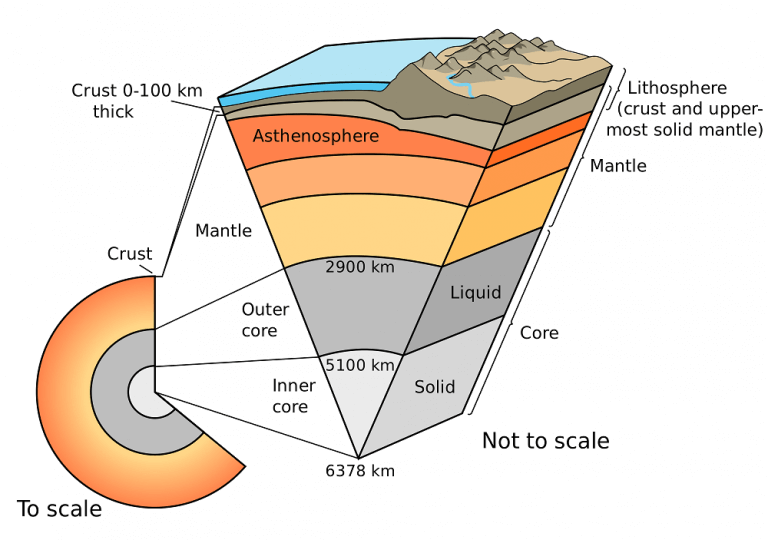
- So far, six major and 20 minor plates are identified.
- The lithosphere includes the crust and top mantle. Its thickness varies between 5-100 km in oceanic parts and about 200 km in the continental areas.
- The oceanic plates contain mainly the Simatic crust and are relatively thinner. The continental plates contain Sialic material and are relatively thicker.
What is Plate tectonics
- It refers to the resulted reaction of the motion of plates.
- All the tectonic activities occur along the plate margins. E.g. seismic events, vulcanicity, mountain building etc.
- Plate margins are divided into three types of boundaries: convergent, divergent, or transform.

1. Constructive (Divergent) Plate Margins
- Upwelling of basaltic lava along MOR.
- Sea floor spreading due to convection currents.
- New oceanic crust formation due to cooling.
- 1st Order relief features.
- Landforms of Divergent Boundaries: Mid oceanic ridges, rift valleys and fissure volcanoes.
- East African Rift valley, Baikal Rift Valley, West Antarctic Rift, and the Rio Grande Rift are major active continental rift valleys.
2. Destructive (Convergent) Plate Margins
- Overridden heavy plate is subducted into mantle.
- Melting along beni-off zone.
- Geomorphic features like fold mountains, volcanic archipelago etc.
- Second order relief features.
These are of three types:
- Oceanic–oceanic convergence.
- Oceanic–continental convergence.
- Continental–continental convergence.
(a) Oceanic–Oceanic Convergence
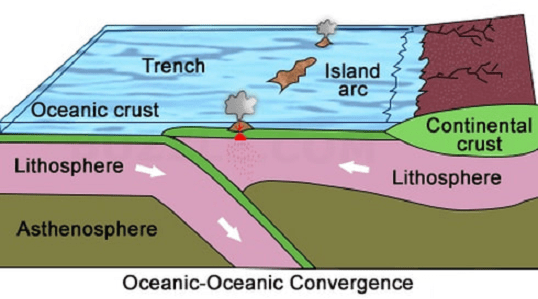
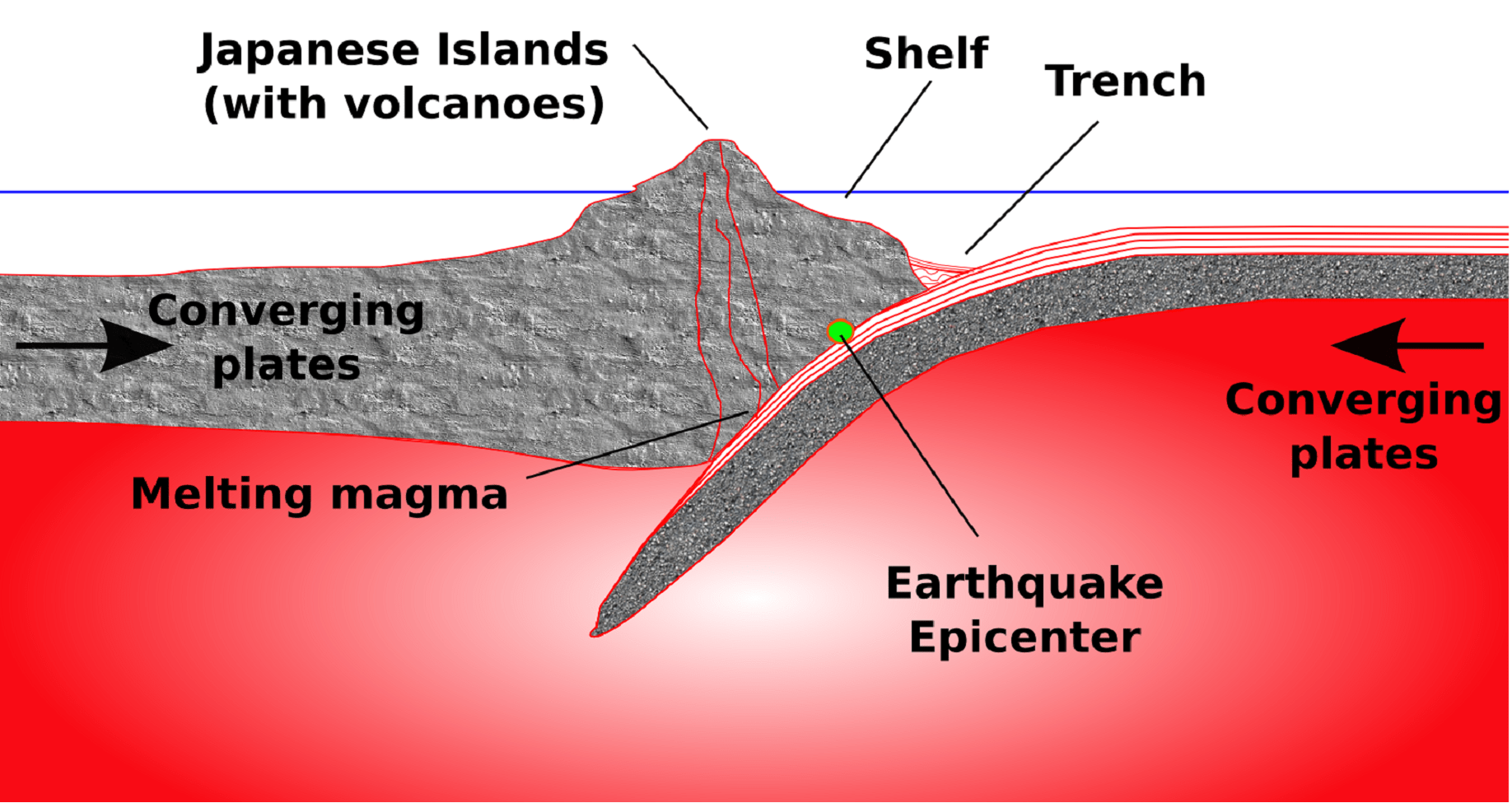
- The cooler and denser oceanic lithosphere sinks beneath the warmer and less dense oceanic lithosphere.
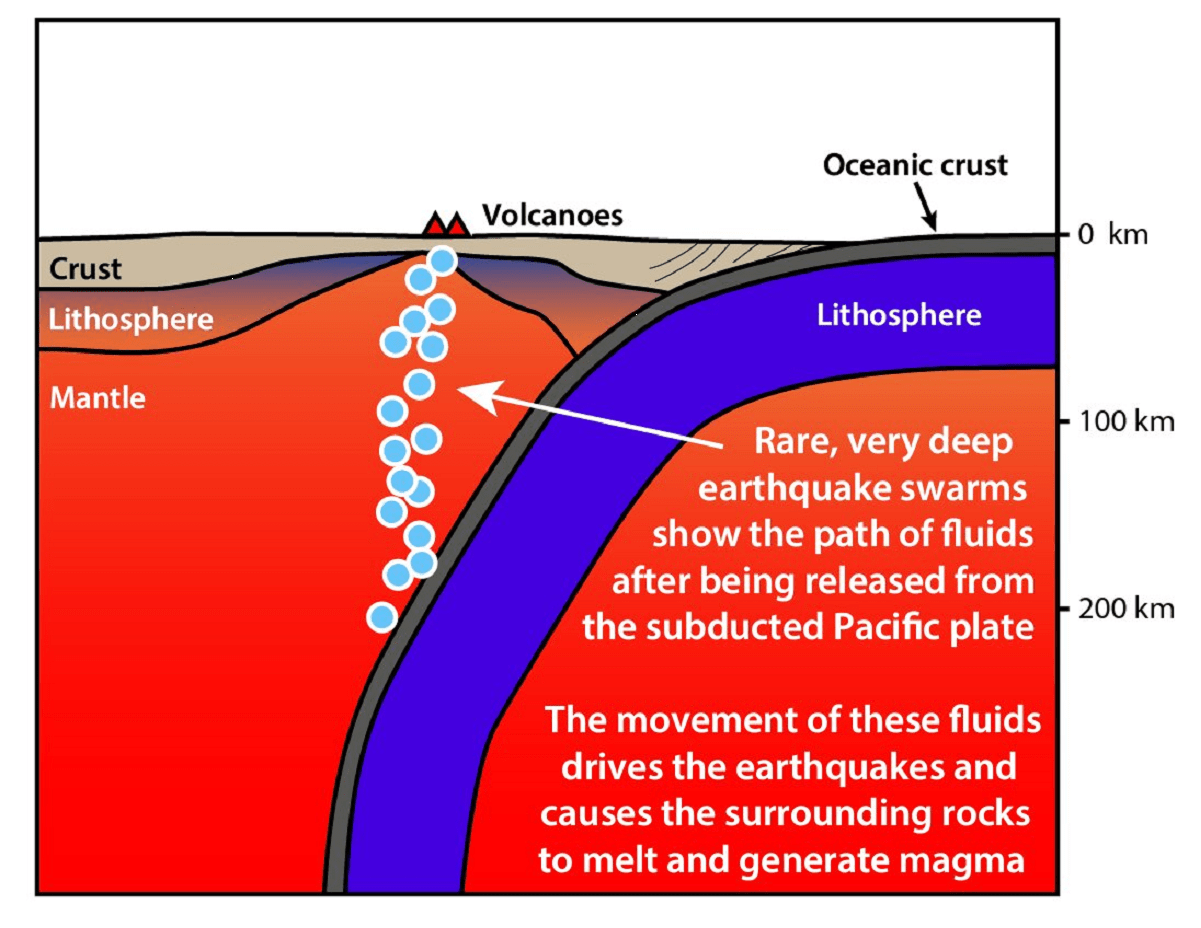
- As the slab sinks deeper into the mantle, it releases water from dehydration of hydrous minerals in the oceanic crust.
- Due to this, oceanic trench formed, shallow and deep-focus earthquakes occur and volcanic activity is initiated.
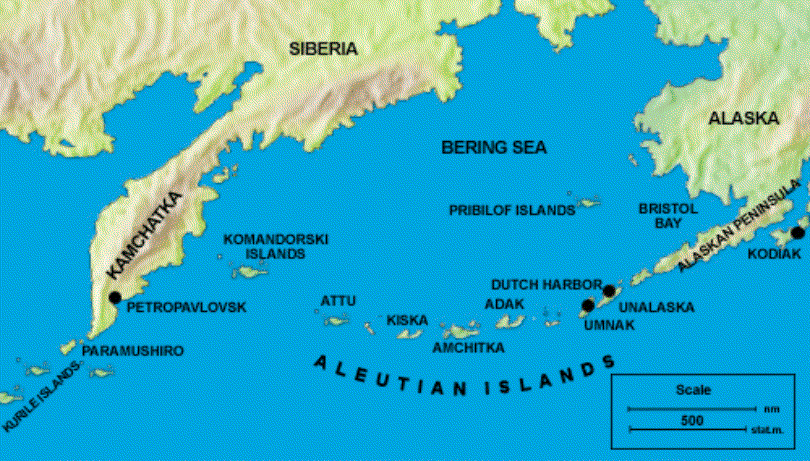
- With time, a volcanic island arc develops such as the Aleutian Islands and the Mariana Islands. Such an arc may eventually become mature island arc system. Eg. Japan, Sumatra and Java.
(b) Oceanic–Continental Convergence
- Oceanic–Continent (O-C) convergence is formed due to collision of oceanic crust with a continent.
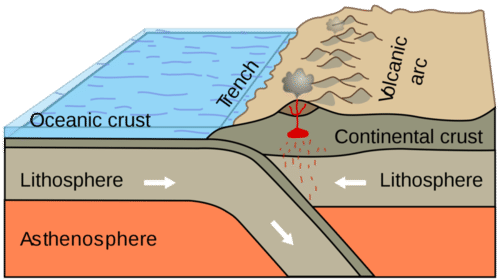
- The oceanic plate is denser, so it undergoes subduction. The dense oceanic plate sinks into the asthenosphere in the process of subduction.
- The subducting slab pulls on the rest of the plate. Such slab pull is probably the main cause of most plate movement.
(c) Continental-Continental Convergence
- Such convergence is formed between two continental plates.
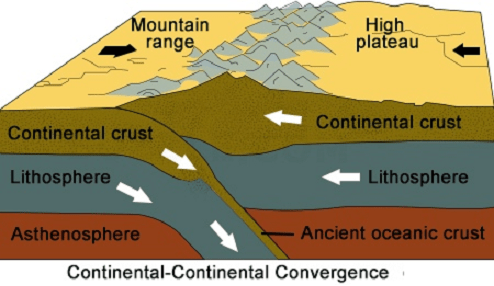
- During this process, oceanic sediments are squeezed and upthrust between the plates.
- These squeezed sediments appear as fold mountains along the plate margins. e.g. Himalayan Mountains.
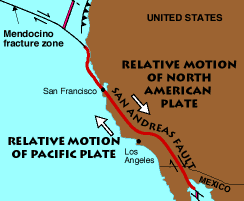
3. Conservative (Shear/Transverse) Plate Margins
- Plate sides pass along transform faults.
- Crust: Neither created nor destroyed.
- It is also called a strike-slip boundary.
- It is a fault along a plate boundary where the motion is predominantly horizontal.
- such boundaries are located where two plates are sliding past each other. There is no creation or destruction of any landforms, but only deformation of the existing landforms.
- The fracture zone that forms a transform plate boundary is known as a transform fault.
- In oceans, transform faults are the planes of separation generally perpendicular to the mid-oceanic ridges.
- North Anatolian Fault and San Andreas Fault along the western coast of the USA.
Significance of Plate Tectonics
- The shape of future landmasses can be predicted. Eg. if the present trends continue, North and South America will separate. A part of land will separate from the east coast of Africa. Australia may move closer to Asia.
- Economically valuable minerals like copper and uranium are found near the plate boundaries.
- Almost all major landforms formed and explained due to plate tectonics.
- Present locations of the continents.
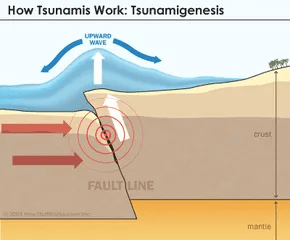
- Cause and locations of volcanic eruption, earthquakes, tsunamis,
- The process of mountain building.
Evaluation
- Plate Tectonics validated the concept of continental drift.
- It also resolved the long-awaited puzzle of the geomorphological feature creation.
Thinkers Contributions on Plate Tectonics Theory
Alfred Wegener:
- Wegener proposed the theory of Continental Drift in the early 20th century.
- He suggested that continents were once joined together in a supercontinent called Pangaea and drifted apart over millions of years.
- Wegener's ideas were initially met with skepticism but laid the groundwork for modern Plate Tectonics Theory.
Arthur Holmes:
- Holmes contributed to the understanding of plate movements through his work on mantle convection.
- He proposed that heat from radioactive decay within the Earth's mantle drives convection currents, causing the movement of tectonic plates.
- Holmes's insights helped explain the driving forces behind plate movements.
Harry Hess:
- Hess introduced the concept of seafloor spreading in the 1960s.
- He suggested that new oceanic crust is formed at mid-ocean ridges as magma rises from the mantle, pushing older crust aside.
- Hess's ideas provided a mechanism for how continents move and renewed interest in Plate Tectonics Theory.
Tuzo Wilson:
- Wilson expanded on Hess's ideas and proposed the theory of plate tectonics.
- He introduced the concept of transform faults, where plates slide past each other horizontally.
- Wilson's contributions helped refine the understanding of plate boundaries and their movements.
Jason Morgan:
- Morgan developed the theory of plate tectonics further by introducing the idea of hotspots.
- He suggested that volcanic hotspots occur where magma rises from deep within the mantle, creating volcanic islands or features.
- Morgan's work added to the complexity of plate movements and their interaction with geological features.
Comparison: Continental Drift, See Floor Spreading and Plate Tectonics
|
Continental Drift |
Sea Floor Spreading |
Plate Tectonics |
|
|
Explained by |
Alfred Wegener in the 1920s |
Harry Hess explained See Floor Spreading in the 1940s. |
McKenzie and Parker, Morgan. |
|
Theory |
Explains the movement of continents only. |
Explains the movement of oceanic plates only. |
Explains the movement of lithospheric plates (both continents and oceans). |
|
Forces for movement |
Buoyancy, gravity, pole-fleeing force, tidal currents. |
Convection currents in the mantle. |
Convection currents in the mantle. |
|
Evidence |
Apparent affinity across different continents. Eg. physical features, botanical evidence, fossil evidence, Tillite deposits, placer deposits, rocks of same age etc. |
Ocean bottom relief, Paleomagnetic rocks, distribution of earthquakes and volcanoes etc. |
Ocean bottom relief, Paleomagnetic rocks, distribution of earthquakes and volcanoes, gravitational anomalies at trenches, etc. |
|
Criticisms |
Too general with illogical evidence. |
Doesn’t explain the movement of continental plates. |
|
|
Acceptance |
Discarded |
Not complete |
Most widely accepted |
|
Application |
Helped in the evolution of convection current and seafloor spreading theories. |
Helped in the evolution of plate tectonics theory. |
Helped in understand various geographical features. |