Petrology: Introduction
Introduction
- It is a branch of Geology, which deals with scientific study of rocks.
- The branch of petrology dealing with study of stones alone is called ‘lithology’.
Rocks
- Rocks are aggregate of minerals.
- These form major part of earth crust.
- Sometimes, earth crust is also known as rocksphere or lithosphere.
- Monomineralic rocks: composed of one mineral only. Eg. Quartz and calcite.
- Multimineralic rocks: mineral lick rocks composed of more than one mineral.
Classification of rocks
Rocks are classified in three types.
1. Igneous or primary rocks
- These are formed due to cooling, solidification and crystallization of Magma and Lava.
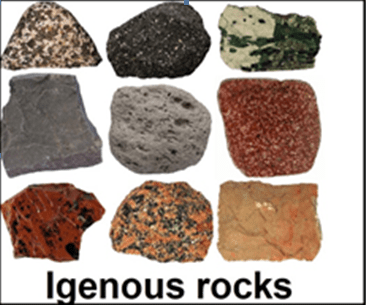
Characteristics
- Also known as primary or parent rocksbecause these originated first. All the subsequent rocks form later, whether directly or indirectly.
- Also known as volcanic rocks.
- Hard
- Do not have strata. Found in massive structures. Like Batholiths, laccolith, dykes etc.
- Absence of fossils.
- Usually contain much feldspar.
2. Sedimentary or secondary rocks
- Formed due to aggregation, compaction and cementation of sediments.
- Derived from pre-existing rocks: erosion, transportation and deposition of loose sediments.
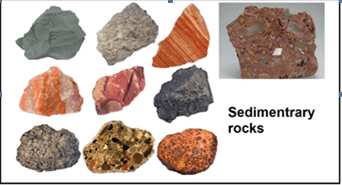
Characteristics
- These are mostly formed under water.
- Also formed on Eg. Loess; Rocks of sand dunes, alluvial fans and cones.
- Generally soft and stratified.
- Unlike igneous rocks, these are not found in massive forms.
- “The sedimentary rocks are important for extent, not for depth in the earth crust.”: In spite of only 5% composition in the crust, these found over largest surface area of the globe. 75%
3. Metamorphic rocks
- It is formed when pre-existing rocks change either in form or composition without disintegration, by increased temperature and pressure.
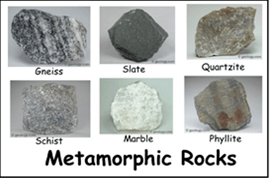
Characteristics
- Harder and stronger rocks.
- Metamorphism takes place above 250 degree C temperature, and under 15 km depth.
- Fossils are generally absent.
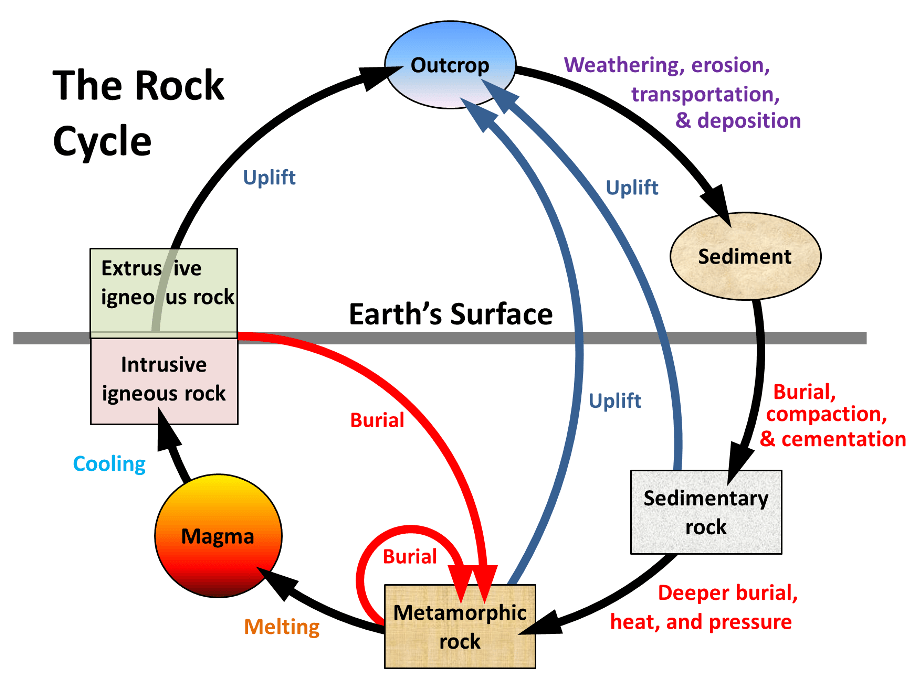
Rock cycle
- One type of Rock changes slowly to another type.
- Rock cycle shows the transitions between three types of rocks: sedimentary, metamorphic, and igneous.
- Composition in the earth crust:
- Igneous rocks: Sedimentary rocks : Metamorphic rocks = 65: 5: 30.
The cycle
- Weathering and erosion produce
- Sediments are transported and deposited. Compaction and cementation form sedimentary rocks.
- If these rocks are deeply buried, high temperature and pressure turns them into metamorphic rocks.
- Further submergence to greater depth leads to intense heating and melting of rocks. Hence, magma is produced.
- The magma rises up and cools to form igneous rocks.
- Exposure of igneous rocks to weathering and erosion again produces And, the cycle continues.
Igneous Petrology: Introduction
Igneous rocks form when hot, molten rock crystallizes and solidifies. The melt originates deep within the Earth near active plate boundaries, then rises toward the surface. Igneous rocks are divided into intrusive or extrusive, depending upon where the molten rock solidifies.
Intrusive or Plutonic Igneous Rocks
- These rocks form when magma is trapped deep inside the Earth. Convective cells of molten rock rise toward the surface.
- Some magma may feed volcanoes on the Earth's surface, but most remains trapped below, where it cools and solidifies very slowly over a long geological time.
- Slow cooling means the individual mineral grains have a very long time to grow, so they grow to a relatively large size. Intrusive rocks have a coarse grained texture.
Extrusive or Volcanic Igneous Rocks
- These rocks are produced when magma cools above (or very near) the Earth's surface.
- These are the rocks that form at erupting volcanoes and oozing fissures. The magma is called lava when molten rock erupts on the surface.
- The erupted magma (lava) cools and solidifies instantly as it is exposed to the relatively cool atmospheric temperature.
- Due to quick cooling, mineral crystals don't have much time to grow. Hence, so these rocks have a fine-grained or even glassy texture.
- Hot gas bubbles are often trapped in the quenched lava, forming a bubbly, vesicular texture.
Igneous petrology
- Igneous petrology is the study of melts (magma) and the rocks that crystallize from such melts, encompassing an understanding of the processes involved in melting and subsequent rise, evolution, crystallization, and eruption or emplacement of the eventual rocks.
- Petrogenesis is the general term for generation of magma and various methods of diversification of such magmas.
Classification of igneous rocks
- Classification generally entails texture observed or composition of the rock.
- Nearly all igneous rocks are composed principally of silicate minerals, which are most commonly those included in Bowen’s Series.
- Minerals are divided in felsic (light-colored) and mafic (dark colored).
- Rocks rich in quartz, feldspars, or feldspathoids are said to be felsic, whereas those rich in ferromagnesian minerals are mafic or even ultramafic if they are totally devoid of felsic minerals.
- Felsic rocks are rich in SiO2, whereas ultramafic rocks are rich in MgO and FeO.
- The term ultramafic refers to a rock that consists of over 90% mafic minerals.
- Based on colour, leucocratic indicates a light-colored rock, and melanocratic indicates a dark-colored rock.
- These terms are not suitable for classification.
- Purely chemical terms such as silicic, magnesian, alkaline, and aluminous that refer, respectively, to the SiO2, MgO, (Na2O + K2O), and Al2O3 content of a rock are also used.
- Silica content is of importance, and the term acidic is synonymous with silicic.
- The opposite of acidic is basic, and the spectrum of silica content in igneous rocks has been subdivided as follows:

- Based on silica saturation:
- Silica oversaturated rocks contain more than 66% SiO2, i.e. free quartz mineral is found.
- Silica saturated rocks are typically those which have sufficient silica to form stable silicate mineral but seldom free quartz occur. They contain more than 52 - 66% SiO2.
- Silica undersaturated rocks contain insufficient silica and silica deficient minerals. Rocks contain 45 - 52% SiO2
- Based on Alumina Saturation:
- Peraluminous: This group contains excess of alumina than required for formation of feldspars, which can be chemically expressed as:
Al2O3 > (CaO+ Na2O+K2O)
- Metaaluminous: Molecular percentage of this category is expressed as
Al2O3 < (CaO+Na2O+K2O) and Al2O3>(Na2O+K2O)
- Peralkaline: This group is alumina poor and oversaturated with alkalis. On a molecular basis will be expressed as:
Al2O3 < (Na2O+K2O)
- Total Alkali Silica (TAS) is another classification scheme discussed in IUGS classification.
- Another broad criterion to classify igneous rocks depends on the emplacement of magma.
- If the rock formed when magma solidified at great depths, the rock is called plutonic or intrusive These rocks are coarse grained due to slow cooling.
- If the rock formed from magma which erupted on Earth’s surface, it is called volcanic or extrusive These rocks are very fine grained due to rapid cooling.
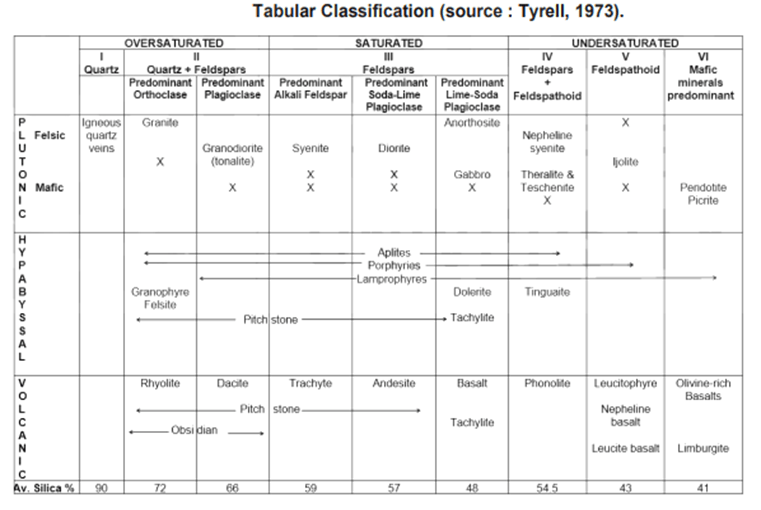
Tabular Classification
This classification scheme takes into consideration (i) the mode of occurrence, (ii) SiO2 percentage and free quartz, (iii) proportion of K-Feldspar, lime (calcic) and sodic (Na) plagioclase.
Chemical classification
- Rock groups of volcanic association (generally) are compared through their chemical variation.
- This is a comparison of degree of alkalinity in relation to lime with varying silica content. Thus, called alkali-lime subdivision.
- Peacock devised this method.
- Alkali lime index is the percentage of SiO2 by weight, in silica variation diagram based on chemical analysis of a genetically related rock series, at which the abundances of CaO and (Na2O + K2O) are equal.
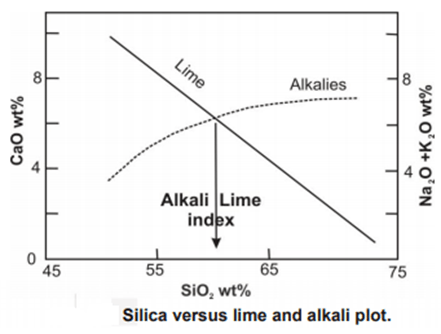
- The more alkaline is the series, the lower is the value of SiO2 at the point of equivalence.
- According to Peacock’s classification:
|
Type |
SiO2 value |
Rock association |
|
Calcic series |
> 61 |
Tholeiite series, primitive arc volcanics |
|
Calc-alkaline series |
56-61 |
Basalt-andesite-rhyolite |
|
Alkali-calcic series |
51-56 |
Alkali olivine basalt-trachyte |
|
Alkalic series |
< 51 |
Phonolite-nephelinite |
- It has been observed that rock series from different tectonic settings have a characteristic alkali lime index.
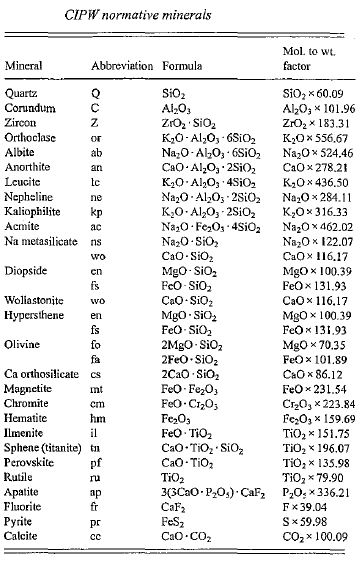
CIPW classification
- This is based on the normative calculation from the bulk chemistry of the rocks.
- Thus, also known as norm classification.
- The norm is a calculated mineralogical composition based on the conversion of a whole-rock chemical analysis into various common minerals.
- The basic principle of classification is to understand relationship between major element chemistry and possible mineralogical composition of the investigated rock.
- The norms calculated may or may not tally with the mode (actual individual minerals percentage calculated by determining volume of the minerals and converting them into their weight by multiplying density and recalculating by 100%).
- The norm is divided in to sialic (rich in silica and aluminum) and a femic (rich in iron and magnesium) group.
Advantages and disadvantages of CIPW
- CIPW classification uses several chemical constituents normally present in the rock.
- Fine grained and glassy rocks can also be classified using this classification.
- CIPW norms of slightly altered igneous and metamorphic rock can give hint to their original nature.
- The disadvantage is that the chemical composition is essential for calculating norms.
- The calculated norms may not match with the actual mineralogy.
IUGS Classification
- Since there have been numerous classifications which lead to confusion, we use the standard nomenclature system known as IUGS classification.
- The IUGS system requires that we determine the mineral components of a rock and plot the percentages of three of those components on appropriate triangular diagrams to determine the proper name.
- The mineralogical composition of a rock is known as its mode.
- The norm is a calculated mineralogical composition based on the conversion of whole-rock chemical analysis into various common minerals.
- The IUGS classification is based on the modal amounts of the common minerals, which are divided into five groups:
- Q- quartz
- A- alkali feldspar, including albite with up to 5 mol% anorthite (<An5)
- P- plagioclase with composition from An5 to An100 and scapolite (a common alteration product of plagioclase)
- F- feldspathoids: nepheline, sodalite, analcite, leucite, pseudoleucite, kalsilite (kaliophilite), nosean_, hauyne, and cancrinite
- M- mafic minerals: olivine, pyroxenes, an1phiboles, micas, monticellite, melilite, opaque minerals, and accessory minerals, such as zircon, apatite, sphene, epidote, allanite, garnet, and carbonate.
- Rocks containing less than 90% mafic minerals (M < 90) are classified on the basis of their proportions of Q, A, P, and F;
- Rocks with M > 90 are classified on the basis of the proportions of the major mafic minerals.
- Because no rocks contain both Q and F, nonultramafic rocks can be classified in terms of three components, either QAP or FAP.
- The three components can be represented in triangular plot.
- The horizontal axis In this diagram indicates the proportion of plagioclase in the total feldspar (P/{P +A}).
- The vertical axis indicates the modal percentage of quartz (Q) measured upward.
- The amount of feldspathoid (F) measured downward from the zero line.
- The diagram is subdivided into areas marking the compositional extent of the main rock types.
Calculations and Plotting:
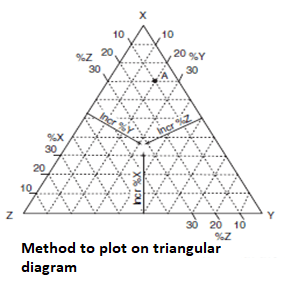
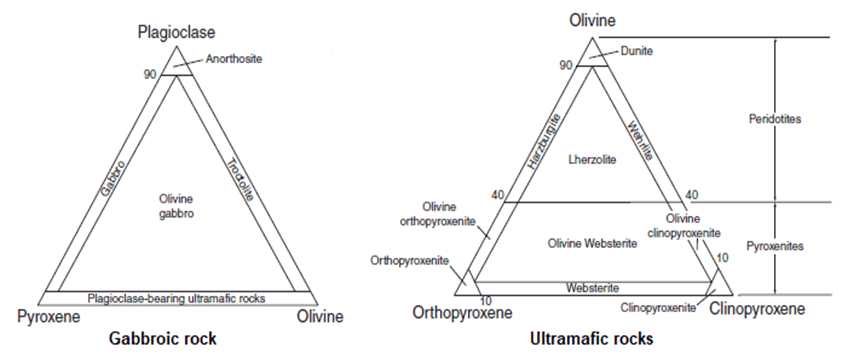
- IUGS classifies rocks in broad categories to simplify the complicated process of classification.
- So, the broad classification is phaneritic rocks, aphanitic rocks, and pyroclastic
Steps to classify the rocks:
- If the rock is aphanitic or phaneritic, determine the mode (% of each mineral present, based on volume).
- From the mode, determine the volume % of Quartz (Q), Plagioclase (P), Alkali feldspar (A), Feldspathoids (F), Mafics (M) and accessories.
- Majority of igneous rocks have at least 10% Q + A + P or F + A + P.
- If rock has 10% of these, M is ignored and remaining 3 are normalized to 100%.
- We use different classifications for aphanitic and phaneritic rocks.
- To find in which field the rock belongs, first determine the ratio 100P/(P + A).
- Select a point along the horizontal P–A line (across the center of the diamond) on respective figure that corresponds to this ratio.
- Next proceed a distance corresponding to Q or F directly toward the appropriate apex.
- Because quartz and feldspathoids cannot coexist, there is no ambiguity as to which triangular half of the diagram to select.
- The resulting point, representing the Q: A: P or F: A: P ratio, should fall within one of the labeled subfields, which provides a name for the rock.
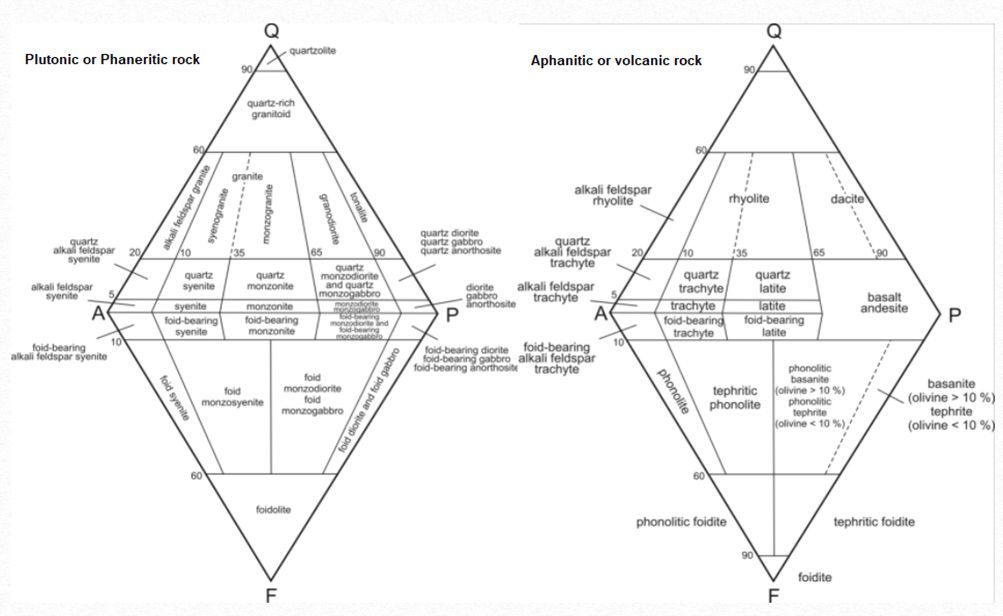
- Gabbroic rocks (plagioclase + mafics) and ultramafic rocks (with over 90% mafics) are classified using separate diagrams.
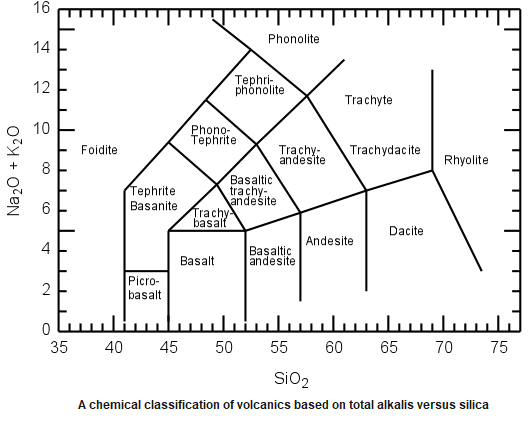
- For volcanic rocks, plots near P make it difficult to distinguish between andesite and basalt.
- IUGS recommends a classification based on total alkalis and silica, called a “TAS” diagram.
- It is a simple X-Y graph with the X-axis showing silica (SiO2) wt% and the Y-axis showing alkalis (Na2O+K2O) wt%.
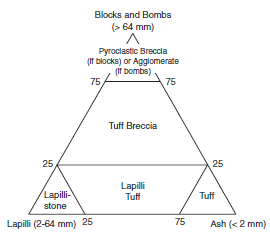
Pyroclastic rocks:
- Pyroclastic rocks are fragmental, generally produced by explosive volcanic activity. Some may be fragments of sedimentary or metamorphic country rock caught up in a violent eruption.
- Pyroclastics are typically classified on the basis of the type of fragmental material (collectively called pyroclasts) or on the size of the fragments.
- For pyroclasts we determine the percentage of fragments falling into the following categories:
- Bombs (rounded) and Blocks (angular or broken) - >64 mm diameter
- Lapilli - 2-64 mm diameter
- Ash - <2mm