
Migmatites
Migmatites
Introduction
- It is the medium to high grade metamorphic rock which consist of alteration band of two or more minerals.
- In some metamorphic belts, the sillimanite zone is succeeded by higher grade zones in which the rocks are often migmatites.
- This means that they are literally mixed rocks and it shows the mixture of igneous and metamorphic rocks. These usually predominantly schists but with pods, veins or layers of leucocratic material of broadly granitic composition.
- The rock forms during the prograde metamorphism with the partial melting occurred in source rocks.
- The rock exhibits the ptygmatic folds with the segregation of light coloured minerals known as leocosome with dark coloured amphibole and biotite rich minerals.
- PTYGMATIC FOLDS: These folds are formed by highly plastic ductile deformation of gneissic banding.
- Schlieren textures: Commonly seen in granite formation in migmatities.
- The textures of migmatites are the result of thermal softening of the metamorphic rocks.
- Although migmatites are best developed in pelitic rocks, they also form in other siliceous metasediments, metabasic rocks, granitoids etc.
- The rocks do indeed appear mixed, having a dark schistose component (the melanosome) that is intimately associated with light colored, coarser-grained, poorly schistose material (the leucosome).
- The term paleosome (or mesosome) refers to material in migmatites that is intermediate in character between melanosome and leucosome, and has been interpreted to be original rock zones unaffected by migmatization.
- Migmatites appear to represent the culmination of high-grade metamorphism under more hydrous conditions than characterize the granulite facies.
- Migmatites are classified structurally on the basis of the relationship between the leucosome and melanosome.

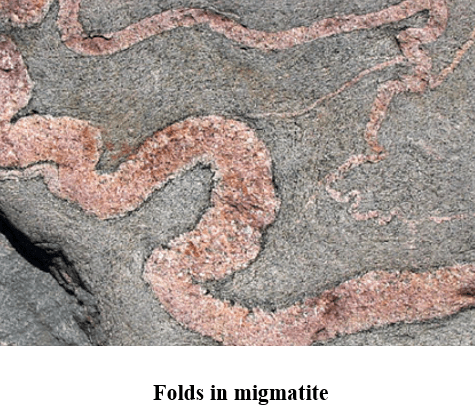
Types
The most common types are:
- Vein-type migmatites: The leucosome forms a fairly random network of distinct veins that separate irregular blocks of melanosome.
- Stromatic migmatites: The most common type, in which the leucosome forms concordant layers that commonly parallel the schistosity of the melanosome. The layers are rarely continuous, however, and typically die out and/or crosscut the melanosome at some point along their length.
- Nebulite: The leucosome occurs as irregularly shaped patches that grade into the melanosome.
- Agmatite: Numerous blocks of paleosome are surrounded by subordinate and relatively narrow veins of leucosome. Agmatites are typically enclave-rich zones marginal to granitoid intrusions.

Origin of migmatites
- The origin of migmatites has been controversial since the inception of the term.
- There are three principal theories:
- Migmatites form by injection of granitic leucosome into dark high-grade schistose rocks.
- Migmatites form by localized partial melting (anatexis). The first melts are granitoids, which compose the leucosome. The melanosome is generally considered to be the restite, or the somewhat refractory residuum from which the melts were extracted.
- Migmatites are created by metamorphic differentiation or metasomatic growth of the leucosome, and melts are not involved.
- The melanosome is generally more mafic than a typical pelite, and the leucosome is much more felsic.
- The injection hypothesis lost favor because it could not explain the more mafic character of the melanosome.
- The composition of the leucosome is generally more tonalitic than granitic.
- Many migmatites have a complex structure that appears to have resulted from multiple events and processes, generally with several generations of crosscutting leucosomes.
- in the given figure the textures and structures of migmatites are highly variable.
- The leucosome in some migmatites may represent partial melts, whereas it may be the product of metamorphic segregation in others.
- Some migmatites may contain both.
- Melts are likely suspects when the leucosome approaches the minimum-melt composition in the Ab-Or-Qtz system, whereas metamorphic growth is more likely when the leucosome is dominated by plagioclase or alkali feldspar.
- In either case, migmatites represent high-grade metamorphic rocks in which fluids, and perhaps melts, played a substantial role.