Granulite Terrains of India
Granulite Terrains of India
Introduction
- Granulite facies, one of the major divisions of the mineral facies classification of metamorphic rocks, the rocks of which formed under the most intense temperature-pressure conditions usually found in regional metamorphism.
- At the upper limit of the facies, migmatite formation may occur.
- Granulite terrain in India can be explained from Southern Granulite Terrain and Eastern Ghat.
Southern Granulite Terrain
- The Southern Granulite Terrane (SGT), the wedgeshaped southern termination of Peninsular India, is a mosaic of several crustal blocks and intervening collisional sutures/shears which developed through multiple orogenic cycles during Mesoarchean to late Neoproterozoic-Cambrian.
- Peninsular India is a mosaic of several Archean cratonic nuclei welded together by Archean-Proterozoic orogenic belts.
- Among these, the Dharwar Craton marks the southernmost cratonic domain.
- The term Southern Granulite Terrain (SGT) arises from the recognition that the region south of the Dharwar Craton is dominantly composed of granulite facies rocks.
- Aka Pandyan Mobile belt
- SGT is situated to the south of the E-W trending Palghat-Cauvery Shear Zone(PCSZ)
- India’s Southern Granulite Terrain Consists of three late Archean to Neoproterozoic,high-grade Metamorphic blocks, joined together.
- The whole terrain is divided into two distinct crustal blocks-
- The Northern Granulite Terrain(NBSGT), and
- The Southern Granulite Terrain(SBSGT)
- The Northern Block (also known as the Salem Block) of the Southern Granulites consists of a granulite massif at the southern edge of the Dharwar Craton.
- The block is located between the ‘Fermor line’ and the Palghat-Cauvery Shear Zone .
- Lithologies present in the Salem include, pyroxene-bearing granites(charnockites), granite gneisses, and migmatites.
In the following figure,
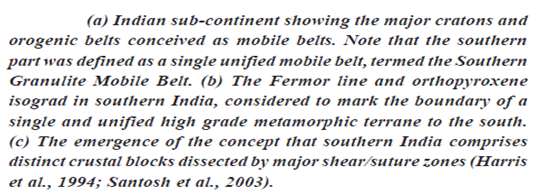

This terrain is dissected by Proterozoic shear zones that separate the Granulite rocks into four regions or blocks-
- Madras Block
- Nilgiri Block
- Madurai Block
- Trivandrum Block

- Charnockite (orthopyroxene-bearing anhydrous granulite), the type area of which is located in the Pallavaram Hills of the Madras Block, is the dominant rock type in most of the crustal blocks of the SGT (except in the Trivandrum Block).
- The next major rock type is TTG (tonalite-trondhjemite-granodiorite) gneisses and their migmatized variants, forming the basement rock in some of the older crustal blocks.
- Intrusive granitoids of both Archean and Proterozoic ages occur in some of the blocks, constituting an integral part of the vertical continental crust building process.
- Supracrustal rocks including metasediments of different metamorphic facies occur adjacent to the margins of many of the crustal block as accreted units, reflecting lateral growth of continent.
- The largest of these occurs within the Trivandrum Block, also termed as the Kerala Khondalite Belt (Chacko et al., 1987), where garnet-sillimanite- cordierite-spinel and graphite bearing aluminous sediments metamorphosed to granulite- and ultra-high temperature granulite facies occur widely, intercalated with garnet and biotite bearing felsic gneisses (termed as leptynites).
- The suture zones and their flanks are dominated by amphibolites or their higher grade equivalents, mafic and ultramafic units, and banded iron formations.
- Among the rock types in the SGT that have attracted global attention are the incipient charnockites and Mg-Al rich ultrahightemperature (UHT) granulites.
- The incipient charnockites are patches, veins, lenses or ladders of greenish domains carrying orthopyroxenebearing granulite facies assemblages overprinting the host gneisses, which are either TTG-type basement rocks with magmatic protoliths, or garnet- and biotite-bearing metasediments.
- These rocks which occur on a mesoscopic scale are sometimes referred to as ‘arrested charnockites’.
- The SGT also hosts some of the world’s classic UHT granulites with diagnostic mineral assemblages which suggest extreme crustal metamorphism under ultrahigh temperature conditions.
- Another important rock suite in the SGT comprises a range of sub-alkaline to alkaline intrusions of granites and syenites distributed within the various crustal blocks and intervening zones, puncturing the basement rocks at several localities.
- Crustal metamorphism at extreme thermal conditions termed as ultrahigh-temperature (UHT) metamorphism generates diagnostic mineral assemblages depending on the protolith composition.
Role of Fluids
- The infiltration of CO2-rich fluids into country rocks which were under reducing conditions (due to the presence of disseminated graphite in these rocks) resulted in the precipitation of coarse flakes of graphite in veins, pegmatites and mesoscopic shear zones.
- The SGT remains as a rare example where multiple approaches converged to indicate CO2 influx from sub-lithospheric sources as an important process that assisted in the formation of anhydrous granulite facies assemblages in the lower crust.
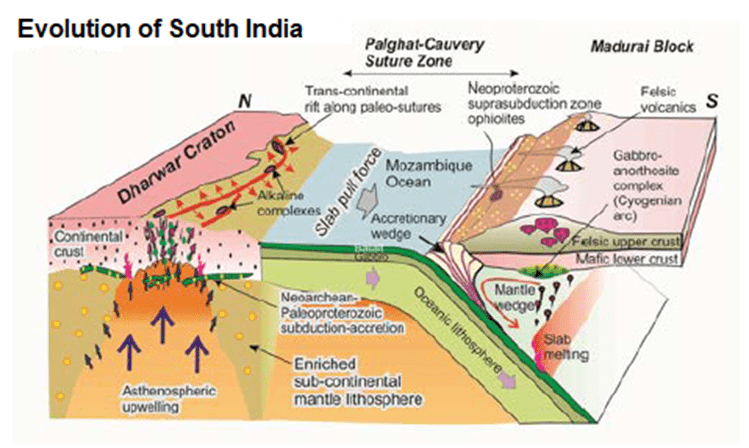
Plate tectonic model
- The Archean tectonic regime is envisaged to have involved accretion of oceanic arcs and micro continents onto the margin of the Dharwar Craton.
- Slab melting and vertical addition was also fundamental to continental growth in the SGT.
- The southern margin of the PCSZ is considered to have been an active convergent margin during mid-Neoproterozoic.
- Neoproterozoic crustal growth and recycling is evidenced from the extensive arc magmatism along the southern domain of the Madurai Block.
- The Southern Granulite Terrane with a diverse assemblage of Precambrian lithologies and as a window to deep crustal and crustmantle interaction processes.
- These include early Earth evolution, formation, maturity, emergence and recycling of continental crust, convergent margin tectonics, arc magmatism, ultrahigh-temperature metamorphism, fluid-rock interaction processes, and supercontinent cycles.
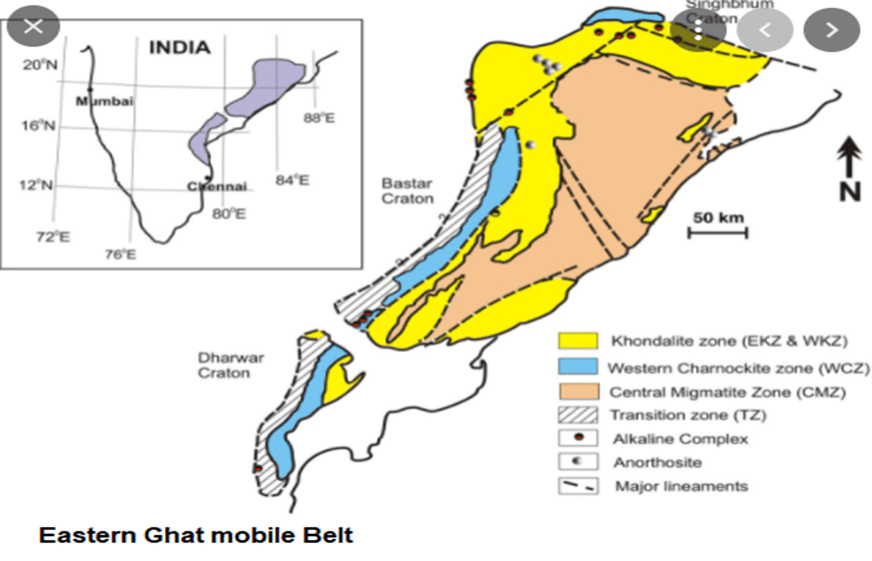
Eastern Ghats granulite belt of India
- The Eastern Ghats mobile belt (EGMB) forms an important component of the Precambrian crust of India and exposes lower crustal rocks (granulites) on a vast scale.
- The Eastern Ghats on the east coast of India is a largely granulite terrain but also exposes granites, migmatites, anorthosites and alkaline rocks.
- This granulite belt has had a prolonged history of mountain building from late Archaean to late Proterozoic.
- During this long period the Eastern Ghats mobile belt witnessed repeated folding and possibly polycyclic metamorphism.
- Some recent findings suggest breaks between orogenic cycles and a proterozoic reworking of Archaean granulites.
- Extreme-temperature crustal metamorphism under fluid-absent conditions and crustal anatexis in huge thickness of pelitic to psammitic protoliths producing leptynites are some of the important results of recent investigations of the Eastern Ghats mobile belt.
- Different generation of charnockites are present in the Eastern Ghats belt.
- It represents one of the highly deformed and metamorphosed (at Ultra High Temperatures, UHT) Precambrian crustal segments of the Indian Shield.
- The belt is widest (∼ 300 km) in the north and thinner towards south (∼50 km), before tapering off beyond Ongole.
- Two major NW–SE trending rifts (grabens), Mahanadi in the north and Godavari in the south, dissect the belt.
- The EGMB is bordered by the Bastar and Dharwar cratons along the west and by the East Indian (Singhbhum–North Orissa) craton in the north.
The Eastern Ghats belt comprises several rock types that may be broadly classified into six groups:
- Metapelitic rocks, dominantly khondalites (garnetsillimanite-k-feldspar gneisses), and quartzites and calc-granulites;
- Massif-type charnockitic and sills of mafic granulites;
- Migmatitic rocks including leptynites (garnetiferous granite gneisses), bands and lenses of charnockitic rocks and mafic and ultramafic granulites (enclaves), and quartzofeldspathic veins and pegmatites;
- Anorthosites;
- Alkaline rock complexes;
- Porphyiritic granites.