Metamorphic Mineral Assemblages
Introduction
Metamorphism occurs mainly as contact or regional metamorphic processes. Regardless of which type of metamorphism process occurs, the result is a collection of minerals that are thermodynamically stable at the new set of conditions.
If they are no longer in equilibrium under the new conditions, the minerals will react to attain a new equilibrium state. This may involve a complete change in mineral assemblage or simply a shift in the compositions of the pre-existing mineral phases. The resultant mineral assemblage will reflect the chemical composition of the original rock and the new pressure-temperature conditions to which the rock was subjected.
The mineral assemblage represents stable chemical equilibrium if the conditions of metamorphism are held for a long geological period of time that equilibrium can be achieved. Most metamorphic rocks represent an equilibrium mineral assemblage.
In general, metamorphic rocks do not undergo significant changes in chemical composition during metamorphism. The changes in mineral assemblages are due to changes in the temperature and pressure conditions of metamorphism.
Thus, the observed mineral assemblages are an indication of the temperature and pressure environment that the rock was subjected to. This pressure and temperature environment is referred to as Metamorphic Facies.
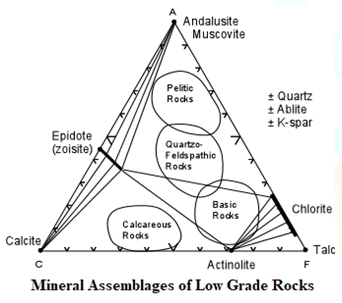
Metamorphic reactions involve changes in mineralogy or in mineral composition. A mineral assemblage is at chemical equilibrium if no such changes are occurring.
A stable mineral assemblage representative of a given set of pressure-temperature conditions a paragenesis.
Minerals within the original rock, or protolith, respond to the changing conditions by reacting with one another to produce a new mineral assemblage that is thermodynamically stable under the new pressure-temperature conditions. These reactions occur in the solid state but may be facilitated by the presence of a fluid phase lining the grain boundaries of the minerals.
The mineral assemblages in metamorphic rocks depend on four factors:
- Bulk chemical composition of the original rock.
- Temperature reached during metamorphism.
- Pressure reached during metamorphism.
- Composition of any fluid phase that was present during metamorphism.
- Time available for metamorphism.
More about mineral assemblage is discussed in the relevant parts of this book.
Metamorphic Phase Diagrams and Mineral Assemblages
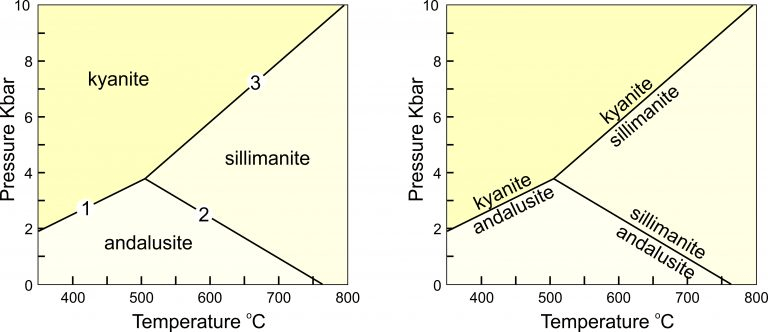
The Laws of Thermodynamics help in predicting which minerals form under particular conditions. We use phase diagrams like the ones seen in the following figure to show the conditions at which particular minerals or mineral assemblages are stable.
For example, in the following diagram, the first one depicts equilibrium for kyanite, sillimanite, andalusite, the Al2SiO5 polymorphs. At the given ranges of pressure and temperature, each polymorph is stable. The reaction lines separating the fields show the conditions at which chemical reactions occur.
The second diagram shows the same information, but the reactions are labeled, not the stability fields.