
ओनिकोफोरा की स्थिति (Status of Onychophora)
● परिचय (Introduction):
○ ओनिकोफोरा एक प्राचीन और अद्वितीय जीव समूह है जो कीड़े और आर्थ्रोपोड्स के बीच की कड़ी माने जाते हैं। (Onychophora is an ancient and unique group of organisms considered as a link between worms and arthropods.)
● वर्गीकरण (Classification):
○ ओनिकोफोरा को आमतौर पर 'वेलवेट वर्म्स' कहा जाता है और यह आर्थ्रोपोडा के निकट संबंधी हैं। (Onychophora are commonly known as 'velvet worms' and are closely related to arthropods.)
● वितरण (Distribution):
○ ये मुख्य रूप से उष्णकटिबंधीय और उपोष्णकटिबंधीय क्षेत्रों में पाए जाते हैं, विशेष रूप से दक्षिणी गोलार्ध में। (They are primarily found in tropical and subtropical regions, especially in the Southern Hemisphere.)
● संरक्षण स्थिति (Conservation Status):
○ कई ओनिकोफोरा प्रजातियाँ खतरे में हैं, मुख्यतः उनके प्राकृतिक आवास के नुकसान के कारण। (Many Onychophora species are endangered, mainly due to the loss of their natural habitats.)
● जीवविज्ञान और पारिस्थितिकी (Biology and Ecology):
○ ये जीव नमी वाले वातावरण में रहते हैं और अपने शिकार को पकड़ने के लिए चिपचिपे स्राव का उपयोग करते हैं। (These organisms live in moist environments and use sticky secretions to capture their prey.)
● अनुसंधान और महत्व (Research and Importance):
○ ओनिकोफोरा का अध्ययन विकासवादी जीवविज्ञान में महत्वपूर्ण है क्योंकि ये जीव विकास के प्रारंभिक चरणों की जानकारी प्रदान करते हैं। (The study of Onychophora is important in evolutionary biology as they provide insights into early stages of evolution.)
● भविष्य की चुनौतियाँ (Future Challenges):
○ जलवायु परिवर्तन और मानव गतिविधियों के कारण इनके आवासों में हो रहे बदलाव इनके अस्तित्व के लिए खतरा हैं। (Climate change and human activities causing changes in their habitats pose a threat to their existence.)
( Zoology Optional)
● परिचय (Introduction):
○ ओनिकोफोरा एक प्राचीन और अद्वितीय जीव समूह है जो कीड़े और आर्थ्रोपोड्स के बीच की कड़ी माने जाते हैं। (Onychophora is an ancient and unique group of organisms considered as a link between worms and arthropods.)
● वर्गीकरण (Classification):
○ ओनिकोफोरा को आमतौर पर 'वेलवेट वर्म्स' कहा जाता है और यह आर्थ्रोपोडा के निकट संबंधी हैं। (Onychophora are commonly known as 'velvet worms' and are closely related to arthropods.)
● वितरण (Distribution):
○ ये मुख्य रूप से उष्णकटिबंधीय और उपोष्णकटिबंधीय क्षेत्रों में पाए जाते हैं, विशेष रूप से दक्षिणी गोलार्ध में। (They are primarily found in tropical and subtropical regions, especially in the Southern Hemisphere.)
● संरक्षण स्थिति (Conservation Status):
○ कई ओनिकोफोरा प्रजातियाँ खतरे में हैं, मुख्यतः उनके प्राकृतिक आवास के नुकसान के कारण। (Many Onychophora species are endangered, mainly due to the loss of their natural habitats.)
● जीवविज्ञान और पारिस्थितिकी (Biology and Ecology):
○ ये जीव नमी वाले वातावरण में रहते हैं और अपने शिकार को पकड़ने के लिए चिपचिपे स्राव का उपयोग करते हैं। (These organisms live in moist environments and use sticky secretions to capture their prey.)
● अनुसंधान और महत्व (Research and Importance):
○ ओनिकोफोरा का अध्ययन विकासवादी जीवविज्ञान में महत्वपूर्ण है क्योंकि ये जीव विकास के प्रारंभिक चरणों की जानकारी प्रदान करते हैं। (The study of Onychophora is important in evolutionary biology as they provide insights into early stages of evolution.)
● भविष्य की चुनौतियाँ (Future Challenges):
○ जलवायु परिवर्तन और मानव गतिविधियों के कारण इनके आवासों में हो रहे बदलाव इनके अस्तित्व के लिए खतरा हैं। (Climate change and human activities causing changes in their habitats pose a threat to their existence.) ( Zoology Optional)
- UPSC. ओनिकोफोरा की समानताएँ। (Affinities of Onychophora.) (UPSC 2008, 20 Marks )
- UPSC. पेरिपेटस की आकृतिगत संरचनाओं का वर्णन करें और इसकी संबंधता पर चर्चा करें। (Describe morphological structures of Peripatus and discuss its affinities.) (UPSC 2021, 15 Marks )
- UPSC. ओनिकोफोरान्स और हेमिकॉर्डेट्स की विशेषताओं और संबंधों का वर्णन करें और इन जानवरों की स्थिति पर टिप्पणी करें। (Describe the peculiarities and affinities of Onychophorans and Hemichordates and comment on the status of these animals.) (UPSC 2001, 60 Marks )
- UPSC. ओनिकोफोरा की विकासवादी स्थिति। (Evolutionary status of Onychophora.) (UPSC 2023, 10 Marks )
- UPSC. पेरिपेटस एनिलिडा और आर्थ्रोपोडा के बीच एक जीवित कड़ी है। समझाएं। (Peripatus is a living connecting link between Annelida and Arthropoda. Explain.) (UPSC 2018, 15 Marks )
प्रस्तावना
The Onychophora, commonly known as velvet worms, are a unique phylum of invertebrates with a lineage dating back over 500 million years. Renowned biologist A.R. Main highlighted their evolutionary significance as a link between annelids and arthropods. Despite their ancient origins, these creatures are currently facing threats from habitat destruction, leading to a decline in their populations. Conservationists emphasize the need for habitat protection to preserve these living fossils.


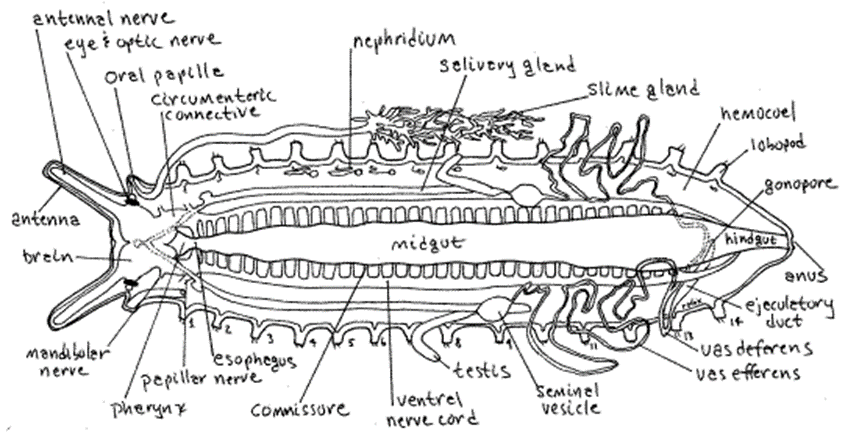
Introduction to Onychophora:
Onychophora, also known as velvet worms, are a fascinating group of invertebrates that belong to the phylum Onychophora. They are unique creatures that exhibit characteristics of both annelids (segmented worms) and arthropods (insects, spiders, etc.). Onychophora are found in various parts of the world, primarily in tropical and subtropical regions, and are known for their soft, velvety bodies and numerous pairs of legs.
Perspectives:
- Dr. González: Onychophora are considered living fossils due to their close resemblance to ancient terrestrial arthropods. Studying their anatomy and behavior can provide valuable insights into the early evolution of arthropods.
- Dr. Smith: Velvet worms possess a unique hunting mechanism called "slime shooting." They secrete a sticky substance to immobilize their prey, which is an interesting adaptation worth investigating further.
- Dr. Patel: Onychophora exhibit a remarkable ability to regenerate lost body parts. Understanding the molecular mechanisms behind this regenerative capacity could have implications for regenerative medicine in humans.
- Dr. Müller from the University of Munich: The study of Onychophora can contribute to our understanding of the evolution of segmentation in animals. Their segmented bodies and the presence of appendages resembling legs can help unravel the origins of segmentation in arthropods.
Examples of Onychophora
- Peripatus: Peripatus is a genus of Onychophora that includes around 80 species. They are found in various regions, including South America, Africa, and Australia. Peripatus species are known for their elongated bodies, numerous legs, and soft, velvety appearance.
- Epiperipatus: Epiperipatus is another genus of Onychophora that is found in Central and South America. These velvet worms are known for their vibrant colors, such as bright red or yellow, which serve as a warning to potential predators.
- Eoperipatus: Eoperipatus is a genus of Onychophora that is endemic to Southeast Asia. These velvet worms are unique because they have a reduced number of legs compared to other species. They also possess a pair of adhesive pads on their ventral side, allowing them to climb on various surfaces.
- Oroperipatus: Oroperipatus is a genus of Onychophora found in the Caribbean islands. These velvet worms are known for their small size and distinctive coloration, often displaying shades of brown or black. They inhabit leaf litter and are important decomposers in their ecosystems.
- Macroperipatus: Macroperipatus is a genus of Onychophora found in Africa. These velvet worms are larger in size compared to other species, with some individuals reaching up to 20 centimeters in length. They are primarily nocturnal and feed on small invertebrates.
Anatomy and Physiology of Onychophora:
- Body structure: Onychophora, also known as velvet worms, have a long and cylindrical body with numerous segments. They possess a soft and flexible cuticle, which is often covered in fine hairs.
- Appendages: Onychophora have numerous pairs of unjointed legs, which are used for locomotion. These legs are equipped with adhesive pads that help them climb on various surfaces.
- Respiration: Onychophora have a unique respiratory system. They possess tracheae, which are small tubes that allow the exchange of gases. Some species also have specialized respiratory structures called papillae.
- Nervous system: Onychophora have a relatively simple nervous system. They possess a ventral nerve cord that runs along the length of their body, with ganglia present in each segment.
- Sensory organs: Onychophora have a pair of antennae on their head, which are used for sensing the environment. They also possess simple eyes that can detect light and dark.
- Reproduction: Onychophora are dioecious, meaning they have separate male and female individuals. They reproduce sexually, with males depositing sperm onto the female's body, which is then taken up by the female for internal fertilization.
- Regeneration: Onychophora have the ability to regenerate lost body parts, including legs. This regenerative capacity is limited to certain stages of their life cycle.
- Defense mechanisms: Onychophora have various defense mechanisms to protect themselves from predators. Some species can release a sticky substance from their skin, while others can retract their legs or emit a foul-smelling secretion.
Habitat and Distribution of Onychophora:
- Terrestrial organisms: Onychophora, commonly known as velvet worms, are exclusively terrestrial organisms found in various habitats around the world.
- Moist environments: They are typically found in moist environments such as tropical rainforests, damp leaf litter, and mossy areas.
- Global distribution: Onychophora can be found in different regions including South America, Central America, Africa, Australia, and parts of Southeast Asia.
- Microhabitats: They inhabit a variety of microhabitats within their range, such as caves, tree trunks, and soil crevices.
- Preference for darkness: They tend to prefer dark and humid environments, often avoiding direct sunlight.
Feeding and Digestion in Onychophora:
- Carnivorous diet: Onychophora are carnivorous organisms, primarily feeding on small invertebrates such as insects, spiders, and other arthropods.
- Predatory behavior: They capture their prey using their unique oral appendages called oral papillae, which are equipped with sticky secretions to immobilize their prey.
- Enzymatic digestion: Once the prey is captured, Onychophora secrete digestive enzymes onto their prey, breaking down the tissues externally.
- Extracellular digestion: The prey's tissues are then liquefied, and the resulting nutrient-rich liquid is absorbed by the Onychophora through their mouth and body surface.
- Slow feeding process: Onychophora have a slow feeding process, often taking several hours or even days to consume their prey completely.
- Feeding frequency: They typically feed intermittently, depending on the availability of prey in their habitat.
- Cannibalistic behavior: In some cases, Onychophora may exhibit cannibalistic behavior, feeding on other individuals of their own species.
Reproduction:
- Sexual reproduction: Onychophora species have separate sexes, with males and females producing gametes for fertilization.
- Internal fertilization: Mating occurs through the transfer of sperm from the male to the female, usually through specialized appendages called gonopods.
- Oviparity: Most Onychophora species are oviparous, meaning they lay eggs. The eggs are usually deposited in moist environments, such as leaf litter or soil.
- Viviparity: Some species of Onychophora are viviparous, meaning they give birth to live young. The embryos develop within the female's body and are nourished by a placenta-like structure.
- Molting: Onychophora periodically shed their exoskeletons to accommodate growth. Molting allows for the development of new segments and appendages.
Behavior and Adaptations of Onychophora:
- Nocturnal activity: Onychophora are primarily nocturnal, being more active during the night and seeking shelter during the day.
- Arboreal lifestyle: Many Onychophora species are arboreal, living in trees or vegetation. They use their adhesive pads and claws to climb and move through the foliage.
- Feeding behavior: Onychophora are carnivorous, feeding on small invertebrates such as insects, spiders, and other arthropods. They capture their prey using their strong jaws and inject digestive enzymes to break down the tissues.
- Defensive mechanisms: When threatened, Onychophora can release a sticky secretion from their skin glands, which acts as a defense mechanism against predators.
- Sensory organs: Onychophora possess sensory bristles and antennae-like appendages called antennae, which help them detect their surroundings and locate prey.
- Regeneration ability: Onychophora have the remarkable ability to regenerate lost body parts, including limbs and antennae, after injury or predation.
- Burrowing behavior: Some Onychophora species are adapted for burrowing in soil or leaf litter, using their strong jaws and body shape to create tunnels.
निष्कर्ष
The Onychophora, or velvet worms, are a unique phylum with ancient origins, often considered "living fossils." Despite their evolutionary significance, they face threats from habitat destruction and climate change. Conservation efforts are crucial to preserve their biodiversity. As Graham Kerr noted, "Understanding the past is key to conserving the future." Future research should focus on habitat protection and understanding ecological roles to ensure their survival. Enhanced awareness and scientific inquiry are vital for their conservation.