
Deccan Volcanic Province
Deccan Volcanic Province
PYQs: Deccan volcanic province
Introduction
- The DVP is one of the Earth’s giant continental flood basalts and has a total exposed area of about 5 lakh square kilometres.
- Its estimated age is 64-65 Ma (Paleocene).
- It is generally believed that the DVP originated during Gondwanaland breakup as part of the Seychelles-India separation event and northward drift of India over Reunion plume.
- The DVP erupted on the Archean-Proterozoic shield areas of south, north-west and central India and the adjoining offshore area off the west coast.
Formation Events
- Along the West Coast rift, the south Indian shield witnessed several prior phases of magmatism before it hosted the Deccan volcanics. The first recorded event occurred at 678 Ma when gabbro, granophyre and anorthosite magmatism occurred. This was followed by granitic plutonism, almost 128 My later, i.e., at 550 Ma. Subsequently, the region hosted pegmatitic intrusions at 460 Ma. These pegmatites mark the end of the major phases of the magmatic episode.
- At 93 Ma, the West Coast region again experienced magmatism, this time involving rhyolitic and dacitic volcanics. This was followed by vast mafic volcanism and plutonism which resulted in the DVP and associated dyke swarms during the period 64-65 Ma, and covered the huge area.
- Four major rift zones are in contact with the Deccan volcanics: the Narmada-Tapi rift, the West Coast rift, the Cambay rift and the Kutch rift.
- Along the Narmada-Tapi rift zone, prior to the Deccan episode, no major magmatic event is reported.
- Instead, the horst (Satpura) and grabens (Narmada and Tapi) paved the way for enormous sedimentation, which gave rise to the Mahakoshal group of rocks.
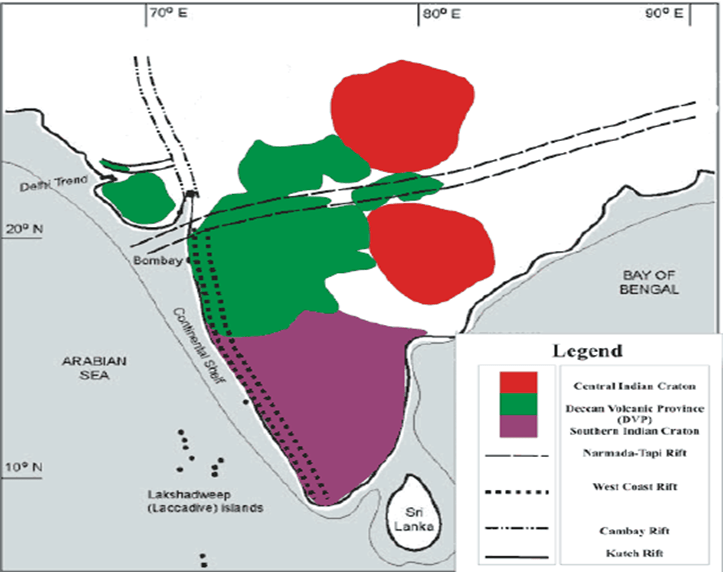
- These metasediments recorded several phases of shearing implying that the Narmada – Tapi rift is associated with intense shear deformation along an east-west trend.
- These metasediments are followed by Jurassic-early Cretaceous sediments on top of which the Deccan volcanics lie.
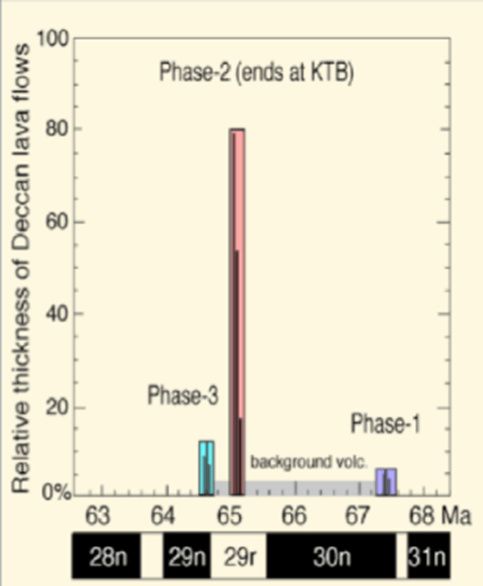
- Studies indicate that Deccan volcanic eruptions occurred in three main phases, all in relatively short period of time:
- First phase was the smallest in terms of volume (6%). Occurred around 67 Ma.
- Phase 2 with 80% of total Deccan volume occurred around 65 Ma and ended below the KT boundary.
- Phase 3 (14%) occurred about 280 ky after KT mass extinction.
- The Narmada-Tapi and West Coast rifts were reactivated in the late Cretaceous.
- The Narmada-Tapi rift zone is believed to be extending along its trend into the offshore area of the Indian west coast.
Stratigraphic position:
- Decca traps overlie unconformably over Archeans, Kalladgi group and Bhima group along the southern margin.
- In Kutch, they overlie Jurassic rocks.
- In Narmada valley they overlie the Bagh bed and near Jabalpur they overlie Lameta bed.
Classification:
- Classified into lower, middle and upper trap.
- The lower flows are around 150 m thick, found in MP and eastern areas, associated with intertrappean beds and rest over lameta beds and bagh beds.
- The middle unit is 1200 m thick lava flows and ash beds, devoid of intertrappean beds. It is exposed in Central India and Malwa region.
- Upper flows are around 450 m thick with numerous intertrappean beds, they are well developed in Mumbai, Kathiawar and kutch (NW peninsula) .
- Paleomagnetic data indicates that the geomagnetic field of Deccan traps reversed its polarity several times during eruption of lavas.
- The reversed flows dominate the lower part, while normal polarity is dominant in upper part.
- The lower and upper part can also be differentiated on the basis of chemical properties.
- The lower unit is composed of horizontal thelitic flows representing quite eruptions.
- The upper part is characterised by explosive activity.
Description:
- Flow morphological studies have led to the recognition of two main types of flows, namely ‘a’a (typically forming simple, sheet flows) and pâhoehoe (typically forming compound, pahoehoe lobate flows).
- a’a types are largely single units and are found in the peripheral parts where thickness ranges from few meters to few tens of meters.
- compound pâhoehoe flows contain many units and are found in the thicker sections of Western Ghats and central parts of the province.
- 23 lava sequences are found in Deccan Volcanic Province. 10 in Western Ghats, 5 in central India and 8 in eastern India.
- DVP is predominantly composed of quartz- and hypersthene-normative tholeiitic basalts in the plateau regions
- The associated intertrappean beds consist of black, cherty detritus and carbonate deposits of lacustrine and fluviatile origin.
- These beds are 1 to 3 m thick and extend laterally for 5-8 km.
- These beds contain a rich record of faunal and floral remains.
- The flora is rich in palm.
- Invertebrate fauna includes Physa princepi, Unio, Melania, Cypris etc.
- Vertebrates are represented by some insects and fragments of frogs, fishes and tortoise.
Thus, DVP becomes one of the most important and thus the most studied geological feature of Indian geology.