
Carbonatites
Carbonatites
PYQs: Carbonatites
- How would you distinguish between the following pairs of rocks petrographically: (IFS 2020)
- Diorites and Anorthosites
- Carbonatites and Peridotites
- How do you explain Carbonatites? Describe in detail its petrological characters. Add a detailed account on its petrogenesis. Support your answer with suitable examples. 20-2009
- Write explanatory notes on the following: Carbonatites; their mode of occurrence, petrography and petrogenesis. 30-2003
- Describe the chemical composition, physical properties and mode of occurrence Carbonatities; their mode of occurrence, petrography and petrogenesis (2003)
Introduction
- The most silica-undersaturated rocks found in alkaline provinces are the carbonatites.
- A group of igneous rocks known collectively as carbonatites are composed essentially of carbonates (>50% carbonate).
- These have such low silica contents that they cannot be classified by the schemes for silicate rocks.
- Most are composed of mixtures of calcite and dolomite, but iron carbonate may be present as well.
- Carbonatites have unique chemical compositions characterized by extreme enrichment in rare-earth elements and in niobium, phosphorus, strontium and barium.
- Carbonatites are the sole commercially mineable source of niobium, the principal source of rare-earth elements, and a possible source of phosphorus.

Classification of Carbonatites
- They range from monomineralic types containing entirely calcite or dolomite to varieties which has silicates, phosphates, REE, sulfides, fluorides.
- Carbonatites are defined in the IUGS system of classification as: igneous rocks composed of more than 50 modal per cent primary (i.e., magmatic) carbonate and containing less than 20 wt.% SiO2.
- Carbonatites are classified based on
- dominant mineral
- whole rock analysis (CaO, MgO and FeO + Fe2O3 + MnO).
- Carbonatites in which the carbonate fraction is more than 90% calcite are known as sovite if coarse-grained and alvikite if finer-grained.
- Carbonatites in which the carbonate fraction is more than 90% dolomite are known as beforsite.
- Intermediate compositions containing from 10% to 50% dolomite are referred to as dolomite-calcite carbonatite, and from 50 % to 90 % dolomite as calcite-dolomite carbonatites.
- The presence of other minerals, such as olivine, monticellite, diopside, phlogopite, perovskite, pyrochlore, and apatite can be placed in front of the name if their abundance is significant, or attention is to be drawn to a particular mineral.
- Carbonatites are also classified according to their bulk chemical composition.
- If the SiO2 content exceeds 20 %, rock is classified as silicocarbonatite.
- Many alkalic rocks associated with carbonatites contain increased carbonate contents.
- Rocks with 10-50 % of carbonate minerals acquire prefix defined by the prevailed carbonate, e.g., calcitic ijolite, carbonatic ijolite.
- Silicate rocks with less than 10 % of carbonates can be described as ijolite with calcite or ijolite with carbonate.
Texture

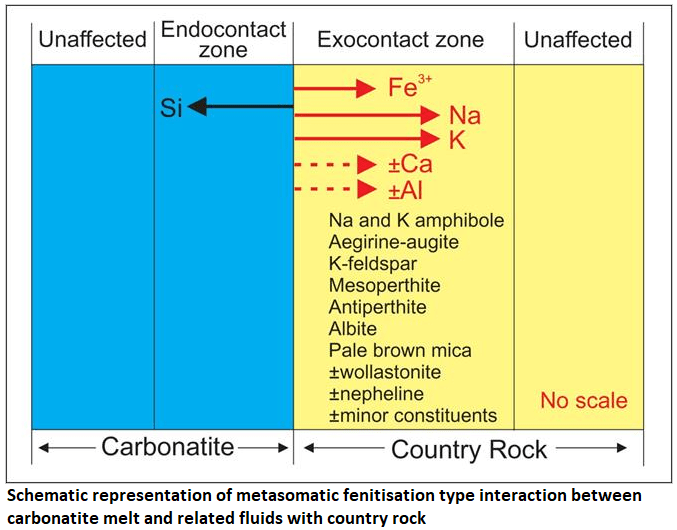
- Since the carbonatitic magmas are highly reactive and volatile rich, they have strong effects on the country rocks through which they intrude.
- Fenitization is a peculiar phenomenon common to carbonatites and alkaline rocks such as ijolite and syenite.
- Fenite is any rock produced by in-situ metasomatism of pre-existing rock.
- Fenitisation is a function of permeability and presence of fractures in the country rock.
- Fenitisation-type metasomatism commonly consists of desilication accompanied by the addition of Na, K, Fe3+, ± Ca, ± Al to the host rock that surrounds carbonatites or carbonatite-alkaline complexes.
- Field evidences suggest that the carbonatites are known to carry mantle and crustal xenoliths and xenocrysts over the surface.
- The presence of xenoliths within the carbonatites indicates their forceful injection and support their magmatic origin.
- Carbonate grains may be elongate parallel to the layering, but many have been recrystallized into smaller polygonal grains.
- Original grain sizes may still be evident from the distribution of other minerals which outlines the original grains.
- The carbonatite may be concentrically zoned from an older, outer zone of calcite carbonatite (sovite), followed by a zone of dolomite carbonatite (beforsite) and a younger core of ankerite or siderite carbonatite.
Origin of carbonatites
- Carbonatites occur as intrusive, volcanic, hydrothermal and replacement bodies.
- Carbonatite magma forms rare lava-flows and tephra, plugs, cone sheets, dykes and rare sills, but never form as a large homogeneous pluton.
- Almost all carbonatites are associated with alkaline complexes.
- There are currently three main hypotheses explaining the origin of carbonatite melts:
- Direct generation by low degree partial melts in the mantle and melt differentiation.
- Fractional crystallization of a carbonate alkaline silicate melt.
- Liquid immiscibility between a carbonate melt and a silicate melt.
- Boron isotopes studies suggests that, although most carbonatites may originate in the upper mantle, younger carbonatites (< 300 My) probably involve at least partial subducted crustal component.

Geometry of alkaline-carbonatite complex
- Most carbonatites occur in small ring complexes associated with silica-poor rocks composed essentially of nepheline and clinopyroxene.
- Carbonatites can occur as volcanics or intrusive
- The carbonatite phase usually comes after the alkaline silicate magmas.
- Many carbonatites do not have associated silicate rocks.
- Carbonatite complexes are generally < 25 km2, and are composite, with multiple intrusions of both silicate and carbonatite magma.
- Exposed intrusive carbonatites include small plugs, cone sheets, and occasional ring-dikes.
- Planar dikes or dike swarms of both silicate rocks and carbonatites commonly cut the entire intrusive complex.

- In a typical sequence, shallow early ijolite and/or nepheline syenite plugs are followed by carbonatites that cut the earlier silicate complex.
- Sovites (typically with over 90% calcite) are the most common type of carbonatite in these complexes and may represent the only carbonatite at a locality.
- The later manifestations of igneous activity in many complexes is the emplacement of dikes or cone sheets of iron-rich carbonatites, collectively called ferrocarbonatite.
- The rocks surrounding virtually all carbonatite complexes have undergone intense sodium metasomatism (metasomatic aureole); that is, their compositions have been changed by the addition of sodium.
- Silicic country rocks may be converted to aegerine-bearing syenites that are termed fenites.
- The prevalence of such metasomatized rocks around carbonatite complexes indicates that large volumes of alkali-bearing solutions are given off during cooling.
- So, alkalis (Na and K) play an important role in the genesis of carbonatites, and ferrocarbonatite
- In many carbonatite complexes, the concentrically arranged rock types become progressively poorer in silica toward the core, which is commonly occupied by carbonatite.
- A typical succession of rock types from rim to core would consist of nepheline syenite, ijolite, and carbonatite, with all rocks being cut by lamprophyric dikes.
Tectonic settings
- Carbonatites are spatially and temporally related to orogenic belts and constructive and destructive plate margins.
- They commonly occur on uplifted or domed areas, associated with major faulting and rifting related to doming.
- The link between these tectonic features and intense magmatic activity means that many carbonatites are also temporally and spatially related to large igneous provinces.
- Carbonatite activity has initiated in the earth as early as Late Archaean and gradually increased.
- Peak activities recorded between 750 Ma and 500 Ma coinciding with the Pan African orogeny and another peak starting at around 200 Ma coinciding with the Gondwana breakup.
Carbonatites in India
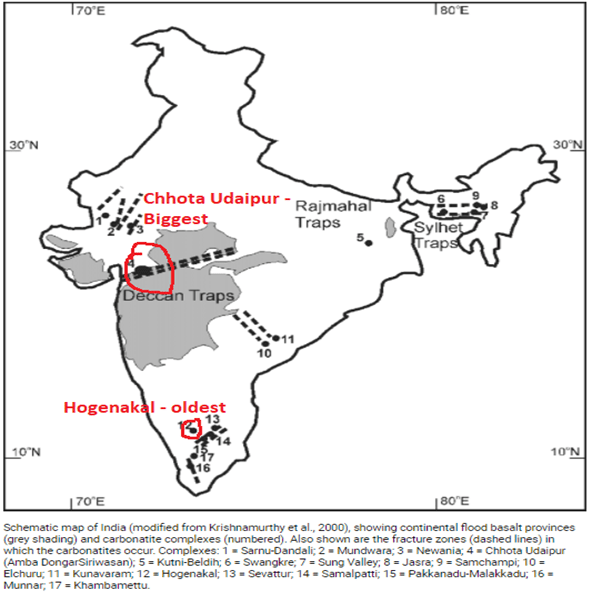
- Hogenakal is the oldest known carbonatite complex in India.
- Significant carbonatite magmatism reported in the western part of India occurred towards end of Cretaceous, coeval with the Deccan Trap basaltic eruption.
- Chhota Udaipur alkaline-carbonatite subprovince hosts biggest occurrence of carbonatites (1200 sq. kms) in the form of a near complete calcite carbonatite (sovite) ring dyke with ferrocarbonatite (ankeritic) as plugs at Amba Dongar, a large sill of carbonatite breccias at Siriwasan and small plugs and dykes in Panwad-Kawant region.
- Some other occurrences are: Sung valley, Kutni-Beldih, Jasra, etc.
Economic mineral deposits
- Carbonatites are major source of Nb, phosphate and rare earth elements (REE).
- Well known ore deposits related to carbonatites include Cu, Nb, REE, Mo, fluorite, apatite, and vermiculite.
- In addition, certain complexes also contain significant resources of other elements such as Zr, Fe, Ti, V, F, Na, Sr, Th and U, some of which can be a main or co-product.
- These deposits may be hosted internally or within the metasomized aureole.