Crystallization of Albite-Anorthite, Diopside-Anorthite and Diopside-Wollastonite-Silica Systems
PYQs: Crystallization of albite-anorthite system
- Explain with suitable examples the implications of albite-anorthite solid solutions in the understanding of crystallisation of magma. (2020)
- Using crystallization behavior of basic magma with the help of albite-anorthite system, explain normal and oscillatory zoning in plagioclase. 10-2016
- How will you explain zoning in Plagioclase by taking help of albite-anorthite system? 5-2014
- Draw the diagram of Mg2SiO4 (Forsterite) – Fe2SiO4 (Fayalite) – SiO2 and write its implication in the crystallization of basic magma. 20-2012
- Describe textures related to equilibrium and fractional crystallization process in Anorthite-Albite system. 20-2010 (may be Sec 2-3 winters, search also Tulane Perthite texture)
- Describe the crystallization of two component system of Albite-Anorthite with solid solutions. 20-2007
- If a melt in the Albite-Anorthite system has composition An 40, describe its crystallization path when crystals maintain perfect equilibrium with melt. 20-2005
- Write 150 words: Crystallization of albite-anorthite system. 10-2002
- Explain in 200 words: Albite-Anorthite silicate system. 20-2001
PYQs: Crystallization of Diopside-anorthite systems
- Discuss with the help of a suitable diagram the crystallization of a melt having composition Diopside-70 and Anorthite-30 under 1 atmospheric pressure. After complete crystallization, what would be the texture of the rock? (2021/10 marks)
- Draw a neat labelled sketch of the Diopside-Anorthite system (1 atm, dry). Describe the crystallization behaviour of an initial melt. (IFS 2020)
- Explain using phase rule the binary eutectic nature of diopside-anorthite system. Comment upon textures produced during crystallization of basaltic magmas rich in diopside and anorthite components. 10-2019.
- Explain the petrogenetic significance of the Diopside-Anorthite system (at 1 atm. dry). Draw labelled sketches. 10-2014
- Explain in 200 words – Describe sequences of Crystallization in Diopside-Anorthite binary system. Give the resultant characteristic textures of the rocks. 20-2007
- Write notes on Binary magma crystallization. 10-2004
- Explain in 200 words – Diopside-anorthite system. 20-2002
- Describe briefly: Crystallization of Anorthite-Diopside system mentioning the common textures developed by the resultant rocks with suitable examples. 14-2001
PYQs: Crystallization of Diopside-wollastonite-silica system
- What is a peritectic? Discuss an appropriate reaction that represents a peritectic. 10-2015
- If Calcite-Wollastonite-Forsterite assemblage occurs at the contract between a gabbro and a marble, name and describe two assemblages progressively away from the contact. 10-2005
Introduction
- The chemical complexity of melts makes it difficult to understand how various factors affect melt behaviour.
- So, simplify the systems to reduce the complexity and to assess the effects of individual chemical constituents and minerals during crystallization and melting.
- To understand this simplified system and contribution of each chemical constituent, we make use of phase rule.
Key terms
System:
- A system is some portion of the universe that we want to study.
- A system may be open (if it can transfer energy and matter to and from the surroundings), closed (only energy, such as heat, may be exchanged with the surroundings), or isolated (neither energy nor matter may be transferred).
Phase:
- A phase is defined as a type of physically distinct material in a system that is mechanically separable from the rest.
- A phase may be a mineral, a liquid, a gas, or an amorphous solid such as glass.
- A piece of ice is a single phase, whereas ice water consists of two phases (the ice and the water are separable).
Component:
- A component is a chemical constituent.
- For purposes of the phase rule treatment, we shall define the number of components as the minimum number of chemical species required to completely define the system and all of its phases.
- For example, ice water, although two phases, has but one component (H2O).
Variables:
- The variables that must be determined to completely define the state of a system can be either extensive or intensive in nature.
- Extensive variables depend on the quantity of material (the extent) in the system. Mass, volume, number of moles, etc. are all extensive variables.
- Intensive variables don’t depend upon the size of the system and are properties of the substances that compose a system. Intensive variables include pressure, temperature, density, etc
Degrees of freedom (or variance):
- The minimum number of intensive variables that need to be specified to completely define the state of the system at equilibrium.
Gibbs phase rule
- The Gibbs phase rule can be expressed as:
F = C – ϕ + 2
where ϕ is the number of phases in the system, C is the number of components, F is the degree of freedom, 2 represents two variables (P and T)
- The phase rule applies only to systems in chemical equilibrium.
One component system or Unary component System
- Phase diagrams are graphical representations of the equilibrium state of a system as a function of constituent component concentrations, temperature and pressure.
- A system consisting of a pure substance, a one-component system, may be represented by a single-component phase diagram.
- SiO2 system
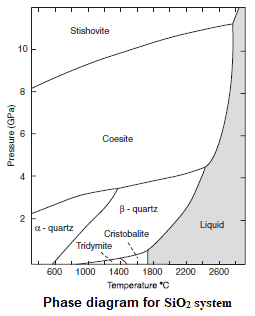
- Within any field only one phase is stable, hence phase =1, component = 1, thus, F = 2 from the phase rule equation. this area is called the divariant field (variance is two, P & T)
- The curves represent two coexisting phases at equilibrium, thus, F= 1. Univariant curve (either one of P or T determines the other).
- There are also points where three phases coexist in equilibrium. These are the invariant points. Possible only at specific T and P.
Two-component (Binary) systems
- When a second component is added to the system, it can interact with the first in different ways.
- Albite-Anorthite system or NaAlSi3O8 - CaAl2Si2O8 system exhibit complete solid solution, here both components mix completely with each other.

- End members represented by pure albite and pure anorthite.
- Addition of Ab component to pure An lowers the melting
- Addition of An to Ab raises the melting point.
- We use phase rule to analyze the behaviour of melt of intermediate composition.
- Consider cooling a melt of intermediate composition a in the figure.
- The composition in question is 60% anorthite and 40% albite, by weight. This composition may be referred to as An60.
- Here we have a single liquid of composition An60 which represents the bulk composition because the system is entirely liquid.
- From phase rule equation, C=2, ϕ = 1, F=2-1+1= 2 (because P is constant).
- Thus, composition of any component and temperature are two variables.
- These two will completely determine the system. Here, An60 and T will do the job.
- If we cool the system to point b in figure, at about 1475°C, plagioclase begins to crystallize from the melt.
- However, the composition of this plagioclase can be found by drawing an isotherm (line of constant temperature), called a tie-line, through the temperature 1475o C to point c (An87), a different composition than that of the melt.
- Here, C = 2 and ϕ = 2, F = 2 - 2 + 1 = 1. Here, we just have to specify one variable to completely determine the system.
- We can specify any one of T, liquid composition in terms of An, Ab or plagioclase.
- The phase rule here states that: for a two-component–two-phase system at a fixed pressure, the composition of both phases (in this case the liquid and the solid) depend only upon temperature.
- We observe two curves specifying the relationship between composition of liquid and solid:
- Liquidus - The line separating the field of all liquid from that of liquid plus crystals.
- Solidus - The line separating the field of all solid from that of liquid plus crystals.
- As crystallization continues with lowering of temperature, the composition of the plagioclase will change along the solidus, continually reacting with the liquid to produce crystals more enriched in the Ab component.
- Meanwhile, the composition of the liquid will change along the liquidus, thus also becoming more enriched in the Ab component.
- This reaction occurs over a range of temperature. Thus, it is called continuous reaction.
- Below 1475o C, the liquid composition changes along the liquidus from b toward g, whereas the plagioclase changes from c toward h.
- We can use the lever principle to calculate the relative amounts of the phases.
- As the temperature approaches 1340°C, the composition of the plagioclase reaches h, which is equal to the bulk composition (An60).
- Here, only a tiny amount of liquid is present. This last liquid has composition g (An22) in figure.
- Continued cooling consumes this immediately. We then lose a phase and gain a degree of freedom.
- We now have a single solid phase below 1340°C (plagioclase of composition An60) that cools along the line h-i.
- With a single phase, F = 2 - 1 + 1 = 2, so we must specify both T and a compositional variable of the plagioclase to specify the system completely.
- Equilibrium melting is simply the opposite process.
- Fractional melting is another important geologic process.
- Purely fractional melting refers to the nearly continuous extraction of melt increments as they are formed.
- If we begin to melt a plagioclase of An60 composition in figure, the first melt has composition g (An20).
- If we remove the melt, the residual solids become progressively enriched in the high-melting-temperature component. The final solid, and the liquid that may be derived from it, shift toward anorthite.
- Most natural magmas, once created, are extracted from the melted source rock at some point before melting is completed. This is called partial melting, which may be fractional melting or may involve equilibrium melting until sufficient liquid accumulates to become mobile.
Binary Eutectic System
a. The addition of second component does not lead to solid solution series most of the times.
b. A good example is Diopside (CaMgSi2O6) – Anorthite (CaAl2Si2O8) system.

c. Suppose we start cooling and crystallization of a liquid with a bulk composition of 70 wt.% An from point a in figure.
d. Since the system is isobaric, phase rule equation gives us F = 2 - 1 + 1 = 2.
e. We can thus specify T and composition to completely determine the system.
f. Cooling to 1450°C (point b) results in the initial crystallization of a solid that is pure An (point c). F = 2 - 2 + 1 = 1, just as with the plagioclase system.
g. If we fix only one variable, such as T, all the other properties of the system are fixed (the solid composition is pure anorthite, and the liquid composition can be determined from the position of the liquidus at the temperature specified)
h. As we continue to cool the system, the liquid composition changes along the liquidus from b toward d as the composition of the solid produced remains pure anorthite.
i. If anorthite crystallizes from the melt, the composition of the remaining melt must move directly away from An as it loses matter of that composition.
j. The crystallization of anorthite from a cooling liquid is another continuous reaction, taking place over a range of temperature.
k. At 1274°C, diopside begins to crystallize along with anorthite. Now we have three coexisting phases, two solids and a liquid, at equilibrium.
l. The tie-line connects pure diopside at g, with pure anorthite at h, and a liquid at d.
m. d is the eutectic point of the system.
n. A eutectic point is the lowest melting temperature for a mixture that can be obtained from the phase diagram indicating the chemical composition of any such mixture.
o. At eutectic, according to phase rule, φ = 3, so F = 2 - 3 + 1 = 0. This is an invariant point.
p. Because it is invariant, T and the compositional variables for all three phases are fixed (points g, d, and h).
q. As crystallization proceeds, the amount of liquid decreases, and both diopside and anorthite are produced.
r. This is a discontinuous reaction as it takes place at a fixed temperature until one phase is consumed.
s. When crystallization is complete, loss of liquid phase results in F=1.
t. Thus, temperature can once again be lowered, with two phases, diopside and anorthite, existing at lower temperatures.
u. In eutectic systems, the final liquid to crystallize must always be at the eutectic composition and temperature.
v. These simplified systems permit us to avoid chemical complexities and thus let us focus on some particular property.
x. Once we can understand some property, we can then add other components to approach more realistic magmatic systems.
Ternary Phase Diagram: Diopside Wollastonite Silica System
The diopside–wollastonite–silica system (CaMgSi2O6−CaSiO3−SiO2) is generally studied as part of a lime–magnesia–silica (CaO−MgO−SiO2) system.
Diopside and wollastonite appear slightly above the center of the diagram. This is a complex diagram, and it's of limited use in geology.
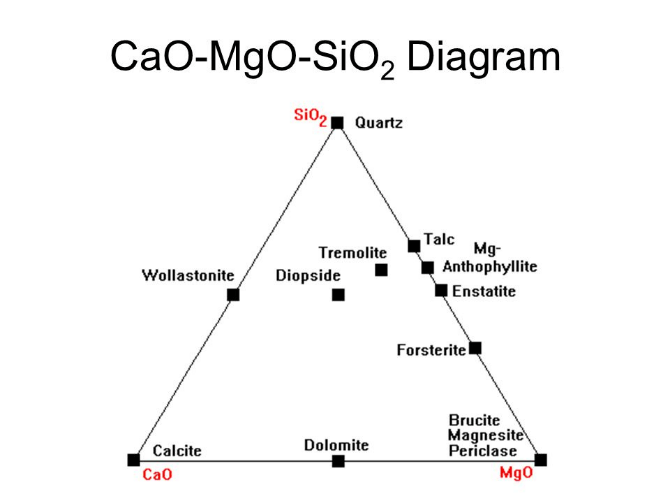
Impure dolomitic and calcitic limestone sediments may be metamorphosed by regional metamorphism; the regional metamorphism of such impure calcitic and dolomitic limestones produces a variety of silicate minerals.
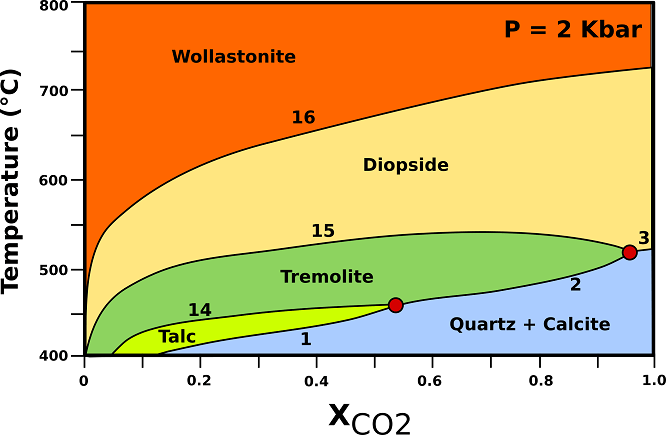
Diopside: Diopside may appear in calcite marbles at lower temperature than in dolomite marbles (650°C). The highest-grade assemblage in calcsilicate marbles is Cal + Qtz + Di. In contrast to dolomite-rich rocks, there is very little overlap between the tremolite and the diopside field in calcite marbles.
Wollastonite: wollastonite does not form in regional metamorphic rocks under closed system conditions. Even under granulite facies conditions the assemblage Cal + Qtz remains stable. Wollastonite may only form by interaction of the marble with an H2O-rich fluid. Such externally derived fluids may invade the marbles along fractures or shear zones.