
Continental Drift Theory
Continental Drift Theory
- B. Taylor (1908) first proposed this theory to reject the Contraction theory of tertiary fold mountains.
- The Concept was elaborated by Prof. Alfred Wegener of Germany (1912).
- As per the continental drift hypothesis, the Earth's continents have moved over geologic time relative to each other, thus appearing to have "drifted" across the ocean bed.
Objective
- To explain the global climate change.
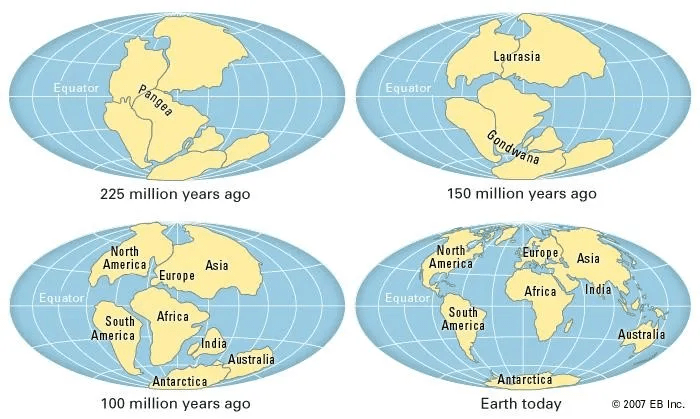

Thinkers Views
Alfred Wegener:
- Wegener proposed the Continental Drift Theory in the early 20th century.
- He believed that continents were once part of a supercontinent called Pangaea, which later drifted apart.
- Wegener's evidence included the fit of continents like South America and Africa, similar rock formations across continents, and fossil similarities.
Arthur Holmes:
- Holmes supported Wegener's theory with his idea of convection currents in the mantle.
- He suggested that these currents could cause the movement of continents, providing a mechanism for continental drift.
- Holmes' insights contributed to the development of plate tectonics theory.
Marie Tharp:
- Tharp's mapping of the ocean floor revealed mid-ocean ridges and deep-sea trenches.
- Her work provided crucial evidence for seafloor spreading, a process linked to continental drift.
John Tuzo Wilson:
- Wilson proposed the concept of transform faults, where tectonic plates slide past each other horizontally.
- His work integrated continental drift with seafloor spreading into the theory of plate tectonics, explaining the movement of continents and ocean basins.
Harry Hammond Hess:
- Hess introduced the idea of seafloor spreading as a mechanism for continental drift.
- He suggested that new oceanic crust forms at mid-ocean ridges, pushing older crust away, which supports the movement of continents.
Basic Premise
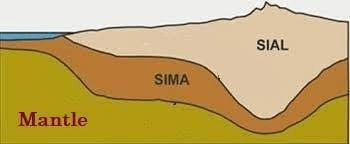
1. Sial and Sima [Edward Suess]
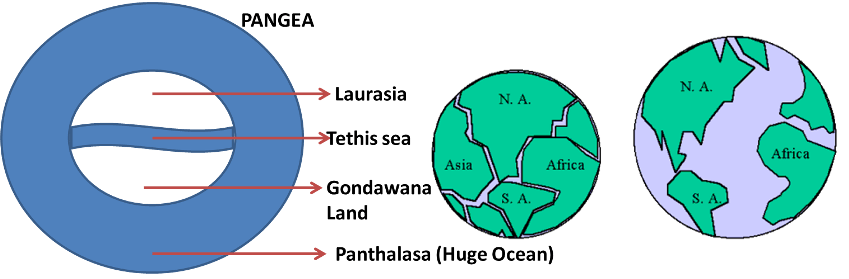
2. United landmass ‘Pangaea’, Primitive Ocean ‘Panthalasa’ in mid-Mesozoic era.
- All the continents formed a single continental mass- “Pangaea”. It means all earth.
- This supercontinent was surrounded by a mega ocean called “Panthalassa”. It means all water.
3. Forces responsible for drift
- Equatorward – gravitational forces, pole-fleeing force, and buoyancy forces.
- Westward –The continental drift was westward due to tidal currents due to the earth’s rotation.
Note: The ‘pole-fleeing force’ is caused by an increase in centrifugal force from the poles towards the equator.
The Theory: Mechanism
- Drifting: Continents are floating and constantly drifting on the earth’s surface.
- Carboniferous period: breaking of Pangaea into Laurasia and Gondwana.
- “Flight from the pole”.
- Tethys Sea was formed.
- Cretaceous period: Disruption of Gondwana (Deccan Trap)
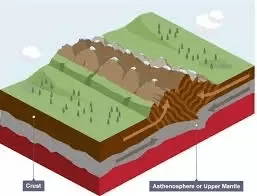
- Mountain building
- Folding of frontal edge of drifting continents due to oceanic rock resistance.
- g. Western Cordilleras by Westward drift.
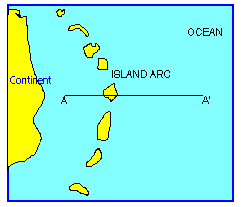
- Island arcs
- Trailing edge of drifting continent failed to keep pace with it.
- Hence, islands and festoons of South east Asia and West Indies were formed.
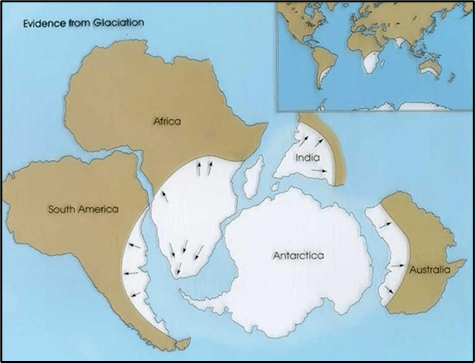
- Carboniferous glaciation
- Around south pole (Natal in South Africa).
Evidence in Support
- Jig Saw Fit:
- Juxta Position of South America and Africa: When facing each other, the shorelines of South America and Africa form a similarity.
- Similarly, when matched, Africa, Madagascar, and India’s east coast fit together.

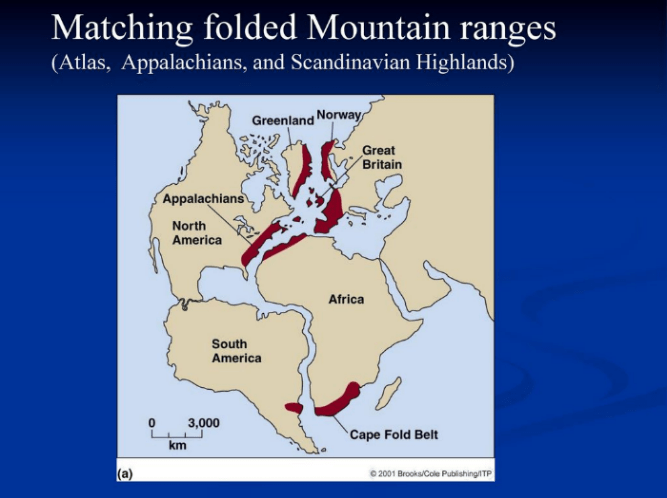
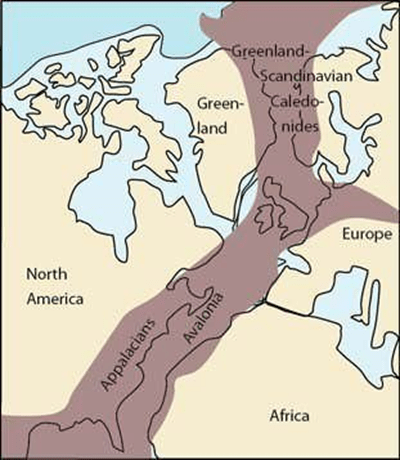
- Geological structure (similarity of age of rocks):
- Appalachian Mountains of North America and Hercynian Mountains of Europe.
- Placer gold (Brazil and Nigeria);
- There is a remarkable similarity in geological structure along the coasts of South America & West Africa.
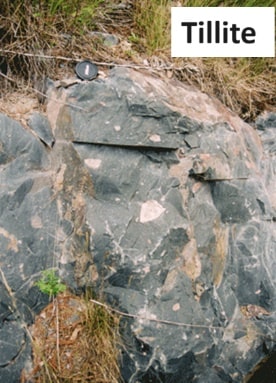
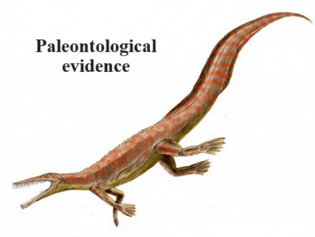
- Tillite: It is a sedimentary rock formed by the deposition of glaciers. The sediments from India are matched with Africa, Falklands Island, Madagascar, Antarctica, and Australia.
- Paleontological evidence:
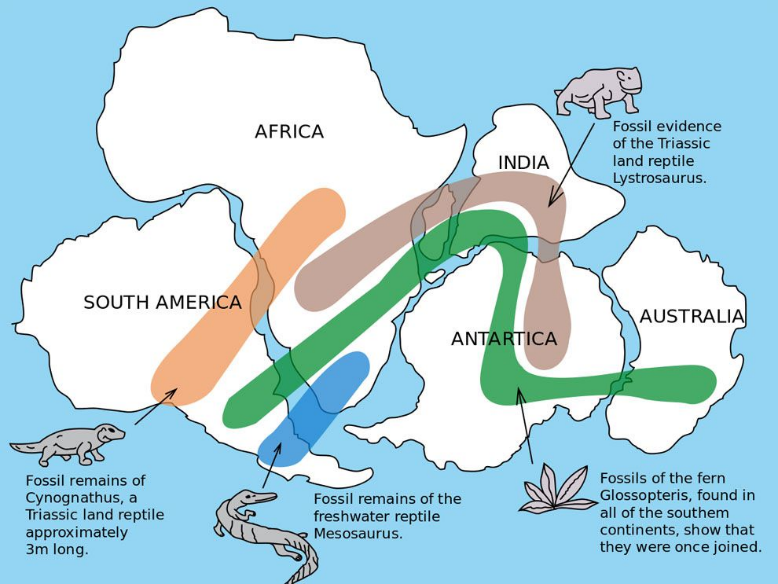
- Distribution of Fossils: Identical species and animals.
- Mesosaurus, a freshwater crocodile-like reptile: It is only found in Southern Africa and Eastern South America.
- Cretaceous period fossils and Glossopteris flora in Gondwanaland.
- Biological evidence:
- The migratory pattern of some species hints towards the joined landmass.
- g. Westward running tendency of Scandinavian Lemmings (mass suicide due to falls in the Atlantic).


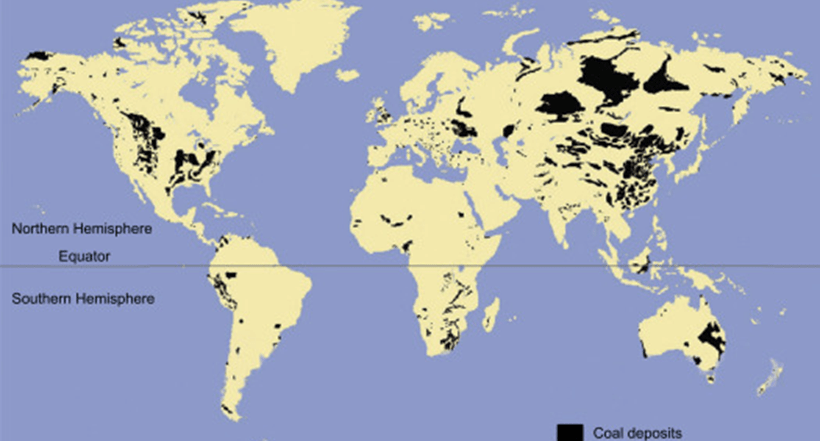
- Paleoclimatic evidence: Glacial-Carboniferous.
- Although coal deposits are formed in tropical regions, those are found in temperate and polar regions.
Criticism
- Although now accepted, the theory of continental drift was rejected for many years. The evidence in its favor were considered insufficient.
- One problem was that a plausible driving force was missing.
- A second problem was that Wegener's estimate of the speed of continental motion, 250 cm/year, was very high. The currently accepted rate for the separation of the Americas from Europe and Africa is about 2.5 cm/year.
- Furthermore, Wegener was treated less seriously because he was not a geologist.
The main criticisms are:
- Not perfect jig saw fit.
- The hypothesis was rejected for lack of any motive mechanism. However, the English geologist Arthur Holmes later proposed mantle convection for that mechanism.
- The forces not enough to drift continent.
- Directional chronological sequence of drift not explained.
- Contrasting viewpoints on mountain building.
- No explanation of intra-continent mountain.
- Wrong postulation of Sial and Sima.
- No account for Pre-Carboniferous era.
Evaluation
- Wegener departed from the orthodox geological ideas like teleological theory.
- Although the theory was mostly rejected, the central theme of horizontal displacement was retained. It became the basis of plate tectonic theory.
- The idea of continental drift has been subsumed into the science of plate tectonics.