
Petrogenetic Significance of The Textures and Structures of Igneous Rocks
Petrogenetic significance of Textures of Igneous Rocks
PYQs: Petrogenetic significance of the textures and structures of igneous rocks
- What do you understand by the term texture of a rock? How do you relate the textures of igneous rocks with the process of magmatic crystallization? (2020)
- What are ‘porphyritic’ and ‘vitophyric’ textures? Describe with the help of suitable sketches. Comment on petrogenetic significance of vitophyric texture. 10-2019
- Write notes on porphyritic and poikilitic texture of igneous rocks (with suitable labelled sketches). Comment on their petrogenetic significance. 10-2016
- Describe (with neat sketches) the following structures of igneous rocks. 1. Pillow structure 2. Rapakivi structure. 10-2016
- Elucidate the petrogenetic significance of the following. 1. Porphyritic texture 2. Perthitic texture 3. Corona structure. 5+5+5-2014
- Write note with diagram – Trachytic and graphic texture. 10-2012
- With the help of neat sketches, bring out the difference between porphyritic and poikilitic type of igneous rocks. 10-2012
- Write explanatory notes on Ophiolite complexes. 10-2012 (notes)
- Discuss various types of textures found in volcanic rocks. Comment on their petrogenetic significance. 20-2011
- What role do gases play in volcanism? What does “pillow structure” indicate about the environment of volcanism? What determines the viscosity of lava? Why are extrusive rocks fine grained? 30-2010
- Describe Ophitic and Sub-Ophitic textures and bring out their petrological significance. 10-2009 (150 words) (pg 48 winters)
- Write detailed notes on the following: Igneous structures citing suitable examples. 20-2005
- Explain in 200 words – Textures in volcanic rocks: petrogenetic significance. 20-2003
- Explain the following: (b) Petrogenetic significance of any five textures of igneous rocks. (2002)
- Explain petrogenetic significance of any five textures of igneous rocks. 10-2002
- Give an account of petrogenetic significance of important inequigranular textures of igneous rocks with suitable examples and neat sketches. 10-2001
Introduction
- Texture defines the size, shape and arrangement of grains of minerals in particular rocks.
- Texture of a magmatic rock is microscopically observed summary of features reflecting conditions of the magma crystallization, mainly size, shape, and distribution of mineral grains.
- Rate of cooling of magma defines the size of grains in igneous rocks.
- The coarser grain is the result of slower rate of cooling.
- The finer grain is the result of fast rate of cooling of magma.
- It is a result of various processes that controlled the rock’s genesis and, along with mineralogy and chemical composition, provides information that we may use to interpret the rock’s origin and history.
- Textures are also used to classify igneous rocks.
- Textures are grouped into two categories:
- Primary textures: Those textures occur during crystallization of magma and result from interactions between minerals and melt.
- Secondary textures: These textures occur due to the alterations that take place after the rock is completely solid.
Formation and growth of crystals
- The formation and growth of crystals, either from a melt or in a solid medium (metamorphic mineral growth), involves three principal processes:
- initial nucleation of the crystal,
- subsequent crystal growth, and
- diffusion of chemical species (and heat) through the surrounding medium to and from the surface of a growing crystal.
- All these rates depend on the temperature of the system.
- Nucleation and growth cannot occur until temperatures are below the temperature at which equilibrium crystallization begins.

- Three cases arise, as shown in figure:
- Slow cooling results in only minor undercooling (Ta), so that rapid growth and slow nucleation produce fewer coarse-grained crystals. This would be called a phaneritic texture.
- Rapid cooling permits more undercooling (Tb), so that slower growth and rapid nucleation produce many fine-grained crystals. If it is fine-grained, the texture is said to be aphanitic.
- Very rapid cooling involves little if any nucleation or growth (Tc) producing a glass. A completely glassy texture is called holohyaline
- Two stages of cooling, i.e., slow cooling to grow a few large crystals, followed by rapid cooling could result in a porphyritic texture, a texture with one size considerably larger than the other.
- In a porphyritic texture, the larger grains are called phenocrysts and the material surrounding phenocrysts is called groundmass or matrix.
- If the phenocrysts are set in a glassy groundmass, the texture is called vitrophyric.
- If the phenocrysts contain numerous inclusions of another mineral that they enveloped as they grew, the texture is called poikilitic.
- The host crystal may then be called an oikocryst.


- In a rock with a porphyritic texture, phenocrysts are divided into:
|
microphenocrysts |
0.03 – 0.3 mm |
|
phenocrysts |
0.3 – 5 mm |
|
Megaphenocrysts |
> 5 mm |
- Another aspect of texture, particularly in medium to coarse grained rocks is referred to as fabric. Fabric refers to the mutual relationship between the grains.
- Three types of fabric are commonly referred to:
- If most of the grains are euhedral - that is they are bounded by well-formed crystal faces. The fabric is said to be idomorphic
- If most of the grains are subhedral - that is they bounded by only a few well-formed crystal faces, the fabric is said to be hypidiomorphic
- If most of the grains are anhedral - that is they are generally not bounded by crystal faces, the fabric is said to be allotriomorphic
The texture of igneous rocks depends upon-
- Degree of crystallization
- Grain size
- Crystal shape
- Mutual relationship between grains of mineral
Size of Grains
- Granularity defines the absolute size of the grains which can vary in igneous rocks.
- It can range from submicroscopic size to yards.
- The grains of the minerals crystallize instantly in the rapid cooling of magma. This is because the size of the crystals are very small i.e. less than 1mm in size.
- If there is rapid cooling in magma the crystals are not able to crystallize and in this way they form glassy texture.
- The type of granularity exists in igneous rock- Phaneric, and Aphanitic.
- Phaneric: The crystals of the rock can be seen by naked eyes or by hand lens.
- Coarse grain texture: Grains of rock >5mm. This type of texture is mainly seen in intrusive igneous rocks.
- Medium grain texture: Size of the grain ranges between 1-5mm.
- Fine grain texture: Size of the grain <1mm and it is mostly seen in extrusive igneous rocks.

- Aphanitic: If the crystals of the rocks are not visible by the naked eyes and we need petrographic microscope to study them.
- Microcystalline texture: If the grains of the minerals is very fine and can be seen under the microscope.
- Cryptocrystalline texture: The minerals grains are very infinitesimally small that even not be visible under microscope but they can be seen under the polarized light.

Shape of the Crystals
The shape of the crystals can be determined by the development of their faces.
- Euhedral: If the crystal faces are well developed in the rock.
- Subhedral: If the faces of the crystals are partly developed.
- Anhedral: If the crystals faces are absent in the rock.

Euhedral

Subhedral

Anhedral crystal
Mutual Relations of Grains
The texture of a rock can be defined by the crystals shape, their size and the mutual arrangement.
Equigranular Texture
It is seen if the texture display the grains of more or less same size.
- Panidiomorphic Texture: If the grains in the rocks are euhedral. This texture is mostly seen in Lamprophyres.
- Hypidiomorphic Texture: If the grains in the rocks are subhedral. This texture is mostly found in Plutonic rocks such as Syenites, Granites.
- Allotriomorphic Texture: If the grains in the rocks are anhedral. Mostly seen in Aplites.
- Orthophyric Texture: If the Felspathic rocks such as Plagiophyers consists of fine grain Panidiomorphic textures.
- Felsitic Texture: If the rock consists of uniform cryptocrystalline matter as whole.

Panidiomorphic

Hypidiomorphic

Allotriomorphic
Inequigranular Texture
It is seen if igneous rock consists of mineral grains which are highly variable in size.
i. Porphyritic Texture:
- If in the igneous rock, the large crystals of the minerals are enveloped by small crystals or matrix or glassy groundmass.
- Phenocryst = Large crystals, groundmass = fine grained material.
- This textures occurs when there is growth seen in some crystals before the growth in the main mass of the magma which consolidates into the finer materials or groundmass.
- This type of texture can found in volcanic and hypabyssal igneous rocks.

ii. Poilikilitic Texture:
- When the small crystals in the rock are enclosed with irregular orientation within the large crystals.
- This texture is mainly found in syenites and monzonites where the host mineral is orthoclase.

iii. Ophitic Texture:
- It is a type of Poikilitic texture where the large crystals of Augite enclose various thin lathes of Plagioclase.
- Subophitic: If the lathes of Plagioclase are partially enclosed in Augite.
- The texture is commonly seen in Dolerites.

iv. Intergranular Textures:
- The different lathes of minerals are arranged in such an order that they form the networking with polygonal and triangular spaces left between them.
- These interspaces are filled with small crystals of Olivine and iron oxide etc.
- Intersertal Texture: If the interspaces are filled with fine grained serpentinous and chloritic materials.

Intergranular texture
Directive Textures
The flow of lava during the phase of consolidation produces this texture.
Trachytic texture
- The laths of feldspar are arranged in the direction of flow of lava.
- Example: Commonly found in trachyte (volcanic igneous rock).
Hyalopilitic Texture
- The laths of feldspar are mixed with glassy groundmass. Mostly seen in volcanic rocks.

Fig. Directive texture
Intergrowth Texture
- When the quartz and orthoclase grains crystallize simultaneously, the intergrowth pattern is seen.
- Orthoclase is responsible for embedding skeletal of quartz grains known as graphic texture.
- Orthoclase and quartz show same optical orientation.
- Example of graphic texture: Graphic granite.

Fig. graphic texture
Some important textures found in igneous rocks
- Ultramafic lavas, when quenched, may develop spectacular elongated olivine crystals, called spinifex The unusual size may be caused by rapid growth of the simple olivine structure in a very low-viscosity magma, not by slow cooling.
- Rapakivi texture involving plagioclase overgrowths on orthoclase, occurs in some granites where the plagioclase preferentially forms on the structurally similar alkali feldspar rather than nucleating on its own.
- It forms by a process of epitaxis, a term used to describe the preferred nucleation of one mineral on another preexisting mineral.
- Spherulitic texture is a texture in which needles of quartz and alkali feldspar grow radially from a common center.
- Variolitic texture of radiating plagioclase laths in some basalts.
- Pegmatitic texture: It occurs during magma cooling when some minerals may grow so large that they become massive (the size ranges from a few centimetres to several metres). This is typical of pegmatites.
- A pegmatite is a holocrystalline intrusive igneous rock composed of interlocking phaneritic crystals usually larger than 2.5cm in size.
- Most pegmatites have a composition that is similar to granite

Compositional zoning
- Compositional zoning occurs when a mineral changes composition as it grows during cooling.
- If equilibrium between the crystal and the melt is maintained, the composition of the mineral will adjust to lowering temperature, producing a compositionally homogeneous crystal.
- Chemical zoning occurs when equilibrium is not maintained, and a rim of the new composition is added around the old.
- The composition of plagioclase in equilibrium with a melt becomes more Na rich as temperature drops.
- The expected zonation here would be from a more anorthite-rich core toward a more albite- rich rim. This type of zoning is called normal zoning.
- Reverse zoning is the opposite of normal zoning, with more sodic inner and calcic outer It is common in some metamorphic plagioclase.
- Oscillatory zoning is the most common type of zoning in plagioclase.
- Oscillatory zoning happens when the composition varies cyclically from core to rim, producing concentric rings of lower and higher extinction angle and interference color.
- Oscillatory zoning can be explained as a crystal’s response to fluctuating external conditions.
- Reaction rim: Reaction rim is a genetic term for a border of secondary minerals formed at the margin of a primary grain in an igneous or metamorphic rock.
- Its use implies that the secondary minerals have formed as a result of reactions between the primary grain and the adjacent primary grain, a fluid, or a melt.


Textures based on Crystallization Sequence:
- Early forming minerals in melts that are not significantly undercooled are surrounded completely by liquid and develop as euhedral crystals, bounded on all sides by crystal faces.
- As more crystals begin to form and fill the magma chamber, crystals will inevitably come into contact with one another.
- The resulting mutual interference impedes the development of crystal faces.
- This leads to formation of subhedral (intermediate texture with some crystal face-formation) or anhedral (no well-formed crystal faces) crystals form.
Texture based on inclusion relationship
- Igneous inclusions forms at an earlier stage than the host that enveloped them.
- Ophitic texture refers to the envelopment of plagioclase laths by larger clinopyroxenes and is commonly interpreted to indicate that the clinopyroxene formed later.
- A granophyric texture is an intergrowth of quartz and alkali feldspar in an igneous rock that is less well defined than a graphic texture and often is somewhat radiating.
- Granophyric texture looks like branching quartz rods set in a single crystal of feldspar.
- Graphic texture is commonly created by exsolution and devitrification and immiscibility processes in igneous rocks. It is called 'graphic' because the exsolved or devitrified minerals form lines and shapes which are reminiscent of writing. Can be seen in hand specimen.

Texture due to movement of crystals and melt
- Flow within a melt can result in alignment of elongated or tabular minerals, producing foliated (planar) or lineated mineral textures.
- If lath-shaped microlites (typically plagioclase) in a volcanic rock are strongly aligned (commonly flowing around phenocrysts), the texture is called trachytic.
- Mingling of two magmatic liquids (either in a chamber or as flows) can create flow banding (alternating layers of different composition.
- Banding and mineral alignment can also result from flow near magma chamber walls.

Cumulate Textures
- Cumulate rocks are igneous rocks formed by the accumulation of crystals from a magma either by settling or floating.
- Types of cumulates are distinguished based on the extent to which the early-formed crystals, once accumulated, grow prior to ultimate solidification of the interstitial liquid.
- Orthocumulate texture: cumulate plagioclase and olivine crystals enclosing quenched basaltic liquid.
- Adcumulate texture: Here all trapped liquid was able to exchange material with the nearby magma, allowing overgrowths to fill the trapped liquid pockets. This results in a rock almost completely made of the cumulate minerals.
- Poikilitic texture: In this texture the larger grain encloses smaller mineral grains. The larger or host or house crystal is known as oikocryst and the enclosed crystals are known as chadocrysts.

Volcanic Textures
- Volcanic rocks cool quickly and tend to form numerous small crystals.
- Upon eruption, the liquid crystallizes to fine tabular or equant crystals comprising the groundmass.
- The groundmass crystals are called microlites (if they are large enough to be birefringent) or crystallites (if they are not).
- Microlites form more easily in basaltic lava eruptions, which have relatively low viscosity. Low viscosity permits rapid nucleation and ion migration, necessary for crystal formation.
- Basalts crystallize readily because they are very hot and are dominated by minerals with simple structures.
- The result is a texture with a dense network of elongate plagioclase microphenocrysts and granular pyroxenes.
- Ophitic texture refers to a dense network of lath-shaped plagioclase microphenocyrsts included in larger pyroxenes, with little or no associated glass.
- This grades into subophitic (smaller pyroxenes that still partially envelop the plagioclase) and then into intergranular texture.
- When the corners of randomly oriented plagioclase laths touch each other to form a network and the polygonal interstitial spaces are filled by granular anhedral pyroxene, the texture is known as intergranular texture.
- Intergranular texture grades into intersertal texture when the interlath polygonal spaces are filled-up by glass or its devitrified product.
- When glass becomes sufficiently plentiful that it surrounds the microlites or microphenocrysts (plagioclase), the texture is called hyalo-ophitic.
- Hyalo-ophitic grades into hyalopilitic as the glass fraction becomes dominant, and crystals occur as tiny microlites.
- The textural terms described above are usually applied to randomly oriented crystals.
- Trachytic texture: In basaltic rock, the calcic plagioclase, glassy and cryptocrystalline material show parallel or sub-parallel alignment and preferred orientation due to flowage of magma in molten state which is referred as to trachytic
- Trachytic texture occurs in rocks that are rich in alkalies. Trachytic textures are often attributed to flow orientation.

Textures based on degree of crystallization
On the basis of degree of crystallization, the igneous textures are classified as- Holocrystalline, Hemicrystalline and Holohyaline.
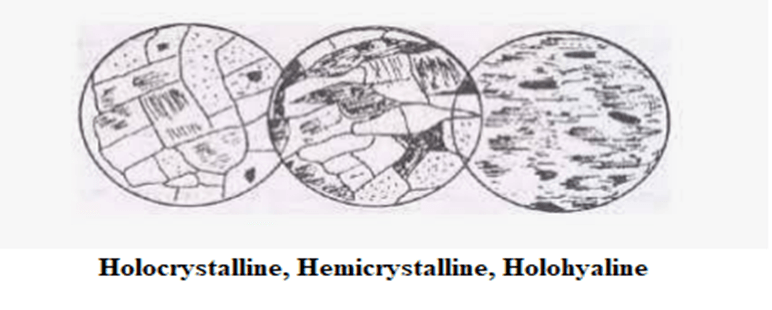
Holocrystalline Texture
- The texture depicts the rocks is composed entirely of crystals.
- Most of the intrusive igneous rocks display this texture.
- Examples: Granite, Syenite.

Microcrystalline or Hemicrystalline or Hypocrystalline Texture
- When the rock comprises partly of crystalline and partly of glassy material, e.g., dolerite, basalt.
- Examples: Rhyolite, Trachyte.

Holohyaline Texture
- The rocks exhibiting this texture are entirely made up of glassy matter or non-crystalline matter (like crystallites and microlites)
- It can be seen in the Obsidian and the Sills composed of pitchstone.

- Crystallinity is largely controlled and governed by following factors:
- Rate of cooling
- Depth of cooling and volume of magma
- Composition and viscosity of magma
- Trapped bubbles of escaping gas create subspherical voids in volcanics, called vesicles.
- Bubbles tend to rise in less viscous basaltic magmas and thus concentrate near the surface of basaltic flows.
- There is a complete gradation from basalt to vesicular basalt to scoria, with increasing vesicle content.
- Vesicles filled with later mineral growth, typically secondary zeolite, carbonate, or opal, are called amygdules. The silicic counterpart of scoria is pumice.

Secondary textures (post magmatic)
- Secondary textures are those that develop after the igneous rock is entirely solid. These processes do not involve melt.
- The process of crystallization does not necessarily cease when the magma becomes solid.
- If the temperature is high enough, recrystallization and both chemical and textural re-equilibration take place.
Exsolution textures
- Exsolution textures represent chemical breakdown of an originally homogenous solid solution as it cools down.
- During cooling in solid state, exsolution (unmixing) takes place and the intergrowth is produced.
- The most common example occurs in alkali–feldspars, where unmixing results in separation of Na rich and K-rich segregations.
- Perthitic texture: Exsolution of alkali feldspar and albite produces perthites which comprises thin strings, films and patches of albite oriented within K-feldspar host, e.g. orthoclase/ microcline.
- Microperthitic texture is the texture which is resolvable under the microscope. It is commonly developed in coarse plutonic rocks like granite, gabbro.
- Antiperthite texture: It is the reverse of the perthitic texture. In this case the patches of orthoclase or microcline occur within plagioclase and gives rise to antiperthic intergrowth.

Secondary Reactions and Replacement
- Since, igneous rocks cool through a temperature range, there are secondary reactions occurring which are not product of a later metamorphic event.
- This is called autometamorphic processes as they are a part of natural igneous cooling.
- Autometamorphic processes are more common in plutonic rocks than in volcanics because they remain at elevated temperatures for a longer time.
- Most autometamorphic reactions involve minerals at moderate temperatures in an environment in which H2O is either liberated from residual melt or externally introduced.
- Such alterations which involve hydration are called deuteric alterations.
- Some of the alterations are:
- Pyroxene is a common primary mafic mineral in a variety of igneous rocks. If H2O penetrates at modest temperatures, a deuteric alteration of pyroxene to amphibole results, called uralitization.
- Biotitization is a process of hydration/deuteric alteration that produces biotite, either directly from pyroxene, or, more commonly, from hornblende.
- Chloritization is the alteration of any mafic mineral to chlorite.
- Seritization is the process by which felsic minerals (usually feldspars of feldspathoids in igneous rocks) are hydrated to produce sericite. Sericite is a term applied to any very fine-grained white mica.
- Symplectite is a term applied to fine-grained intergrowths resulting from the combined growth of two or more minerals as they replace another mineral.
- Myrmekite is an intergrowth of dendritic quartz in a single crystal of plagioclase.
- The quartz appears rod-like in thin section, and numerous adjacent rods go extinct in unison, indicating that they are all parts of a single quartz crystal.
- Myrmekites are very common in granitic
- As the plagioclase replaces the K-feldspar, SiO2 is released, thereby producing the quartz.

Devitrification
- Devitrification is the secondary crystallization of glass to fine-grained mineral aggregates.
- Glasses typically are not stable at low temperatures, thus a readjustment of the atomic arrangement may take place to form more stable structures.
- This devitrification process is very slow, but over millions of years, a glass will form a completely crystalline mass.
- Devitrification in more silicic glassy rocks produces a microgranular mass of small, equidimensional grains of inter-locking feldspar and silica minerals called felsitic texture and such rocks are known as felsites.
- Perlitic cracks in crystals are evidence of their original glassy condition.
- Perlitic cracks refers to curved or spherical cracks found in glassy or devitrified igneous rocks, formed by contraction during rapid cooling of the magma.
- Spherulitic texture: Devitrification of glass may also produce radial aggregates of fibrous or needle-like crystals (commonly cristobalite or tridymite plus feldspar) called spherulites. This texture is common in glassy felsic volcanic rocks.
- Spinifex texture: This texture is characteristic of komatiitic rock (an ultramafic rock of volcanic origin).
- Spinifex texture is defined as randomly oriented, extremely fine-grained, slender hollow crystals or acicular olivine phenocryst formed by rapid cooling or quenching of ultramafic lavas.

Petrogenetic significance of Structures of igneous rocks
Introduction
- Igneous rocks can be studied on scales from the microscopic to the global.
- The term structure is very much different from texture.
- Structure is used for larger features of a rock, observed in the field on large outcrops like flow banding, layering, vesicles, etc. If you observe a basaltic outcrop you would describe its structure as vesicular or amygdaloidal.
- The lava once reaches the earth surface, it consolidates and form the igneous rocks of different types. If they are not capable to reach the earth’s surface then they form different structures.
The structures of igneous rocks are large scale features which are affected by different factors-
- Viscosity of magma
- Magma Composition
- Temperature and Pressure
- Volatile gases
Forms of igneous bodies can be grouped into:
- Extrusive: when bodies form on Earth’s surface
- Intrusive: when bodies form within the Earth.
The various igneous structures are-
- Vesicular and Amygdaloidal structures.
- Pillow lava
- Blocky or aa lava, and Ropy or Pahoehoe lava
- Joint and sheet structure
- Columnar structure
- Pegmatites
- Spherulitic
- Orbicular structure
- Banding
- Reaction rim
- Xenolithic structure
Extrusive, or volcanic, processes, products, and landforms
- Volcanic products and landforms will be discussed in Paper 1 general geology (volcanic products).
- Brief description here.
- The style of volcanic eruption, and the resulting deposits, are determined by the physical properties of the magma, particularly the viscosity and volatile (gas) content.
- The combination of viscosity and volatile content determines whether a volcanic eruption will be violent or quiescent.
- Basaltic magma is of low viscosity; thus, the eruptions are calm as large bubbles or bursts.
- Rhyolitic magmas are highly viscous, so they resist volatile escape until gases overcome the resistance, resulting in explosive
- Some landforms formed by volcanic eruptions are crater, shield volcanoes, stratovolcano, pyroclastic cones, maar, tuff rings, tuff cones, domes, calderas.
Vesicular and Amygdaloidal Structures
- The gases need to be escaped when the magma contains the lot of volatiles or gases in them and it comes on the earth surface.
- Due to the decrease in the pressure, these volatiles escape in the atmosphere and the consolidation process take place.
- Due to this the rock consists of various small vesicle and cavities left behind at the surface which are spherical and irregular in shape and size.
- Due to the presence of vesicles they give rise to vesicular structure.
- Example: Vesicular basalt, pumice, scorcia.
- After the certain period of time when these vesicles are filled up with secondary minerals which are found at low temperature such as quartz, zeolite, calcite etc. then the structure is called amygdaloidal structure and the infillings are called amygdales.
- Example: Amygdaloidal basalt.

VESICULAR STRUCTURE

AMYGDALOIDAL STRUCTURE
Scoriaceous and Pumiceous Structures
- Scoria is a clinkery looking extrusive, highly vesicular basalt.
- If the vesicles are so abundant that they make up over 50% of the rock and the rock has a density greater than 1, then the rock is said to be scoriaceous.
- Pumice is a volcanic rock containing numerous vesicles that remain after trapped volatiles escape from the cooling lava.
- Such structures are characteristic of highly siliceous lavas because they are highly charged with volatiles.
- If vesicles are so abundant that they make up over 50% of the rock and the rock has a density less than 1 (i.e. it would float in water), then the rock is known as pumiceous.
- Vugs are angular cavities in a rock formed by collection of volatile fluid between existing crystals, the resulting structure is known as vuggy structure.

Lava flow features: aa and Pahoehoe lava (Blocky lava and Ropy lava)
Lava flows are more quiescent or silent than the explosive volcanic eruptions. Flows occur mostly in lavas with low viscosity and low volatile content. They are thus most common in basalts.
Pahoehoe or ropy lava
- In the early stages of eruption, magma emerges as incandescent lava at about 1200°C. These lavas are mainly composed of basaltic composition and exhibits low viscosity and high velocity.
- This runny lava cools and forms a smooth black surface, which may develop a corrugated, or ropy, appearance. Such lavas are called pahoehoe or ropy lava.
- Due to high velocity they flow and extend in large areas, and thus on solidification they consist of smooth surface.

aa or blocky lava
- As the lava cools further and the viscosity increases, the flows begin to move more slowly and develop a thicker scoriaceous crust.
- As the fluid interior continues to move, the crust breaks up into blocks of clinkery scoria, which ride passively on the top.
- These lavas are mainly composed of silica composition.
- The motion is like a conveyor belt, in which the surface slides beneath the front of the advancing flow.
- Due to high viscosity they are not extended in large distance and solidify quickly over the rough surface which gives them the blocky appearance.
- The rubble-like lava flows that result are called aa or blocky lava.
- Example: Andesite, rhyolite.
Remarks
- Aa and pahoehoe are end members of a continuous series of flow-top characteristics.
- Pahoehoe is restricted to basalts of low viscosity, but aa can occur in flows of different compositions.
- Numerous basalt flows begin as pahoehoe and turn to aa further from the vent as they cool and slow down.
Lava Tunnel
- On cooling and consolidation of lava, the enclosed fluid lava drains out through some channel known as lava tunnel.
- The hardened basaltic flows commonly contain cave-like tunnels called lava tubes that are supposed be conduits carrying lava.
- These conduits develop in the interior of a flow where temperatures remain high long after the molten material on the surface hardens.

Flow foliation
- Thick intermediate-to-silicic lavas typically exhibit flow foliation, which may consist of aligned phenocrysts, bands of different color, or pumice bands.
- These layers could have been different batches of mingled magmas or portions of the same magma with a different temperature, composition, or content of crystals, H2O, or oxygen.
- The layers were then stretched, sheared, and/or folded during flow.
Jointing and Sheet structures

- The joints are the small scale structures formed by the stress applied on any type of igneous rocks.
- There can horizontal, vertical or inclined joints.
- The joints which are horizontal in nature they are formed closely spaced and thus they resemble sheet like structure and have the property of parallelism.
- The sheets are thinner at the ground surface.

Fig. Joints
Columnar structure
- Subaerial lava flows (those that flow on land) and some shallow sheet-like intrusions may develop a characteristic jointing pattern called columnar joints.
- Because the top and bottom of the flow cool before the central layer, the outer areas contract, but the center doesn’t.
- This results in tensional stresses that create regular joint sets as blocks pull away from one another to create polygons separated by joints.
- The joints propagate down from the top and up from the bottom as cooling progresses toward the center.
- These structures are characterised by the intersection of closely spaced sets of joints which are in the form of polygon or columns.
- These structures are mainly seen in shallow intrusions and ashflow tuffs.
- Example: Basalt

Pegmatites
- These are the igneous rocks which composed of large phenocysts of minerals which are rarely found in other rocks.
- These are formed at the final stage of crystallization of magma.
- The large crystals are formed due to the slow rate of crystallization of magma.
- Pegmatites consist of crystals which consist of low viscosity fluids.
- Grain size= ~ 1cm in diameter.
- Example: Syenite and Granite.

Fig. Pegmatite
Spherulitic Structure
- The structure arises due to the aggregation of two minerals (mainly seen in quartz and feldspar).
- One mineral crystallize first and then second mineral thus take place from the liquid or glass exit between the fibres.
- The shape of spherulite is radiating needle like crystals mainly seen in felsic igneous rocks which are volcanic and glassy in nature.
- Example: Pitchstone, Obsidian

Orbicular Structure
- This type of structure is mainly seen in phanerocrystalline or holocrystalline rocks which consist of orbicules in numerous quantities.
- These igneous rocks sometimes mined as ornamental stone.
- Orbicules are in the form of concentric circles forming layers after layers around the nucleus in the during the cooling of magma.
- Example: Orbicular granite

Fig. Orbicular Structure
Pillow lava
- This is a peculiar ellipsoidal pillow-shaped structure which occurs mostly in basic/mafic lavas.
- When basaltic lava flows enter standing water, they form either tongues or more equidimensional blob-like structures, both of which are called pillows.
- Pillows generally have a vesicular crust or glassy skin. Chilled margins develop at the peripheral portion of pillow due to sudden cooling.
- The lava flows into the oceans and cools quickly.
- Pillow lavas are mostly spread across the oceanic floor and mostly basaltic in nature.
- Example: Pillow basalt.

Pyroclastic deposits will be discussed in Paper 1 volcanic landforms.
Xenoliths
- Xenolith is an accidental foreign rock fragment trapped in another rock of igneous origin. Xenolith itself may be igneous, sedimentary or metamorphic in origin.
- The unrelated xenoliths are always older than their host rocks because they existed before the magma around them was solidified.
- Xenocrysts differ from the xenoliths. Xenolith is the term used for rock fragment, whereas xenocryst refers to individual mineral fragment.

Xenolithic structure
Intrusive, or plutonic, processes and bodies
- The generic term for an intrusive igneous body is a pluton, and the rocks outside the pluton are called the country rocks.
- The size and shape of plutons is generally speculative because erosion exposes only a small portion of most bodies.
- Plutons can be classified into:
- Tabular bodies or sheet like bodies
- Non-tabular bodies
- Further classification is based on shapes and bodies relation with country rock.
- In relation with the country rock, they are divided into:
- Concordant body: When the igneous body runs parallel to the bedding or foliation plane of the country rock.
- Discordant body: When the igneous body cuts across the bedding or foliation plane and penetrates through the country rock.
Tabular Intrusive Bodies

- Tabular intrusive bodies are simply magma that has filled a fracture.
- A concordant tabular body is called a sill. A sill occurs when magma exploits the planar weaknesses between sedimentary beds or other foliations and is injected along these zones.
- A discordant body is called a dike. A dike is a magma-filled fracture that cuts across bedding or other country rock structures.
- Dikes and sills are typically shallow and thin, occurring where the rocks are sufficiently brittle to fracture.
- They might come in sets, reflecting the tendency for fractures to form in sets as a brittle response to imposed stresses over an area.
- Genetically related sets of numerous dikes or sills are called
- Dike swarms need not be parallel. Based on their pattern, they are categorized as follows:
- Radiating dykes: When different dykes seem to radiate from a common centre.
- Arcuate dykes: When several dykes form arc like structure.
- Ring dykes: When arcuate dykes occur in a form of more or less a complete circle or ring.
- Ring dikes occur when the pressure exerted by the magma is less than the weight of the overlying rocks.
- Cone sheets: Cone sheets refer to sheets of an igneous body which occurs in the form of inverted, co-axial cones, with thin layers of country rocks lying in between them.
- Both the cone sheets and ring dykes have near circular outcrop on surface, but the ring dykes are nearly vertical.
- The cone sheets converge toward the apex of the cone. Cone sheets form when the pressure of the magma is greater than the confining pressure of the overlying rocks.
- The term vein refers to a small tabular body, whether or not it is discordant or concordant.
- This term is typically used in association with ore bodies. These offshoots (veins) are typically quartz rich and may contain ore minerals.
- The term is not recommended for other igneous bodies.
- Tabular bodies are generally emplaced by injection, associated with dilation of the dike walls.
Non-Tabular intrusive bodies
- The two most common types of non-tabular plutons are stocks and batholiths.
- The shape of these bodies is irregular and depends upon the depth of emplacement, the density and ductility of the magma and country rocks, and any structures existing in the country rocks at the time of emplacement.
- A stock is a pluton with an exposed area less than 100 km2, and a batholith is a pluton with an exposed area larger than 100 km2.
- A batholith is a large body of irregular shape that cuts across surrounding rocks.
- Batholiths are always made up of granitic and intermediate rock types and are often referred to as granite batholith.
- They do not have a determinable floor but have steep walls.
- A stock is like a batholith, but smaller.
- Some stocks represent the cylindrical conduit and magma chamber beneath volcanoes. This type of stock is called a plug.
- The exposed portion of a plug, commonly remaining after the more easily eroded volcanics of the cone have been removed, is called a volcanic neck.
- Based on shape, plutons are divided into laccolith and lopolith.
- A laccolith is a concordant stock with an arched roof and ideally a flat floor. In many cases, the floor may sag somewhat due to the weight of the injected magma.
- A lopolith is a concordant type of pluton intruded into a structural basin.
- A laccolith is sufficiently viscous (and silicic) to limit magma flow along the horizontal plane, and it is shallow enough to physically lift the rocks.
- Lopoliths are usually mafic, and they are characteristically much larger than laccoliths.
- Both are essentially sills.
- Phacoliths are concavo-convex concordant igneous rocks which occur along the crest and trough of folds of the country rocks.

Banding
- The bands in igneous rocks arise due to the alteration of different minerals which are unlike of those of lens or flat lens.
- Sometimes the layers are thin but can extend to hundreds of feet with less undulations arise in dip and strike of layer.
- Example: Gabbro (parallel layers of light and dark minerals)

Banding structure
Reaction rim structure
- When the reaction between the crystallized mineral and the left magma is incomplete in nature then it give rise to the corroded mineral which forms due to the reactions.
- The secondary rim is formed around the primary rim in the igneous rock.