Vulcanicity: Volcanoes- Causes and Products, Volcanic Belts
Introduction
- A volcanic eruption is when lava and gas are released from a volcano sometimes explosively.
- A volcanic hazard refers to any potentially dangerous volcanic process (e.g. lava flows, pyroclastic flows, ash).
- It is the probability a volcanic eruption or related geophysical event will occur in a given geographic area and within a specified window of time.
- The risk that can be associated with a volcanic hazard depends on the proximity and vulnerability of an asset or a population of people near to where a volcanic event might occur.
Causes of Volcanoes
Volcanic hazards are caused due to volcanic eruption. Prominent cause behind volcanic eruption are:
- The buoyancy of the magma,
- The pressure from the exsolved gases in the magma
- The injection of a new batch of magma into an already filled magma chamber.
Here are some important causes:
- Plate Tectonics
- Volcanoes are often found near plate boundaries where tectonic plates interact.
- Subduction zones, where one plate slides beneath another, can create intense pressure and heat, leading to volcanic activity.
- Example: The Pacific Ring of Fire is a prime example of volcanic activity caused by plate tectonics. It is a horseshoe-shaped region encircling the Pacific Ocean where many active volcanoes and earthquake zones are located due to the interaction of several tectonic plates.
- Hot Spots
- Hot spots are areas where magma rises from deep within the mantle, often far from plate boundaries.
- As the hot spot moves or the plate shifts, volcanoes can form in a series called a volcanic chain.
- Example: The Hawaiian Islands are formed by a hot spot in the Pacific Plate. As the plate moves slowly over the hot spot, a chain of volcanic islands like Hawaii, Maui, and Oahu is formed. The currently active volcano in this region is Kilauea.
- Mid-Ocean Ridges
- Volcanic activity is common along mid-ocean ridges, where tectonic plates are pulling apart.
- Magma rises to fill the gap, forming new crust and underwater volcanoes.
- Example: The Mid-Atlantic Ridge is a mid-ocean ridge where volcanic activity is prominent. Magma rises from the mantle to create new oceanic crust, leading to underwater volcanic features like seamounts, ridges, and rift zones.
- Magma Composition
- The composition of magma, including its viscosity and gas content, influences volcanic eruptions.
- High viscosity magma, such as rhyolitic magma, can lead to explosive eruptions due to trapped gases.
- Example: Mount St. Helens in Washington, USA, erupted explosively in 1980 due to the presence of viscous, gas-rich magma (andesitic composition). The buildup of pressure from trapped gases resulted in a devastating eruption.
- Water Interaction
- Water plays a role in volcanic eruptions, especially in subduction zones.
- Water from subducted plates can lower the melting point of rocks, leading to magma formation and explosive eruptions.
- Example: The explosive eruptions of the Mount Pinatubo volcano in the Philippines in 1991 were influenced by water interaction. Subducted oceanic crust released water into the mantle, causing magma to become more fluid and leading to powerful eruptions.
- Volcanic Hotspots
- Some regions, known as volcanic hotspots, experience frequent volcanic activity due to underlying geological features.
- These hotspots can be found both on land and underwater, often associated with mantle plumes.
- Example: Yellowstone National Park in the United States sits atop a volcanic hotspot. The park features geysers, hot springs, and geothermal activity due to the underlying Yellowstone hotspot, which has experienced past volcanic eruptions and continues to be monitored for future activity.
Products of Volcanic Eruptions
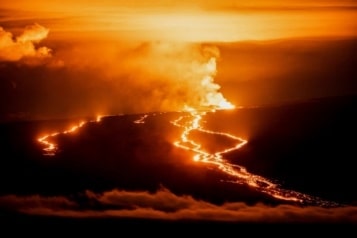
- Lava Flows
- Lava flows are streams of molten rock (lava) that travel down the sides of a volcano during an eruption.
- They vary in viscosity, with basaltic lava being less viscous and andesitic or rhyolitic lava being more viscous.
- Lava flows can be fast-moving or slow-moving, depending on their viscosity, and can cover large areas, posing a threat to nearby communities.
- Example: In the lava flows from Hawaii's Kilauea volcano, the basaltic lava from Kilauea flows for long distances.
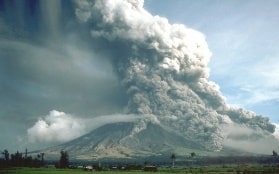
- Pyroclastic Flows
- Pyroclastic flows are extremely hot, fast-moving mixtures of volcanic gases, ash, and rock fragments.
- They can travel at speeds exceeding 100 miles per hour and are highly destructive, engulfing everything in their path.
- Pyroclastic flows are associated with explosive eruptions and are one of the most dangerous volcanic phenomena.
- Example: The eruption of Mount Vesuvius in 79 AD produced devastating pyroclastic flows that buried the Roman cities of Pompeii and Herculaneum.
- Ashfall
- Ashfall consists of fine volcanic ash particles that are ejected into the atmosphere during an eruption and then settle back to the ground.
- Volcanic ash can disrupt air travel, damage crops, and pose respiratory health hazards to humans and animals.
- Example: The 2010 eruption in Iceland caused widespread ashfall, disrupting air travel across Europe.
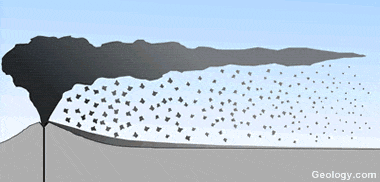
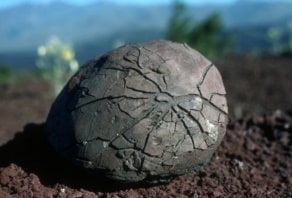
- Volcanic Bombs
- Volcanic bombs are large, solidified pieces of lava ejected during an eruption.
- They have an aerodynamic shape and can travel considerable distances before landing.
- The size of volcanic bombs can range from a few centimeters to meters in diameter.
- Lapilli
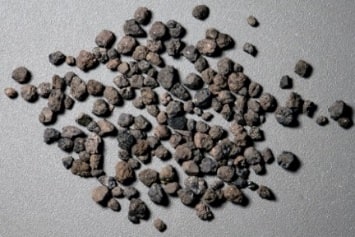
- Lapilli are small to medium-sized volcanic rock fragments ejected during eruptions.
- They are typically less than 64 millimeters in diameter and can vary in composition depending on the type of volcano.
- Example: Lapilli from the eruption of Mount Pinatubo in the Philippines in 1991.
- Volcanic Gases
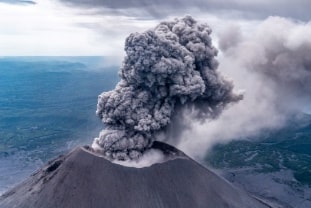
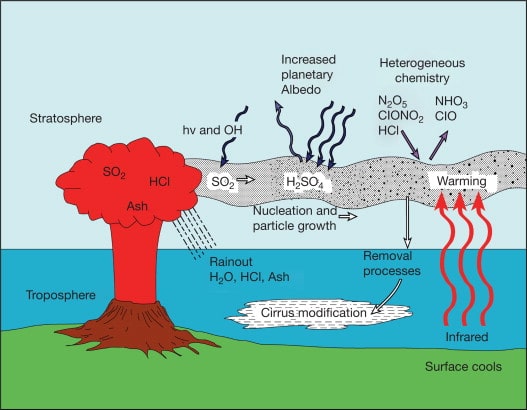
- Volcanic gases, including water vapor, carbon dioxide, sulfur dioxide, and others, are released during volcanic eruptions.
- These gases can contribute to atmospheric and environmental changes, including acid rain and global climate effects.
- Example: The release of sulfur dioxide gas during the 1986 eruption of Lake Nyos in Cameroon led to a deadly gas cloud.
- Tephra
- Tephra is a collective term for all volcanic material ejected into the atmosphere during an eruption, including ash, lapilli, and volcanic bombs.
- Tephra can have widespread effects on air quality, agriculture, and infrastructure.
- Example: The explosive eruption of Mount Krakatoa in 1883 ejected tephra into the atmosphere. It caused a significant reduction in global temperatures and colorful sunsets worldwide.
- Volcanic Rocks
- Volcanic rocks are solidified lava and volcanic fragments that make up the volcanic edifice.
- Common types include basalt, andesite, and rhyolite, each with distinct mineral compositions and textures.
- Example: The volcanic rocks of the Hawaiian Islands are primarily basaltic in composition. Mauna Loa and Mauna Kea are examples of shield volcanoes built from layers of basaltic lava flows.

- Calderas
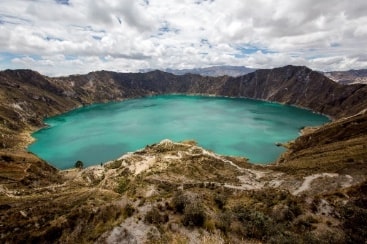
- Calderas are large, circular depressions that form when a volcano's magma chamber partially or completely empties during an eruption.
- They can be several kilometers in diameter and are often associated with powerful eruptions.
- Example: Yellowstone National Park in the United States is situated within a massive caldera formed by the collapse of a supervolcano during a cataclysmic eruption over 600,000 years ago.
- Volcanic Cones
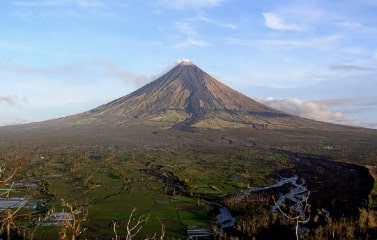
- Volcanic cones are the physical structures that form around a volcanic vent as a result of accumulated lava flows, ash, and other volcanic materials.
- They can vary in size and shape, with examples including stratovolcanoes, shield volcanoes, and cinder cones.
- Example: Paricutin in Mexico is a cinder cone volcano that formed in 1943 and grew rapidly over the course of several years, providing a classic example of cinder cone development.
Distribution of Volcanoes
- Most of the world's volcanoes occur in belts that trace the boundaries of Earth's tectonic plates.
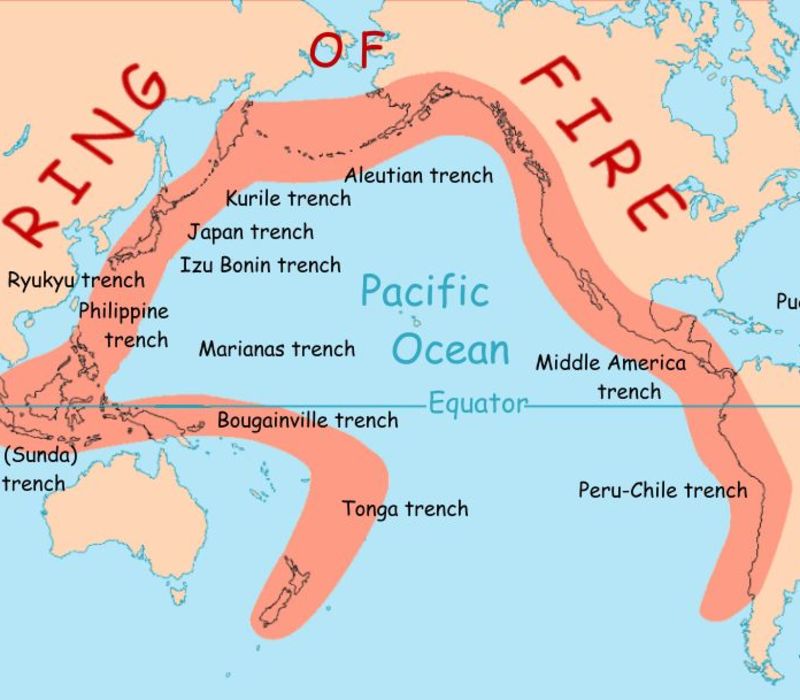
- Most volcanoes are found along the “Ring of Fire” that encircles the Pacific Ocean.
- Some volcanoes, like those that form the Hawaiian Islands, occur in the interior of plates at areas called “hot spots”.
- They're found in the center of plate boundaries, where magma escapes through cracks in the surface.
- Island arc nations such as Indonesia, the Philippines, and Japan host the largest populations within 100 km of an active volcano.
- Indonesia have the most explosive eruptions on record as well as the greatest number of eruption-related fatalities.
- Around 15% of volcanic activity occurs at mid-ocean spreading centers and continental rifts.
- Volcanoes in the alpine mountain chains and the Mediterranean Sea, as well as those in Eastern Africa's fault zone, make up the Mid-Continental belt.
Volcanoes in India
- There is no volcanoes in Himalayan and Peninsular region in India.
- India’s sole active volcano is Barren Island in Andaman and Nicobar Islands which erupted in 1803, 1891, 1995, 2005 and 2017.
- The other volcano is Narcondam which lies 150 km north-eat of Barren Island. It is believed to be extinct.
Distribution of Volcanoes
- Most of the world's volcanoes occur in belts that trace the boundaries of Earth's tectonic plates.
- Most volcanoes are found along the “Ring of Fire” that encircles the Pacific Ocean.
- Some volcanoes, like those that form the Hawaiian Islands, occur in the interior of plates at areas called “hot spots”.
- They're found in the center of plate boundaries, where magma escapes through cracks in the surface.
- Island arc nations such as Indonesia, the Philippines, and Japan host the largest populations within 100 km of an active volcano.
- Indonesia have the most explosive eruptions on record as well as the greatest number of eruption-related fatalities.
- Around 15% of volcanic activity occurs at mid-ocean spreading centers and continental rifts.
- Volcanoes in the alpine mountain chains and the Mediterranean Sea, as well as those in Eastern Africa's fault zone, make up the Mid-Continental belt.
Volcanoes in India
- There is no volcanoes in Himalayan and Peninsular region in India.
- India’s sole active volcano is Barren Island in Andaman and Nicobar Islands which erupted in 1803, 1891, 1995, 2005 and 2017.
- The other volcano is Narcondam which lies 150 km north-eat of Barren Island. It is believed to be extinct.
Volcanic Belts
- Volcanic belts are geological features characterized by a linear arrangement of volcanoes, volcanic islands, and associated tectonic activity.
- They are often associated with tectonic plate boundaries and are formed as a result of the movement of Earth's lithospheric plates.
- The "Ring of Fire" is one of the most famous volcanic belts, encircling the Pacific Ocean. It is a convergent boundary where multiple plates interact, resulting in numerous volcanoes and frequent seismic activity.

Causes and Theories of Volcanic Belts:
A. Plate Tectonics
The primary cause of volcanic belts is the movement of tectonic plates. This movement can result in three main types of volcanic belts:
- Convergent Boundaries: Volcanic belts form when two tectonic plates collide, causing one plate to be subducted beneath the other. This subduction generates intense heat and pressure, leading to the formation of magma and volcanic eruptions.
- Divergent Boundaries: At divergent boundaries, tectonic plates move away from each other, creating a gap in the Earth's crust. Magma rises to fill this gap, forming new crust and volcanic activity.
- Transform Boundaries: In some cases, volcanic belts can occur along transform boundaries, where two plates slide past each other. The friction and stress at these boundaries can lead to volcanic activity.
B. Hotspots:
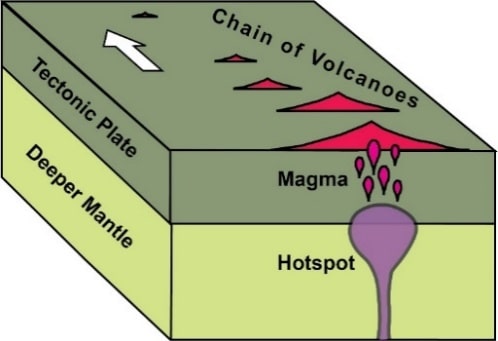
Some volcanic belts are associated with mantle hotspots, where a stationary plume of hot magma rises through the Earth's mantle, creating a chain of volcanic islands or seamounts. As a tectonic plate moves over the hotspot, a series of volcanic islands or seamounts are formed. The Hawaiian Islands are an example of this.
Types of Volcanic Belts
1. Convergent Plate Boundary Volcanic Belts:
- Volcanic Arcs: Formed at subduction zones where one tectonic plate is forced beneath another. Examples include the Andes in South America and the Cascades in North America.
- Back-Arc Basins: These occur on the side opposite the volcanic arc and are often associated with extensional tectonics. An example is the Sea of Japan.
- Island Arcs: Island arcs are curved chains of volcanic islands formed at convergent plate boundaries. They are typically associated with the subduction of oceanic plates beneath other oceanic or continental plates.
2. Divergent Plate Boundary Volcanic Belts:
- Mid-Ocean Ridges: Volcanic activity along underwater mountain ranges created by the upwelling of magma at divergent plate boundaries.
Examples:
- Mid-Atlantic Ridge: Underwater volcanic belt running through the Atlantic Ocean, formed as the Eurasian and North American Plates move away from the South American and African Plates.
- East African Rift System: A terrestrial example of divergent boundary volcanism as the African Plate is splitting into the Nubian and Somali Plates.
3. Intraplate Volcanic Belts:
- Hotspot Chains: Formed by mantle plumes that create a chain of volcanic islands or seamounts as a tectonic plate moves over the hotspot.
Examples:
- Hawaiian Islands: Result from the Pacific Plate moving over a stationary hotspot, creating a chain of volcanoes with the youngest being active (Big Island of Hawaii).
- Yellowstone Hotspot: Located in the interior of the North American Plate, responsible for the supervolcano in Yellowstone National Park.
4. Transform Plate Boundary Volcanic Belts:
- These are rare. In some cases, volcanic activity can occur along transform fault boundaries, where two plates slide past each other horizontally. This is less common but can result in localized volcanic features.
Examples:
- The San Andreas Fault Zone: Although primarily known for its faulting, it has some associated volcanic activity due to the Pacific Plate and North American Plate sliding past each other.
- The North Anatolian Fault in Turkey: Another transform fault with localized volcanic activity.
Characteristics of Volcanic Belts
- Volcanic Eruptions: Volcanic belts are characterized by frequent volcanic eruptions, which can vary in intensity from relatively mild eruptions to catastrophic events.
- Mountain Building: Many volcanic belts are associated with the formation of volcanic mountains. These mountains are often steep and rugged due to the accumulation of volcanic materials.
- Earthquake Activity: Along with volcanic eruptions, seismic activity, including earthquakes, is common in volcanic belts, especially at plate boundaries.
- Mineral Resources: Volcanic belts can be rich sources of mineral deposits, including valuable metals such as gold, silver, and copper, as well as geothermal energy resources.
- Hazards: While volcanic belts can provide important resources, they also pose significant hazards to human populations living nearby. Eruptions, lava flows, ash clouds, and volcanic gases can all have devastating effects on local communities.
Volcanic Features Within Volcanic Belts
- Volcanoes: These are the primary outlets for magma and can vary in size and shape, from shield volcanoes to stratovolcanoes.
- Calderas: Large volcanic craters formed by the collapse of a volcano's summit.
- Lava Flows: Streams of molten rock that flow downslope during eruptions.
- Pyroclastic Deposits: Volcanic ash, rocks, and debris ejected during eruptions, which can accumulate as layers of sediment.
Geological Hazards Associated with Volcanic Belts
- Eruptions: Explosive eruptions can release ash, gases, and lava, impacting local environments and global climate.
- Earthquakes: Volcanic activity often accompanies seismic events, including tsunamis near subduction zones.
- Lahars: Volcanic mudflows triggered by eruptions can be highly destructive.
Conclusion
Volcanic belts are dynamic geological features that result from the interaction of tectonic plates, shaping our planet's surface and influencing natural hazards and Earth's geological history.
Types of volcanic Hazard
Volcanic Earthquakes
- There are two general categories of earthquakes that can occur at a volcano: volcano-tectonic earthquakes and long period earthquakes.
- Earthquakes produced by stress changes in solid rock due to the injection or withdrawal of magma (molton rock) are called volcano-tectonic earthquakes.
- These earthquakes can cause land to subside and can produce large ground cracks.
- These earthquakes can occur as rock is moving to fill in spaces where magma is no longer present.
- Volcano-tectonic earthquakes don't indicate that the volcano will be erupting but can occur at anytime.
- Long period earthquakes are produced by the injection of magma into surrounding rock.
- These earthquakes are a result of pressure changes during the unsteady transport of the magma.
- When magma injection is sustained a lot of earthquakes are produced.
- This type of activity indicates that a volcano is about to erupt.
- Scientists use seismographs to record the signal from these earthquakes. This signal is known as volcanic tremor.
Directed Blast
- The USGS defines a directed blast as “a hot, low-density mixture of rock debris, ash, and gases that moves at high speed along the ground surface.” Lateral blasts have a significant low-angle component.
- Because they carry rock debris at high speeds, directed blasts can devastate areas tens to hundreds of square miles within a few minutes.

Tephra
- When a volcano erupts it will sometimes eject material such as rock fragments into the atmosphere. This material is known as tephra.
- The largest pieces of tephra (greater than 64 mm) are called blocks and bombs. Blocks and bombs are normally shot ballistically from the volcano.
- The smallest particles which are less then .01 mm can stay in the atmosphere for two or three years after a volcanic eruption.
- Volcanic ash is also a part of tephra and is very hazardous.
Volcanic Gases
- An erupting volcano will release gases, tephra, and heat into the atmosphere.
- The largest portion of gases released into the atmosphere is water vapor.
- Other gases include carbon dioxide (CO2), sulfur dioxide (SO2), hydrochloric acid (HCl), hydrogen fluoride (HF), hydrogen sulfide (H2S), carbon monoxide (CO), hydrogen gas (H2), NH3, methane (CH4), and SiF4.
- Some of these gases are transported away from the eruption on ash particles while others form salts and aerosols.
- Volcanic gases are also produced when water is heated by magma.
- Gases also escape from pyroclastic flows, lahars, and lava flows, and may also be produced from burning vegetation.
Lava Flows
- Lava flows are the least hazardous of all processes in volcanic eruptions.
- How far a lava flow travels depends on the flows temperature, silica content, extrusion rate, and slope of the land.
- A cold lava flow will not travel far and neither will one that has a high silica content. Such a flow would have a high viscosity (a high resistance to flow).
- A basalt flow have low silica contents and low viscosities so they can flow long distances (>4km). These flows can move at rates of several kilometers per hour.
- If a lava flow is channelized or travels underground in a lava tube then the distance it travels is greatly extended.
Debris Avalanches, Landslides, and Tsunamis
- A debris avalanche is formed when an unstable slope collapses and debris is transported away from the slope.
- Large scale avalanches normally occur on very steep volcanoes.
- A cold debris avalanche usually results from a slope becoming unstable whereas a hot debris avalanche is the result of volcanic activity such as volcanic earthquakes or the injection of magma which causes slope instability.
- Landslides commonly originate as massive rock falls or avalanches, which disintegrate during movement into fragments ranging from small particles to blocks hundreds of meters across.
- Landslides are common on volcanic cones because they are tall, steep, and weakened by the rise and eruption of molten rock.
- Due to the collapsing landmasses or the earthquakes during volcanic activity, tsunami can also be triggered.
Pyroclastic Surge
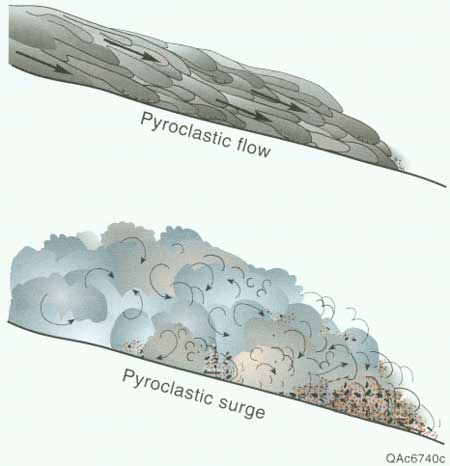
- Pyroclastic surges are low density flows of pyroclastic material.
- The reason they are low density is because they lack a high concentration of particles and contain a lot of gases.
- These flows are very turbulent and fast. They overtop high topographic features and are not confined to valleys. However, this type of flow usually does not travel as far as a pyroclastic flow.
- Since pyroclastic surges are fast and not constrained by topography it is hard to find a safe place to be when they come.
Pyroclastic Flows
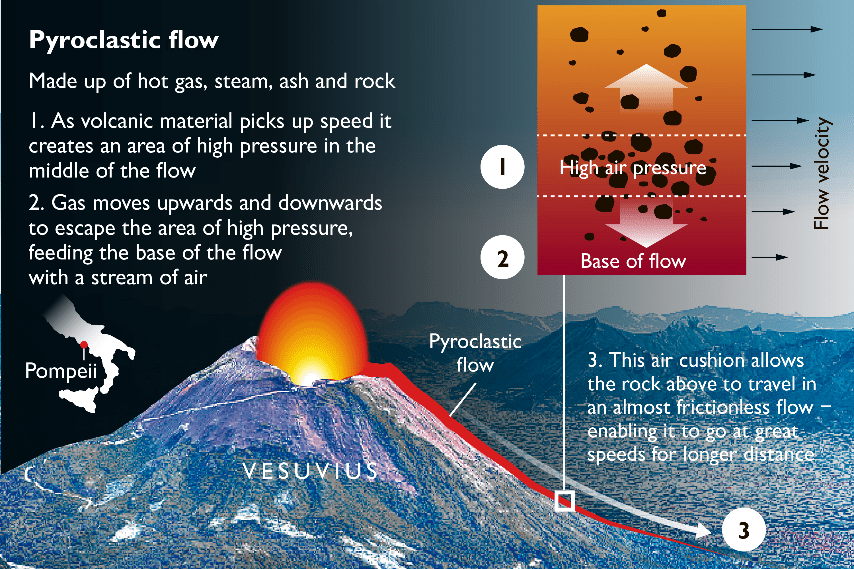
- Pyroclastic flows are fluidized masses of rock fragments and gases that move rapidly in response to gravity.
- Pyroclastic flows can form in several different ways.
- They can form when an eruption column collapses, or as the result of gravitational collapse or explosion on a lava dome or lava flow.
- These flows are more dense than pyroclastic surges and can contain as much as 80 % unconsolidated material.
- The flow is fluidized because it contains water and gas from the eruption, water vapor from melted snow and ice, and air from the flow overriding air as it moves downslope.
Lahars
- Lahars are similar to pyroclastic flows but contain more water.
- Lahars form
- from debris avalanches that contain water from snow and ice which, when released, mixes with loose debris to form a lahar,
- from pyroclastic flows and surges which release water that mixes with debris,
- from pyroclastic flows which dilute themselves with river water as they travel downslope,
- from natural dam failure (i.e. a lava flow dam or crater lake), and
- from rainfall on loose material such as ash.
- They have a wide range of velocities that depends on the channel width, channel slope, volume of the flow, and grain size composition.
Effects of Volcanoes
- Volcanic tremor warn of an impending eruption so that people can be evacuated to areas of safety.
- Volcano-tectonic earthquakes can cause damage to manmade structures and land sliding.
- Directed blasts can also destroy manmade structures and kill all living things by abrasion, impact, burial, and heat.
- Material ejected in the atmosphere can be electrically charged and can produce lightning which is fatal.
- Large ejecta shot ballistically from the volcano are also a hazard to those unfortunate enough to be near the volcano.
- Volcanic Ash fall can disrupt electricity, television, radio, and telephone communication lines, bury roads and other manmade structures, damage machinery, start fires, and clog drainage and sewage systems.
- Ash can produce poor visibility and cause respiratory problems.
- If ash builds up on the tops of roofs, it will often cause collapse.
- Ash is also a hazardous to airline sector as it causes engine failure, costly repairs and delays in flights etc.
- Tephra can also destroy vegetation which can result in famine.
- Tephra also produces fertile soil for crops.
- Large amounts of volcanic gases will sometimes build up in low lying areas and can asphyxiate livestock and harm vegetation.
- Fluoride and chloride in these gases can contaminate water.
- Fluoride and chloride can also be irritating to the skin and eyes of animals and can damage clothes and machinery.
- Volcanic gases also causes acid rain in the vicinity and are one of the reason behind greenhouse gas concentration in the atmosphere.
- Lava flow are slow thus people rarely got killed however they can injure people and damage infrastructure and vegetation.
- They melt snow and ice and can cause flooding.
- Pyroclastic surges can bury, burn, and destroy things upon impact.
- These surges contain lots of gases that can asphyxiate people.
- Pyroclastic flows and lahars are the greatest volcanic hazards.
- Pyroclastic flows can incinerate, burn, and asphyxiate people.
- Gases within a pyroclastic flow can explode and cause ash to rain down on nearby areas.
- Pyroclastic surge, pyroclastic flow, lahars and tephra are the main cause behind mortality during volcanic eruption.
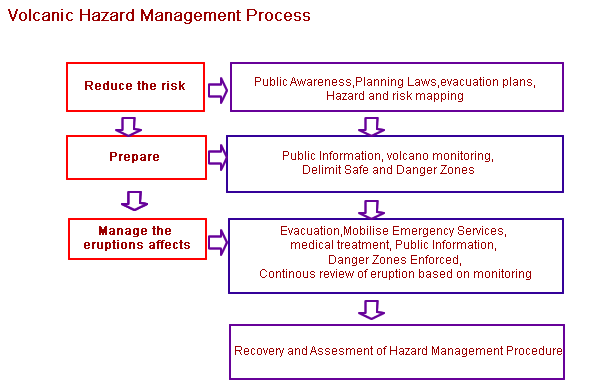
Disaster Management of Volcano Disaster
A. Pre-disaster stage
- Preparedness (P): This stage involves activities aimed at enhancing the readiness and capacity to respond effectively to a volcanic hazard. It includes:
- Risk assessment and mapping: Identifying areas at risk and assessing the potential impacts of volcanic activity.
- Early warning systems: Developing and implementing systems to detect and monitor volcanic activity, issue timely warnings, and communicate them to the population at risk.
- Evacuation planning: Developing evacuation plans, establishing evacuation routes, and identifying safe locations for affected populations.
- Public education and awareness: Conducting awareness campaigns to inform the public about volcanic hazards, their potential impacts, and appropriate response actions.
- Mitigation (M): This stage involves measures taken to minimize or reduce the impacts of volcanic hazards. It includes:
- Land-use planning: Implementing regulations and guidelines to restrict or control development in high-risk areas.
- Engineering measures: Constructing physical structures like barriers, diversion channels, or reinforced buildings to protect critical infrastructure and communities.
- Hazard-resistant infrastructure: Designing buildings and infrastructure to withstand volcanic hazards, such as ashfall, pyroclastic flows, or lahars.
- Ecosystem management: Preserving or restoring natural systems like forests or wetlands that can help mitigate volcanic hazards by reducing erosion or acting as buffers.
- Example: construction of volcano-resistant bridges and roads in areas prone to lahars, which can mitigate the impact of volcanic mudflows on transportation networks.
- Prevention (P): This stage focuses on actions to prevent or reduce the occurrence of volcanic hazards. It includes:
- Monitoring and research: Continuously monitoring volcanic activity, studying volcanic processes, and improving scientific understanding to predict eruptions more accurately.
- Volcano observatories: Establishing and maintaining observatories to monitor and analyze volcanic activity, issuing alerts, and coordinating with other relevant agencies.
- Hazard zoning and regulation: Implementing regulations to restrict certain activities near volcanoes, such as prohibiting settlements in high-risk zones.
- Volcano surveillance: Regularly assessing the health of volcanoes and conducting inspections to detect any changes in their behavior or potential signs of an impending eruption.
B. Disaster stage
- Rescue operation (R): This stage involves immediate response actions during and immediately after a volcanic eruption. It includes:
- Search and rescue: Conducting operations to locate and evacuate people in danger, providing emergency medical assistance, and ensuring their safety.
- Emergency shelters: Setting up temporary shelters to accommodate displaced populations and providing them with basic necessities like food, water, and medical aid.
- Emergency communication: Establishing reliable communication systems to coordinate rescue efforts and disseminate critical information to affected populations.
C. Post-disaster stage
- Relief (R): This stage involves providing immediate assistance to affected communities and addressing their urgent needs. It includes:
- Humanitarian aid: Providing food, water, healthcare, and other essential supplies to affected populations in temporary shelters or evacuation centers.
- Emergency infrastructure restoration: Repairing or rebuilding damaged infrastructure like roads, bridges, and utilities to restore basic services.
- Psycho-social support: Offering counseling and mental health services to affected individuals to help them cope with the emotional and psychological impacts of the disaster.
- Recovery (R): This stage involves the medium- to long-term efforts to restore and rebuild affected areas. It includes:
- Reconstruction and rehabilitation: Rebuilding damaged infrastructure, homes, and public facilities to restore the community's functionality and improve resilience to future eruptions.
- Livelihood restoration: Supporting affected individuals and businesses by providing financial assistance, vocational training, and opportunities for income generation.
- Community engagement: Involving local communities in the decision-making process to ensure their needs and perspectives are considered during the recovery phase.
- Rehabilitation (R): This stage focuses on long-term measures to reduce vulnerability and enhance resilience to future volcanic hazards. It includes:
- Risk reduction measures: Implementing policies and regulations to minimize vulnerability, such as enforcing building codes and promoting hazard-resistant construction practices.
- Capacity building: Enhancing the skills and knowledge of local communities, emergency responders, and government agencies to effectively manage future volcanic hazards.
- Sustainable development: Incorporating hazard considerations into development plans and promoting sustainable practices that minimize vulnerability to volcanic hazards.