
Tsunami
Tsunami
Introduction
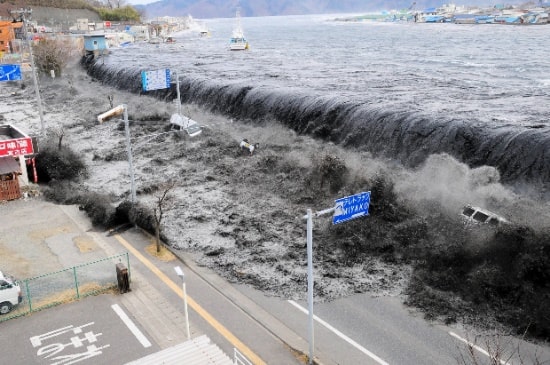
- A tsunami is a series of waves in a water body caused by the displacement of a large volume of water, generally in an ocean or a large lake.
- It is generated by the displacement of water from a large event.
- Tsunami waves do not resemble normal undersea currents or sea waves because their wavelength is far longer.
- The term seismic sea wave is also used to refer to the phenomenon because the waves most often are generated by seismic activity such as earthquakes.
- The series of waves, with periods ranging from minutes to hours, arriving in is called "wave train".
- Although the impact of tsunamis is limited to coastal areas, their destructive power can be enormous, and they can affect entire ocean basins.
Geographical Perspectives on Tsunamis
- Plate Tectonic Theory:
- The movement and interaction of tectonic plates, particularly at subduction zones and transform boundaries, can trigger underwater earthquakes, resulting in the displacement of water and the generation of tsunamis.
- Tuzo Wilson, a prominent geophysicist, proposed the theory of plate tectonics in the 1960s, highlighting the connection between earthquakes and tsunamis caused by tectonic plate movements.
- Environmental Determinism:
Role in Tsunami occurrence:
- Environmental determinism suggests that natural phenomena, including tsunamis, are primarily influenced by the physical environment.
- It emphasizes the role of coastal topography, oceanic currents, and proximity to tectonic plate boundaries as key factors contributing to the occurrence and magnitude of tsunamis.
Impact of Tsunamis:
- Environmental determinism suggests that the natural environment, including natural disasters like tsunamis, determines the cultural, economic, and political characteristics of a region.
- The occurrence and magnitude of tsunamis in a particular region can impact settlement patterns, economic activities, and even cultural practices.
- For example, in coastal regions with a high frequency of tsunamis, communities may adapt their architectural styles to withstand such events. Traditional buildings in Japan, such as the "minka" farmhouses with their steep thatched roofs, were designed to minimize damage from earthquakes and tsunamis.
- Spatial Analysis:
- Spatial analysis focuses on understanding and interpreting the patterns and relationships between geographic features and phenomena.
- It can help identify areas prone to tsunamis based on historical data and geological factors.
- By analyzing the spatial distribution of past tsunamis, researchers can identify high-risk zones and develop hazard maps to guide land-use planning and emergency management strategies.
- For instance, using spatial analysis techniques, scientists have identified the "Ring of Fire" in the Pacific Ocean as a region highly susceptible to earthquakes and tsunamis due to plate tectonic activity.
- Spatial analysis also enables the assessment of vulnerability of coastal communities to tsunamis. By considering factors such as population density, infrastructure, and socio-economic conditions, geographers can identify areas where the impact of a tsunami would be devastating.
Types of Tsunami
Local Tsunami:
- A local tsunami is one that originates from within about 100 km or less than 1 hour tsunami travel time from the impacted coastline.
- Local tsunamis can result in a significant number of casualties since authorities have little time to warn/evacuate the population.
Regional Tsunami:
- A regional tsunami is one that is capable of destruction in a particular geographical region, generally within 1,000 km from its source.
- Regional tsunamis can arrive to affected coastlines within 1-3 hours of being generated, however, as with local tsunamis, due to the limited warning time they can still prove very destructive and deadly.
Distant Tsunami:
- A tsunami originating from a source, generally more than 1,000 km or more than 3 hours tsunami travel time from the impacted coastline is called an ocean-wide or distant or tele-tsunami.
- These tsunamis are less frequent, but more hazardous than regional tsunamis.
- They usually start as a local tsunami that causes extensive destruction to a shoreline near the source, and the waves continue to travel across an entire ocean basin with sufficient energy to cause additional casualties and destruction on shores more than a 1,000 km from the source.
- These tsunamis have the ability to cause widespread destruction, not only in the immediate region but across an entire ocean.
Distribution of Tsunamis
- Types of region: Coastal areas
- Major region: 70% Pacific Ocean, 15% Mediterranean Sea, 9% Caribbean Sea and Atlantic Ocean, and 6% Indian Ocean. most tsunamis have been generated in Japan, Peru, Chile, New Guinea and the Solomon Islands.
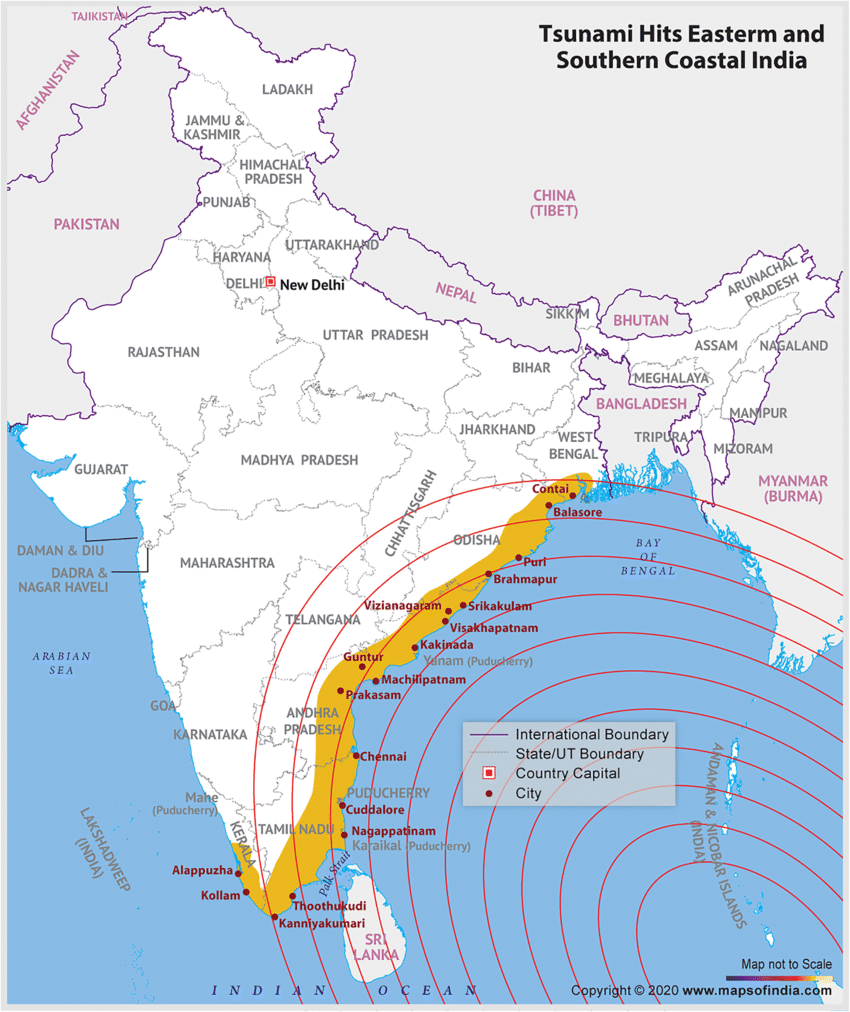
- Region in India: The tsunami affected a total of 2,260 km of Indian coastline besides the entire Andaman and Nicobar Islands.

Causes of Tsunamis
Underwater Earthquakes:
- Tsunamis are often triggered by underwater earthquakes, especially those with a high magnitude.
- When tectonic plates shift suddenly beneath the ocean floor, they displace water, creating massive waves.
- Example: The 2004 Indian Ocean earthquake, which had a magnitude of 9.1-9.3, triggered a devastating tsunami that affected several countries in Southeast Asia.
Volcanic Eruptions:
- Eruptions from underwater volcanoes can cause tsunamis.
- The sudden release of volcanic material and gases can displace water and generate powerful waves.
- Example: The eruption of Mount Krakatoa in 1883 caused a series of tsunamis in the Sunda Strait, resulting in significant coastal destruction and loss of life.
Submarine Landslides:
- Large-scale landslides underwater, such as those caused by underwater volcanic activity or sediment instability, can displace water and lead to tsunamis.
- The rapid movement of sediment and rock can create immense waves.
- Example: The 1998 Papua New Guinea tsunami was caused by a massive submarine landslide near the island of Sissano, triggering waves that impacted coastal communities.
Meteorite Impacts:
- In rare cases, meteorite impacts in the ocean can generate tsunamis.
- The impact displaces water and creates a shockwave that propagates outward, forming tsunami waves.
Submarine Explosions:
- Explosions from underwater sources, such as military activities or gas hydrate destabilization, can lead to tsunamis.
- The sudden release of energy displaces water and generates waves with significant force.
- Example: The eruption of the underwater volcano Anak Krakatau in 2018 caused a tsunami in Indonesia, demonstrating the potential for tsunamis from volcanic activity.
Fault Movements:
- Seafloor faults and fractures can cause sudden movements, leading to the displacement of water and the formation of tsunamis.
- These movements can be triggered by various geological processes, including plate tectonics.
- Example: The 2011 Tōhoku earthquake off the coast of Japan was caused by movement along the Japan Trench subduction zone, resulting in a powerful tsunami.
Meteotsunamis:
- Atmospheric disturbances, like severe storms or rapid pressure changes, can create meteotsunamis.
- These tsunamis are smaller in scale compared to those caused by geological events but can still pose a threat to coastal areas.
- Example: The meteotsunami that occurred in the Balearic Islands in 2006 was caused by a rapid atmospheric pressure change during a severe storm, leading to abnormal wave heights along the coast.
Other Reasons:
- Meteorological conditions: rapid change in barometric pressure
- Man-made or triggered tsunamis: deep water explosions
Effects of Tsunamis
Primary effect
- Death of humans and animals
- Habitat destruction
- Infrastructure destruction
Secondary effect
- Disease
- Marine life poising
- Economic burden
Remedial Measures / Disaster Management of Tsunamis
A. Pre-disaster stage
- Preparedness (P)
- Preparedness involves activities and measures taken before a tsunami event to minimize its impact.
- These activities include developing early warning systems, educating communities about tsunamis, creating evacuation plans, and conducting drills and simulations to ensure readiness.
- Examples: Establishing tsunami warning systems with sirens, alarms, and notification systems. Conducting public awareness campaigns to educate people about the signs of a tsunami and the appropriate response actions to take.
- Mitigation (M)
- Mitigation focuses on reducing the vulnerability of communities and infrastructure to tsunamis.
- It involves implementing structural and non-structural measures to minimize the impact of a tsunami.
- Structural measures include constructing tsunami barriers, breakwaters, and coastal defenses, while non-structural measures involve land-use planning, zoning regulations, and building codes.
- Examples: Building elevated evacuation routes or safe shelters in coastal areas. Implementing land-use policies that restrict development in high-risk zones.
- Prevention (P)
- Prevention aims to address the root causes of tsunamis and prevent them from occurring or minimize the likelihood of their occurrence. However, it's important to note that tsunamis are natural phenomena and cannot be prevented practically.
- It involves measures such as monitoring and early detection of seismic activity, coastal ecosystem management, and geological surveys to identify potential landslide or fault line risks.
- Examples: Installing seismic sensors and buoys in the ocean to detect earthquake activity. Conducting regular surveys and assessments of coastal areas prone to landslides.
B. Disaster stage
- Rescue (R)
- During the disaster stage, the primary focus is on saving lives and providing immediate assistance to affected individuals.
- Rescue operations involve search and rescue teams deploying to affected areas, evacuating people to safe locations, and providing medical aid and support.
- Examples: Deploying helicopters, boats, and trained personnel to evacuate people from areas at risk. Setting up temporary medical facilities to treat injured individuals.
C. Post-disaster stage
- Relief (R)
- Relief activities involve providing emergency assistance to affected communities, addressing immediate needs such as food, water, shelter, and medical aid. Humanitarian organizations, government agencies, and volunteers play a crucial role in delivering relief supplies and services to affected areas.
- Examples: Distributing food, water, and essential supplies to displaced individuals. Setting up temporary shelters and sanitation facilities.
- Recovery (R)
- Recovery focuses on restoring essential services, infrastructure, and livelihoods in the affected areas.
- It involves rebuilding damaged infrastructure, repairing utilities, and supporting economic recovery efforts to help communities return to normalcy.
- Examples: Repairing damaged roads, bridges, and buildings. Assisting businesses in resuming operations and providing financial support to affected households.
- Rehabilitation (R)
- Rehabilitation involves long-term efforts to restore the affected community to a sustainable and resilient state.
- It includes rebuilding infrastructure with a focus on resilience, improving disaster management systems, providing psychological support to survivors, and promoting community-based initiatives for resilience building.
- Examples: Constructing resilient buildings and infrastructure that can withstand future tsunamis. Offering counseling and mental health support to survivors. Implementing community-based programs for disaster preparedness and response.
NDMA guideline on Tsunamis
- Tsunami Bulletins and Warning Categorisation
- Tsunami Early Warning Dissemination
- Documentation and Creation of Maps and Databases
- Public Awareness regarding upcoming tsunami and appropriate response.
- Education on Tsunamis
- Training and Capacity Building of Professionals
- Medical Preparedness
- New Standards for Protection of Structures against Tsunami
- Shelters for Storm Surges and Tsunamis
- Institutionalisation of Design and Construction for Tsunami Safety
- Specific Design Principles for Tsunami
- Protecting Seafronts and Lifeline Structures
- Bio-Shields
- Selection of Species and Efforts for Community Involvement
- Monitoring Shelterbelt Plantations and Mangrove Regeneration Zones
- Funding Support for the spread of Mangroves and Shelterbelts
- Ensuring Implementation