
Sediments and Sedimentary Rocks
Sediments and Sedimentary Rocks
Introduction
Sediments are the product of weathering and erosion, which are subsequently transported by processes like aeolian, fluvial, glacial, gravity etc. and ultimately deposited to form sedimentary rocks.
- Origin: These originates within (in-situ) or ex-situ (transported) area of deposition.
- Texture: It gives an idea about transported distance.
- Composition of sediments: It gives idea about rocks of source area.
- If deposition by swift streams: coarse grains, angular and poorly sorted sediments.
- If deposition in silent waters: Fine grains, round and well sorted sediments. Eg. Delta, backwaters.

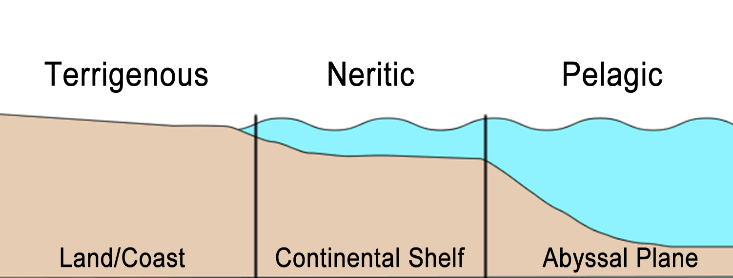

Classification of sediments
- Terrigenous sediments:
- Terrestrial origin: They are product of weathering of terrestrial rocks.
- Allogeneic: means extra basinal or transported origin.
- These are clastic sediments as they are made up of coarse fragments.
- These are composed of detritus, and formed by weathering, erosion and transportation. E.g. gravel, sand, silt etc.
- Their deposition is largely limited to the continental shelf.
- Pelagic sediment or pelagite
- Marine origin: They accumulate due to settling of particles on the ocean floor.
- Authigenic: formed by precipitation or recrystallization instead of being transported.
- Fine-grained
- Mainly composed of Biological detritus (organic matter): They are formed by dead aquatic organisms, shells, shell fragments, their faecal matters etc.
- Trace amounts of meteoric dust and volcanic ash is present.
- Neritic sediments
- These are found at the continental shelf.
- These are dominated by lithogenous sources.
- Biogenic sediments
- These include fossils.
- Carbonate of coral reefs. Silicates of forams (Foraminifera)
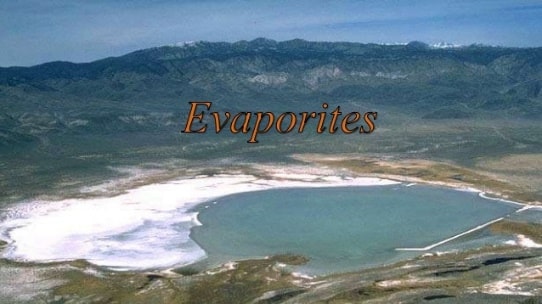
- Evaporite
- These are the sediments resulting from evaporation, concentration and crystallization from an aqueous solution.
- Eg. Limestone, gypsum, halite (NaCl).
Sedimentary Rocks or Secondary Rocks
Introduction
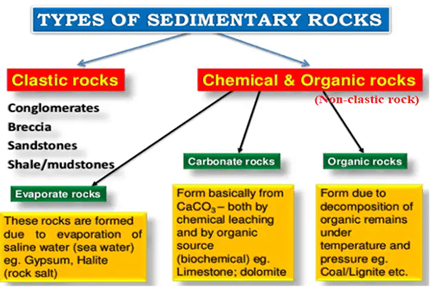
- These are formed due to aggregation, compaction, and cementation of sediments.
- These are derived from pre-existing rocks due to geomorphic processes like erosion, transportation, and deposition of loose sediments.
- These include rocks formed by accumulation of dissolved ions, chemically precipitated or organic materials.
- Rivers, oceans, winds, and rain runoff all can carry the particles washed from eroding rocks. Such material, called detritus, consists of fragments of rocks and minerals.
- When the energy of the transporting current is not strong enough to carry these particles, the particles drop out in the process of sedimentation.
- Sedimentary rocks can form from grains of pre-existing rocks (detritus), from chemical processes, or from organic processes. These are mostly formed under water. These can also form on Eg. Loess; Rocks of sand dunes, alluvial fans and cones.
- These are generally soft, horizontal and
- These are not perfectly horizontal, but are folded.
- Unlike igneous rocks, these are not found in massive forms.
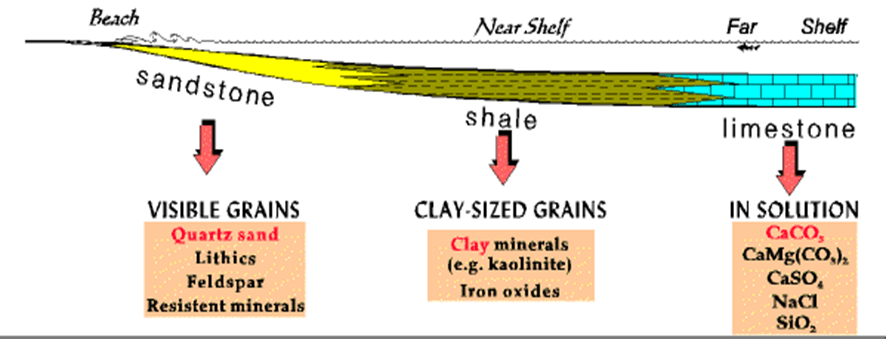
Sedimentary rocks of different grain sizes
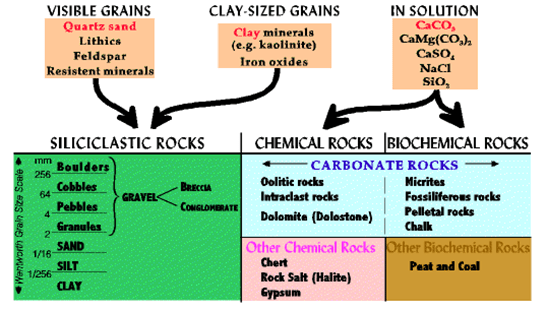
- The simple ideal model for the evolution of sedimentary rocks says there are three end products that all sedimentary processes are working to reach - quartz sandstone, shale, and limestone.
- Quartz sandstone = all visible grains
- Shale = all clay sized grains
- Limestone = all dissolved minerals, including not only calcite CaCO3, but also halite (table salt; NaCl), and gypsum (CaSO4.H2O) among others.
Importance of sedimentary rocks
- “The sedimentary rocks are important for extent, not for depth in the earth crust.”: Despite only 5% composition in the crust, these found over largest surface area (75%) of the globe.
- These are archives of earth’s history: contains fossils, sedimentary structures etc.
- Helps in Paleogeographic analysis, depositional environment or paleoclimate etc.
- Repository of resources: eg. Iron, aluminium, Fossil fuel like coal, petroleum, shale gas etc.
- Idea about exploration process. Petroleum in Anticlines.
- Used as construction material: sandstone in Lalqila, Sand (Quartz).
Texture of Sedimentary Rocks
- Texture refers to the size, shape, and arrangement of the grains that make up a sedimentary rock.
Texture Types
- There are two fundamentally different textural types: elastic and crystalline. Conglomerates exhibit mainly elastic texture. They contain individual fragments (clasts) of pre-existing rocks and minerals that were transported and deposited as discrete particles.
- In clastic textures, grain boundaries touch one another tangentially.
- When grains are interlocked or intergrown, the texture is referred to as crystalline. Crystalline textures result from the in situ precipitation of solid mineral crystals.
Grain Size
- Clasts or crystals are conventionally categorized by their maximum grain diameter. The diameter can be estimated visually, but accurate measurements require more sophisticated methods.
- It is often necessary to disaggregate (break apart) consolidated sedimentary rocks and separate grains based on size by passing them through a nest of wire mesh sieves of different sizes.
- Variation in grain size in elastic sedimentary rocks is known as sorting.
- A well-sorted sedimentary rock shows little variation in grain diameter; a poorly sorted sedimentary rock exhibits large deviations from the mean grain size.
Shape
- Shape is often described in terms of sphericity. Equant grains (whether they be cubes or spheres) have high sphericity, those with one or more dimensions of unequal length have lower sphericity.
Roundness (Angularity)
- The roundness or angularity of grains refers to the sharpness or smoothness of their corners.