
Petrography and Petrogenesis of Anorthosite
Petrography and Petrogenesis of Anorthosite
Anorthosite
- Anorthosites are defined as plutonic rocks with over 90% plagioclase (there are no known volcanic equivalents).
- Their highly felsic nature and their location in continental areas are characteristics they share with granitoid rocks.
- The felsic mineral, however, is a calcic plagioclase, which, along with subordinate associated high-temperature mafic minerals, suggests a stronger similarity to basaltic rocks.
- Six major types or anorthosite occurrences:
- Archean anorthosite plutons
- Proterozoic “massif-type” anorthosite plutons
- 1-cm- to 100-m-thick layers in layered mafic intrusions
- Thin cumulate layers in ophiolites/oceanic crust
- Small inclusions in other rock types (xenoliths and cognate inclusions)
- Lunar highland anorthosites
Archean anorthosites
- Most Archean anorthosites cluster in the age range.

- They typically occur as kilometer-scale lenses in Archean high-grade metamorphic gneiss terranes.
- They are generally less than 1 km thick and appear to be sheet-like, conformable sills.
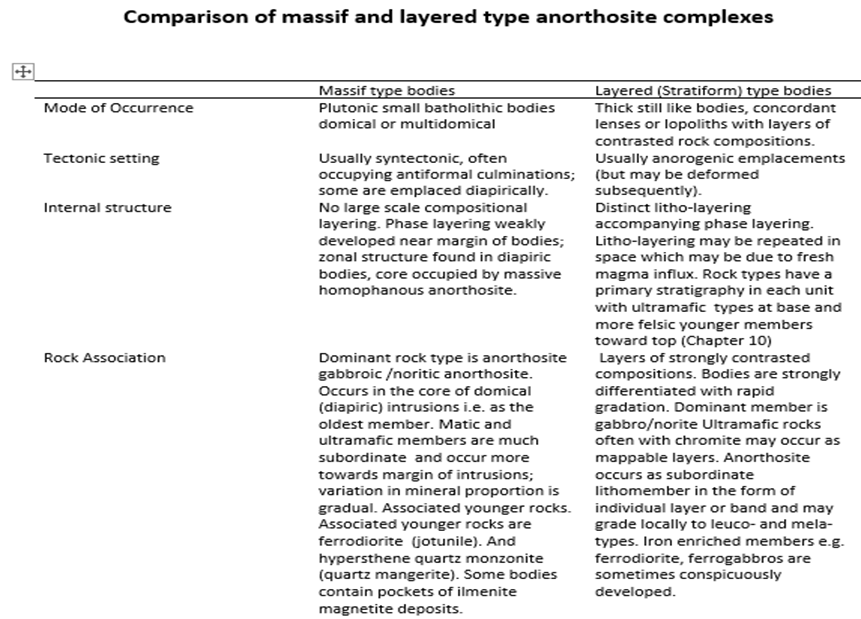
- Archean anorthosites are associated with gabbroic rocks and tend to be internally layered.
- Many Archean anorthosite bodies are emplaced as shallow sills into “supracrustal” rocks (a common term among Precambrian geologists, used to indicate rocks deposited at the Earth’s surface: on top of the crust, not within it).
Petrology and Geochemistry of Archean Anorthosites
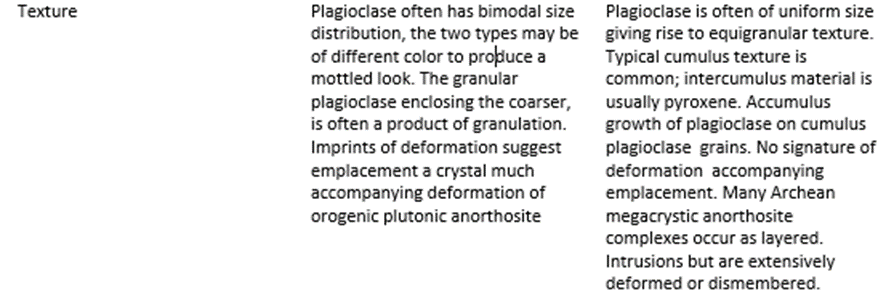
- The plagioclase crystals in Archean anorthosites are subhedral to euhedral megacrysts.
- The megacrysts are relatively equidimensional, a strange shape for plagioclase, which usually forms elongate laths.
- The megacrysts are unusually homogeneous and calcic in composition (An80–95) and are surrounded by a finer-grained mafic matrix.
- The mafic matrix is typically dominated by metamorphic amphibole, but some primary pyroxene or olivine may occasionally remain, as oxides, such as chromite or magnetite.
- The original mineralogy suggests that the magma was initially dry and was hydrated during subsequent metamorphism.
- Cumulate texture is well developed in undeformed bodies, where layering is also more obvious.
- The major element concentrations are controlled by the percentage of accumulated plagioclase, and the bulk chemical composition of anorthosites, therefore, is not that of the initial liquid.
The Parent Liquid of Archean Anorthosites
- The predominance of cumulate material, combined with the absence of any volcanic equivalents or modern anorthosite occurrences, makes it difficult to determine the parent magma of Archean anorthosites.
- Three methods to formulate parental composition:
- One way is to determine the compositions of the various layers and sub-units and then sum them for the whole layered complex.
- Another approach is to look at marginal areas and flows, dikes, and sills, all of which are finer and less differentiated than the main anorthosite bodies. These rocks are variable, but generally basaltic, with a similar high Al2O3 and plagioclase content that may constitute up to 80% of the rock.
- The final method is to use the minerals present in the anorthosite and the crystal-liquid partition coefficients to infer the composition of the liquid that would be in equilibrium with the solid assemblage.
- The general consensus is that the parental magma for Archean anorthosites is a tholeiitic basalt that is rich in Fe, Al, and Ca. The parent is enriched in plagioclase components.
- The high Fe content of the parental basalt indicates that it cannot be a primary magma.
- It must be differentiated at depth from a more primitive magma, either a basalt, a picrite, or even a komatiite.
Petrogenesis of Archean Anorthosites
- The original settings of Archean anorthosites are difficult to assess because there are no modern analogs.
- The common association of Archean anorthosites with the mafic lavas (including pillow lavas) of greenstone belts has led several investigators to conclude that most of these bodies are oceanic and consanguineous with mafic magmatism.
- Their location in continental cratons would then be due to their being caught up in the later amalgamation of Archean arcs and microcontinents.
- the parental Fe-rich tholeiite must have been derived from a more primitive tholeiite at depth, via crystallization of olivine and pyroxene in a magma chamber.
Proterozoic anorthosites
- Proterozoic anorthosites are generally referred to as massif-type anorthosites.
- This name is to indicate a plutonic mass of large size.
- It differs from their Archean counterparts in several ways. They are larger and less sill-like, the plagioclase crystals are shaped in the common tabular form and are less anorthitic, they contain less mafic matrix or mafic cumulates, and they are associated more with granitoids and not greenstone belts/supracrustals.
- The shape of Proterozoic anorthosite bodies is highly varied, ranging from funnel-shaped, to lopoliths, to large sheets.
- Most bodies are composite, with multiple intrusions accumulated over a relatively brief 20 to 30 Ma span.
- Proterozoic anorthosites are almost always associated with nearly anhydrous pyroxene-bearing granitoid rocks (charnockites), as well as with Fe-rich and K-rich diorites, monzonites, and other K-rich granitoids.
- This association is referred to as AMCG complexes (for anorthosite–mangerite–charnockite–granite).
- The tectonic setting is characteristically anorogenic, and the massifs are intruded into thick, stable cratonic crust.
- The mafic parental magmas are intruded during a period of incipient rifting and continental breakup or post-orogenic collapse.
- Proterozoic anorthosites defined two belts in reconstructed Pangea. A northern hemisphere belt (in Laurasia) extends from the Ukraine, through Fennoscandia and Greenland into North America. A southern hemisphere belt (in Gondwanaland) extends from India through Madagascar into Africa.
- This belt is complex and long-lived, containing a variety of rock types and evidence for both extensional and compressional (Grenville) events.
Petrology and Geochemistry of Proterozoic Anorthosites
- Proterozoic anorthosites are dominated by massive to weakly layered plutons containing 75 to 95% plagioclase.
- The plagioclase crystals are tabular, or lath-shaped, and commonly long, but may reach 1m. The composition is typically in the range An40–65.
- The more sodic plagioclase composition may be due to deeper crystallization or a more sodic continental environment than the calcic oceanic or island-arc terranes.
- Like their Archean counterparts, Proterozoic anorthosites exhibit cumulate textures.
- In some areas, the mafic mineral content exceeds the 10% limit that defines anorthosite. The rocks are then called leuco-norite,leuco-gabbro, or leuco-troctolite (anorthositic rocks with over 10% orthopyroxene, clinopyroxene, or olivine, respectively).
- Same problem as Archean ones.
- Because they are cumulates, the major element composition does not represent that of a parental or derivative liquid, but rather an accumulation of plagioclase crystals with an interstitial liquid in open-system exchange with another magma reservoir.
- The distribution of mafics is irregular and may reflect diffusion of late liquid over considerable distances and significant temperature ranges.
The Parent Liquid of Proterozoic Anorthosites
- The nature of the parent liquid of Proterozoic anorthosites is not easily determined.
- the simplest explanation: that of anorthosite melts (nearly pure melted plagioclase).
- The cumulus textures and lack of a volcanic equivalent also suggest that differentiation, not straight equilibrium crystallization, was an important process in the formation of anorthosites.
- The mineralogy of anorthosites is typically basaltic, only the relative proportions differ.
Petrogenesis of Proterozoic Anorthosite Massifs
- That anorthosites are cumulates derived from basaltic parent liquids, but how and where this is accomplished is of considerable debate.
- Figure illustrates genesis of plagioclase-rich magmas in general and Proterozoic anorthosites in particular.

- It proposes that anorthosite genesis begins with a high-Al basaltic magma created by partial melting of a depleted mantle source.
- Such localized mantle melting suggests a plume origin, and the enormous size of massif anorthosites indicates a large igneous province (LIP), generally attributed to the surfacing of a newly-initiated plume head.
- As the plume rises and begins to melt in the spinel- or plagioclase-peridotite stability field, the aluminous magma so generated rises through the mantle but is denser than the crust, so it ponds at the base of the continental crust as a liquid underplate (Figure a).
- Here olivine and Al-rich pyroxenes crystallize and sink, accumulating at the bottom of the chamber. The heat released by the crystallization induces partial melting of the crust at the chamber roof (Figure b).
- Assimilation or partial melting of plagioclase-rich mafic lower crust is considered an important prerequisite for creating liquids capable of crystallizing large quantities of plagioclase.
- Either way, some combination of crystal fractionation, partial melting, and assimilation at or near the base of the continental crust causes the evolved melt to increase in
- Al2O3, Fe/Mg, and LREE until the liquid reaches the plagioclase cotectic and andesine also crystallizes. The residual melt is now approximately an Fe-rich high-Al tholeiite.
- Large compositionally homogeneous plagioclase crystals grow due to slow cooling and perhaps recharge of more primitive magma into the chamber.
- Recharge permits extensive crystallization of plagioclase while still maintaining a high concentration of plagioclase components in the liquid.
- Plagioclase is buoyant in basaltic magmas (especially in dense Fe-rich ones) at these depths.
- Its buoyancy decreases at shallow depths because the liquid expands more than the plagioclase as pressure is reduced.
- Plagioclase crystals float and accumulate at the top of the chamber (Figure c).
- A low-density, plagioclase-rich crystal mush gradually builds up at the chamber top.
- The mush becomes less dense than lower continental crust, at which point it rises to shallow crustal levels as a series of plagioclase–liquid mush diapirs, coalescing there to form thick sheet-like composite anorthosite intrusions (Figure d and e).
- Further accumulation of plagioclase and adcumulus liquid expulsion (probably due to compaction) may occur in the shallow chambers.
- The ultramafic cumulates are left at the base of the crust, where they either remain or delaminate and sink back into the mantle. This would explain why they are not detected in the crust near the anorthosite massifs.
- Why was the process illustrated in figure restricted to the Proterozoic?
- The Archean was dominated by small arcs and microcontinents that finally amalgamated to produce large continents in the Proterozoic.
- Archean plumes probably rose into oceanic basins or island-arc-like crustal fragments, where they cooled relatively rapidly, forming smaller Archean mafic intrusions and anorthosites.
- Perhaps the thermal blanketing effect of the large new continents, accompanied by relatively high Precambrian heat flow, warmed the sub-continental mantle.
- Convective removal of the thermal boundary layer may also result in increased anorogenic magmatism, producing anorthosites and the Proterozoic anorogenic granitoids.
- Thus, large massif-type anorthosites could not be produced earlier because the continents were not extensive enough to provide the necessary insulation, and they could not be produced later due to secular cooling of the mantle.
Lunar Anorthosites
- Samples returned by the Apollo 11 landing on the moon included some brecciated anorthosites.
- The surprising presence of fragments of lunar anorthosites led to the suggestion that the samples represented pieces of the lunar highlands that were ejected by highland cratering meteorite impact events onto the mare surface.
- Prior to the collection of these samples, the highlands were considered to be comprised of either primitive chondritic material or granitic material. Nobody thought that the highlands were anorthositic.
- The composition of lunar anorthosite plagioclase is very anorthitic (An94–99).
- The anorthosites contain abundant Si, Ca, and Al, with some Na and Fe.
- The low Na and K contents may reflect an early loss of alkalis in the moon. The anorthosites are also very old: 4.4 Ga
- There are two principal theories regarding the origin of lunar anorthosites.
- The favored theory is that they formed by crystallization and flotation of plagioclase from a moon-encircling magma layer several hundred kilometers thick.
- The layer formed early as a melting response to accretion and gravitational collapse of the moon (hence the age).
- If so, as the ages suggest, the anorthosites spelled the end of the cold accretion model.
- Indian Occurrences: Eastern ghat granulite belt, in Dharwar craton, Singhbhum granite batholith.