
Isostasy
Introduction to Isostasy
- Isostasy is the mechanical stability between upstanding parts and low-lying basin on a rotating earth.
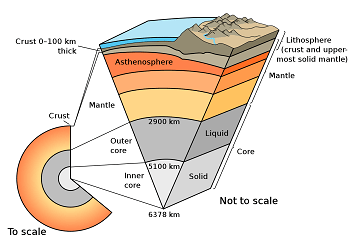
- Isostasy is the state of gravitational equilibrium of earth's lithosphere (or crust), as though it is floating on the denser underlying layer, the asthenosphere or the upper mantle.
- Isostasy controls the regional elevations of earth crust in accordance with the densities of their underlying rocks.
- The landmass columns (like mountain, plateau, plains etc.) of equal cross-sectional area that rise from the asthenosphere to the surface are assumed to have equal weights.
- Therefore, higher columns like mountains have low-density rocks, and a larger root that extends deep into the underlying m
- This concept was proposed by American geologist E.F. Dutton (1889).
Background
- In the 18th century, French geodesists attempted to determine the geoid shape of the Earth by measuring the length of a degree of latitude at different latitudes (arc measurement).
- In the in geodetic surveys of Pierre Bouguer in Andes and Sir George Everest in the Himalayas, gravitational anomalies were found.
- The Bouguer anomaly is positive over ocean basins and negative over high continental areas. This shows that the low elevation of ocean basins and high elevation of continents is also compensated at depth.
- Bouguer anomaly is the difference between the measured and expected local gravitational fields for the altitude and local terrain.
- The difference of latitude of Kalianpur and Kaliana was determined by both direct triangulation method and astronomical method. This discrepancy between two methods was attributed to the low attraction of the Himalayas.
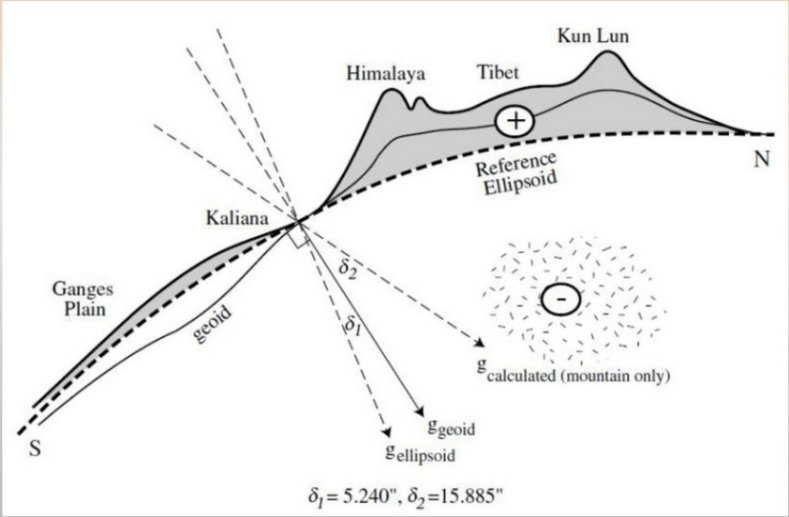
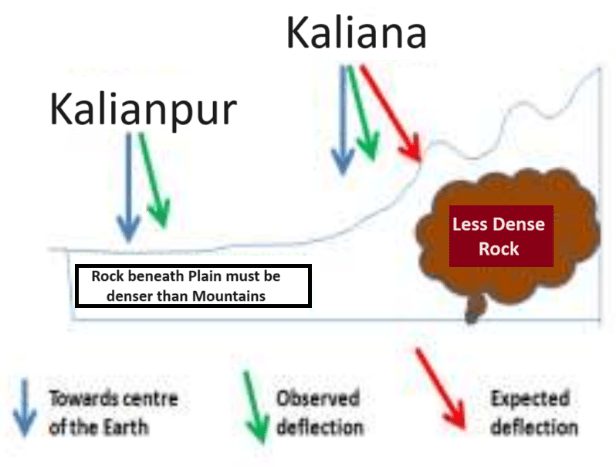
Reason to explain the low attractional force of the mountains:
- The Himalayas are hollow and are composed of bubbles and not the rocks.
- There is low density of mountain rocks, and thus their attraction is also low.
- All the columns have equal mass above an equal density level. There is such a level below the surface of the earth below which there is no change in the density of the rocks. Density varies only above this level. This was explained by various theories of isostasy.
Thinker’s view
- According to Dutton the upstanding parts of the earth must be compensated by lighter rock material from beneath so that the crustal reliefs should remain in mechanical stability.
- According to J.A. Steers (1961), ‘this doctrine states that wherever equilibrium exists on the earth's surface, equal mass must underlie equal surface areas.'
- The American geologist Clarence Dutton coined the term 'isostasy' in 1889.
- However, two hypotheses were already proposed, one in 1855 by George Airy and other by John Henry Pratt in 1859.
- The Airy hypothesis later refined by the Finnish geodesist V.A. Heiskanen and the Pratt hypothesis by the American geodesist J.H. Hayford.
Three principal models of isostasy are used.
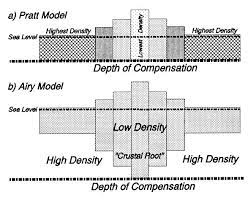
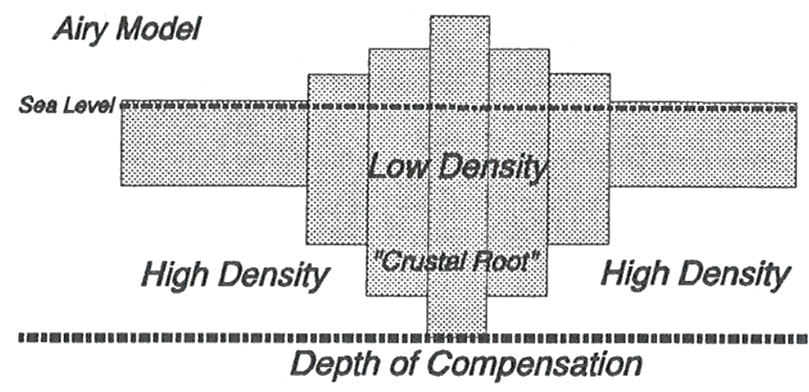
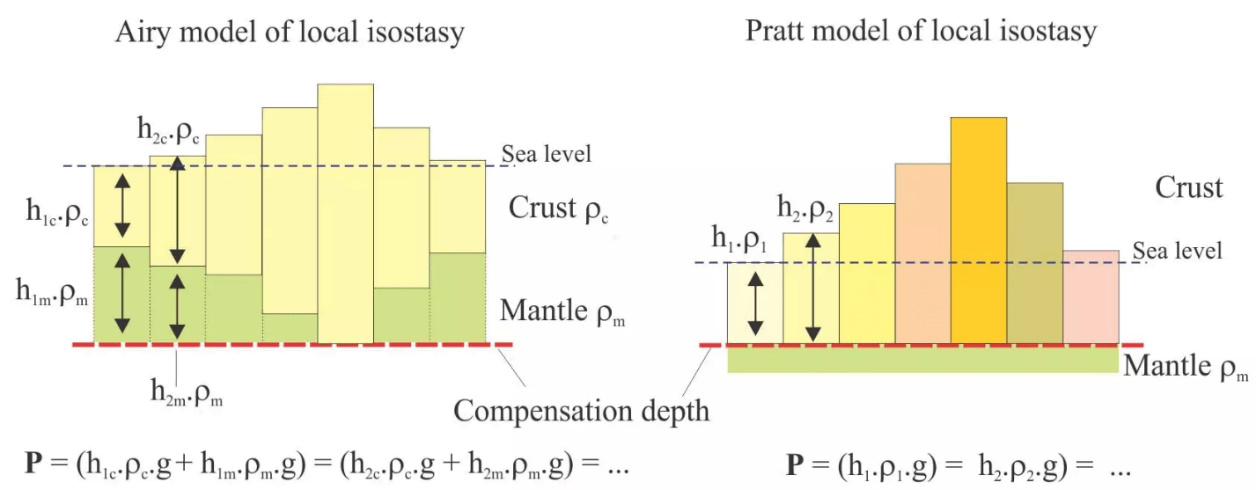
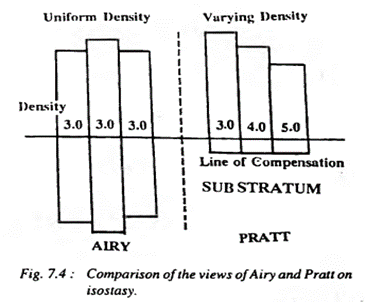
- Airy–Heiskanen model: different topographic heights are accommodated by changes in crustal thickness, in which the crust has a constant density.
- Pratt–Hayford model: different topographic heights are accommodated by lateral changes in rock density.
- The Vening Meinesz, or flexural isostasy model: The lithosphere acts as an elastic plate, and its inherent rigidity distributes local topographic loads over a broad region by bending.
Evaluation
- The Airy and Pratt models are purely hydrostatic, which take no account of material strength.
- However, the flexural isostacy takes into account elastic forces from the deformation of the rigid crust.
- Convergent plate margins are tectonically highly active. They are not in complete isostatic equilibrium. These regions show the highest isostatic anomalies on the Earth's surface.
- Mid-ocean ridges are explained by the Pratt hypothesis as overlying regions of unusually low density in the upper mantle.
Airy’s Theory
- Isostasy is a geological principle that explains the equilibrium of Earth's crust, particularly with respect to the distribution of weight and buoyancy.
- Sir George Biddell Airy, a British mathematician and astronomer, proposed the concept of isostasy in the mid-19th century, based on principle of flotation.
Objective:
- To solve the riddle of gravitational anomaly found in geodetic surveys.
Basis
- The landmass columns (like mountain, plateau, plains etc.) of equal cross-sectional area that rise from the asthenosphere to the surface are assumed to have equal weights.
- There is uniform density of rocks with varying depth.
- It is based on the principle of floatation and Pascal's law.
The Theory
- The inner part of the mountains is not hollow, rather the excess weight of the mountains is compensated by lighter materials below.
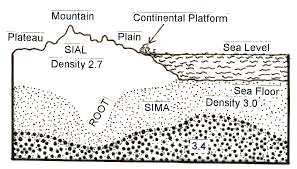
- The crust of relatively lighter material is floating in the substratum of denser material. i.e., Sial is floating over Sima, or the lithosphere is floating over the asthenosphere.
- g. The mountains are floating in denser magma. The lighter rocks of mountains do not merely rest on a surface of denser material beneath, but sink into the denser magma or asthenosphere, like a boat.
- This concept is based on the principle of floatation, for which freeboard to draught ratio is 1/9 (Joly took it 1/8).
- If the density of the crust is 2.67 and that of substratum is 3.0, for every one part of the crust above the substratum, nine parts of the crust are sinking in the substratum. Hence, Himalayas must have a root.
- Airy simply maintained that the crustal parts were floating in the magma of the substratum like a boat.
- Thus, according to Airy the Himalayas are exerting their real attractional force, because there existed a long root of lighter material in the substratum which compensated the lighter material above.
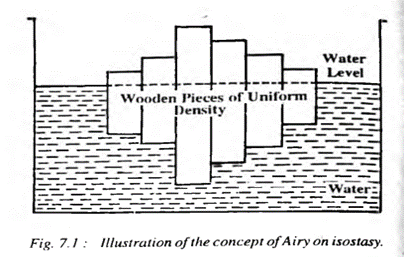
- Airy postulated that ‘Larger the land column above the substratum, greater the root would be submerged in the substratum.’
- According to Airy, there is, 'uniform density of landmasses with varying thickness.'
- e. the density of different columns of the land (e.g. mountains, plateaus, plains etc.) remains the same, but their thickness or length varies from place to place.
- To prove it, Airy put pieces of iron of varying lengths in a mercury basin.
Application
- For the 8848 m height of the Himalaya there must be a root of its 9 times. The mountain must have a root of 79,632 m in the sub-stratum.
Criticism
- Simplified Model: The model simplifies the Earth's lithosphere as a rigid, uniform layer, whereas the actual lithosphere exhibits variations in rigidity and composition.
- Ignores Mantle Flow: Airy's model does not consider the flow of the mantle, which can influence crustal movements. In reality, mantle convection plays a significant role in shaping the Earth's surface.
- Melting of Root: The root of mountains will melt at 80,000 m depth. (T increased by 1 degree Celsius 132 m)
- Ignores Plate Tectonics: The model does not account for the dynamic processes associated with plate tectonics, such as the subduction of plates and the creation of mountain ranges.
- Limited to Local Scale: It is most applicable to explaining local variations in topography but does not address large-scale geological phenomena comprehensively.
Evaluation
- Airy deserves great respect to develop the idea. Quite recently, his fundamental concept was rejuvenated by Heiskanen. Probably most geographers will follow him. (J.A. Steers, 1961).
Evaluation can also be done using:
- Morisawa- Tectone geomorphic model
- RIS
- Isostatic base level change – cycle lengthening and shortening.
Pratt’s Theory
John H. Pratt, Archdecon of Calcutta, a British Mathematician and astronomer, presented his theory of isostatic compensation in 1859.
Objective
- To solve the riddle of gravitational anomaly found in geodetic surveys.
Basis आधार
- Archimedes' Principle: An object immersed in a fluid experience an upward buoyant force equal to the weight of the fluid displaced by the object. In the Earth's context, the dense lithosphere floats on the semi-fluid asthenosphere.
- Equal Weights of Columns: The landmass columns (like mountain, plateau, plains etc.) of equal cross-sectional area that rise from the asthenosphere to the surface are assumed to have equal weights.
- Principle of Isostatic Compensation: There is uniform depth with varying density. Pratt proposed that variations in elevation are due to differences in the thickness and density of the Earth's crust. Thicker, less dense crust results in higher elevation, while thinner, denser crust leads to lower elevation.
The Theory सिद्धांत
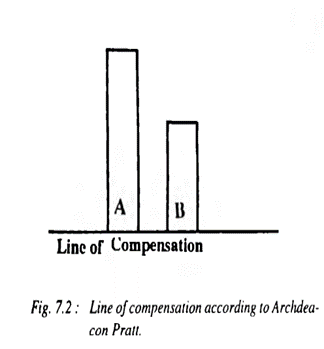
- There is inverse relationship between the height of the reliefs and density (d).
- The density of each higher part is less than a lower part i.e., the density of mountains is less than the density of plateaus, that of plateau is less than the density of plain etc.
- There is a law of compensation, instead of a law of floatation which governs isostasy.
- There is a Level of Compensation (LoC). The variation in density is only above this level i.e. in lithosphere only, not in pyrosphere or
- There is 'uniform depth with varying density.'
- e. Density does not change within one column, but it changes from one column to other.
- Each surface area has equal mass; hence it exerts equal pressure till the LoC. Hence, larger the column, lesser the density and vice versa.
Criticisms
- Simplified Assumptions: The model assumes that the Earth's lithosphere behaves as a rigid, perfectly elastic material, which is not entirely accurate.
- Viscoelastic Behavior: In reality, the Earth's mantle does not behave as a purely viscous or purely elastic material, making predictions based on Pratt's model more complex.
- Incomplete Explanation: The model primarily addresses vertical movements of the Earth's crust but does not account for lateral movements associated with tectonic plate interactions.
- Neglect of Other Factors: Pratt's model does not consider other factors like erosion, sedimentation, or volcanic activity that also influence landform changes.
Evaluation
- There is an indirect glimpse of floatation in Pratt’s theory.- W. Bowie.
- Similarly, though Pratt does not believe directly in the concept of 'root formation' but his concept indicates the glimpse of root formation indirectly.
- As per Bowie, both Airy and Pratt are similar, but not the same. Airy postulated a uniform density with varying thickness, and Pratt a uniform depth with varying density.
Flexural Rigidity Model by Vening Meinesz
- Vening Meinesz was a Dutch geophysicist who made significant contributions to the understanding of isostasy, which is the concept that explains the equilibrium of Earth's lithosphere on the asthenosphere.
- His isostasy model provided insights into the distribution of massss within the Earth's crust and its effects on surface elevations.
Objective:
- The Vening Meinesz isostasy model aims to explain the equilibrium of the Earth's lithosphere, particularly the vertical movement of solid materials in response to changes in the load or distribution of mass on the Earth's surface.
Basis:
- Archimedes' Principle: Objects immersed in a fluid experience a buoyant force equal to the weight of the fluid they displace. In the Earth's context, the lithosphere floats on the semi-fluid asthenosphere.
- Airy's Model Modification: He modified George B. Airy's earlier isostatic model, which considered only variations in crustal thickness, by incorporating variations in crustal density.
The Concept:
- Isostatic Compensation: Earth's lithosphere floats on the semi-fluid asthenosphere beneath it. When there are changes in the mass distribution on the Earth's surface, such as due to the deposition or erosion of material, the lithosphere responds by adjusting its elevation to maintain equilibrium.
- Airy vs. Pratt Isostasy: The model considers both Airy isostasy, which deals with variations in crustal thickness, and Pratt isostasy, which accounts for variations in density within the crust and upper mantle.
- Flexural Rigidity: The lithosphere is assumed to have a certain degree of rigidity, and it bends or flexes in response to surface loads. This flexural rigidity determines the amount of vertical adjustment.
Criticism:
- Simplified Assumptions: Critics argue that the model makes simplifications that may not always reflect the complex geological realities, such as assuming uniform lithospheric rigidity.
- Ignores Viscosity Variation: The model does not explicitly consider variations in asthenospheric viscosity, which can influence the rate and extent of isostatic adjustment.
- Doesn't Explain All Geologic Features: The model primarily explains long-term vertical movements of the lithosphere but may not account for short-term phenomena like earthquakes.
- Not Universally Applicable: Isostasy may not be the dominant force in regions with active tectonic processes, such as plate boundaries, where other factors like mantle convection play a more significant role.
Evaluation
Vening Meinesz's isostasy model was a significant step forward in understanding how the Earth's lithosphere adjusts to variations in subsurface mass. Modern geophysics and the theory of plate tectonics have expanded our understanding of Earth's dynamics beyond the scope of this model, but it remains a foundational concept in the study of crustal movements.
Hayford and Bowie
They have supported the Pratt’s model.
The theory
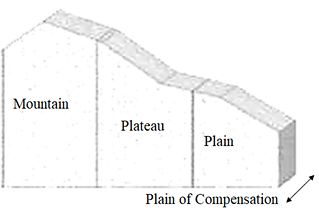
- There is a plane where there is complete compensation of the crustal parts. This plane of compensation is located at 100 km depth.
- There is varying density with height above this plane of compensation. d α1/height
- There is a zone below the plane of compensation where density is uniform in lateral direction.
Criticism
- The concept, that the crustal parts are in the form of vertical columns, is not valid because the crustal features are found in the form of horizontal layers.
- Joly rejected the concept of level of compensation at 100 km depth. At this depth the high temperature would melt everyting, and the geological events will disturb the plane.
Joly
- He developed his theory while rejecting the idea of Hayford and Bowie.
- We find a glimpse of the law of floatation in Joly's concept which is closer to the Airy's concept.
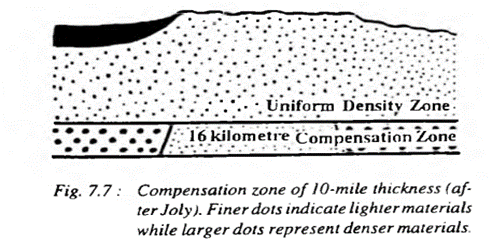
- There is a 10-mile zone of compensation. The density varies in this zone. There is uniform density of rocks with varying thickness above this zone.
Heiskanen hypothesis, 1933
- This theory combined both the models of Airy and Pratt.
- Density varies within the column and between the columns. For example, as we go downward, the rocks of a column become denser i.e. density increases downward.
- Density varies both vertically and horizontally.
- This hypothesis says that two-thirds of the earth’s crust follows the Airy model, and one-third follows the Pratt model.
Arthur Holmes
- Holmes and D.L. Holmes
Their views on isostasy are compatible with the views of Airy. They consider 'uniform density of landmasses with varying thickness.'
They have also assumed that upstanding crustal parts are made of lighter materials and their major portions are submerged in greater depth of lighter materials.
Demonstration
In the following figure, each column has the same area and extends downward to the same depth below sea-level, the same depth at which the weight of each column exerts approximately the pressure on the underlying material, irrespective of its surface elevation.
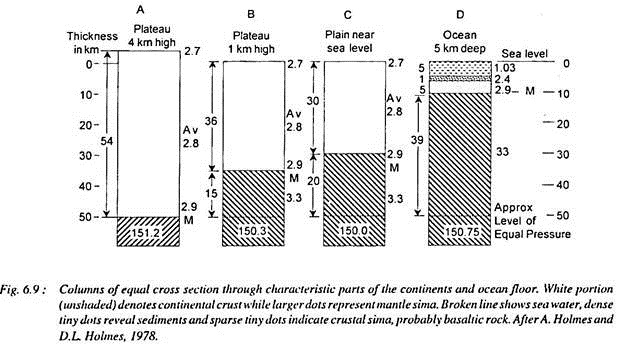
A Holmes and D.L. Holmes have taken the depth of 50 km for isostatic compensation.
They explained the concept of equal weight along the ‘level of equal pressure’ through the examples of 4 columns of equal cross-section. Each column has a thickness of 50 km. M indicates Mohorovicic Discontinuity.
According to Holmes and Holmes,
Superincumbent Weight = ∑ density thickness depth
- For the plateau (4 km high from sea level): 54 8 (average density) = 151.2 (the whole section is continental crust)
- For the plateau (1 km high): 36 8 + 15 3.3 (continental crust) + 15 3.3 (mantle sima, probably basaltic rock) = 150.3
- For the plain near the sea level: 30 x 2.8 (continental crust) + 20 x 3.3 (mantle simal = 150.0
- For the ocean: (5 km deep) 03 (sea water) + 1 2.4 (sediments) + 5 2.9 (crustal sima, probably basaltic rock) + 39 3.3 (mantle sima) = 150.75.
Global isostatic Adjustment
There is no complete isostatic adjustment over the globe because the earth is not a stable system. The endogenetic forces disturb the isostatic adjustment. Isostatic adjustment exist at extensive regional level.
The endogenetic forces and tectonic events cause disturbances in the ideal condition of isostasy, but nature always tends towards the isostatic adjustment.
Here are some case studies.
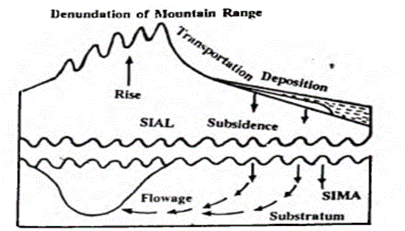
1. Denudation of mountains
- A newly formed mountain due to tectonic activities is subjected to denudation. Eroded sediments are deposited in the oceanic areas. Hence, there is continuous increase of weight of sediments on the seafloor.
- The mountainous area gradually becomes lighter, and the oceanic floor becomes heavier, and thus isostasy between these two areas gets disturbed.
- As the weight over the mountain decreases, there is gradual rise in it. Continuous sedimentation on the seafloor causes its gradual subsidence.
- But the balance has to be maintained. Thus, to maintain isostatic balance, there must be slow flowage of relatively heavier materials of substratum towards the lighter materials of the rising column. This takes place at or below the level of compensation.
- Thus, the process of redistribution of materials ultimately restores the disturbed isostatic condition to complete isostatic balance.
2. Glacial isostatic adjustment
- During the Pleistocene ice age, great sheets of ice, two miles thick, covered much of Earth's Northern Hemisphere.
- However, in the deglaciation phase, the land once under the ice began to rise, and it is still rising. Thus, the isostatic balance was disturbed.
- Scandinavia and Finland have risen by 900 feet. It is still rising with the rate of 1 foot per 28 years under the process of isostatic recovery. The isostatic adjustment in these areas could not be achieved till now.
- This ongoing movement of land is called glacial isostatic adjustment.
3. Sudden and violent endogenetic forces
- The state of isostatic balance is disturbed all of a sudden.
- The isostatic adjustment through the process of flowage in substratum is not maintained.